

Dell slaves over a hot Blu-ray player for the good of mankind.
Showing posts with label Classics. Show all posts
Showing posts with label Classics. Show all posts
Thursday, February 28, 2019

Friday, August 25, 2017

Sunday, November 10, 2013

Tuesday, October 29, 2013
The Amityville Horror (1979)

Directed by Stuart
Rosenberg.
1979. Rated R, 119
minutes.
Cast:
Rod Steiger
Don Stroud
Murray Hamilton
Natasha Ryan
K.C. Martel
Meeno Peluce
Helen Shaver
Amy Wright
Irene Dailey
The Lutz family is shopping for a
house. Even though George (Brolin) and Kathy (Kidder) are on a strict budget,
they need a place big enough for them, Kathy’s three kids from a previous
marriage and their dog. Fortunately, a house sitting right on the lake with
more than enough property is available. It would normally go for an exorbitant
price, but the real estate agent is desperate to get this one off the market. That has
something to do with what happened a year ago. One of the prior residents lost
it and killed his whole family. Yes, our prospective buyers are aware of this
fact. But hey, the agent assures the Lutzes that their low-ball offer will be
accepted so they make the deal and move in. This shouldn't be a problem
because, as George says, “Houses don’t have memories.” Or, do they? Things go
haywire promptly at 3:15 AM every night and anyone wearing any type of
religious garb is rudely welcomed.
It isn't long before hell starts
breaking loose which helps create tension early on, keeping us engaged. We’re
not exactly sure what’s going to happen next, but we eagerly anticipate what
that might be. Even better, the house seems to be working a divide and conquer
scheme, mostly concentrating on George. More and more as the movie progresses
he gets that far away look in his eyes, separates himself from the family and
we’re just waiting for him to completely snap.
An interesting subplot is that of
Father Delaney (Steiger) who shows up early to bless the house at the Lutz's
request. How this story plays out runs perfectly alongside the main plot. It
doesn't quite fit the haunted house motif, but it works by bolstering our
understanding of the house’s power. It becomes a character with more than one
dimension, proactive in what it’s doing to the family, reactive and defensive
with those who may have the ability to stop it.

Thirty plus years since its
release, The Amityville Horror is a movie that has to
contend with history. First and foremost, it has to deal with the countless
haunted house flicks that have come out since 1979. Many, if not all of them,
are heavily influenced by this movie. Though not nearly as impactful on the
viewer as it once might have been, it stands above most of the crowd. Helping
it to do so is how the family is handled and the performances of the leads.
Many of the genre’s entries trudge along way too slowly, showing the family’s
mundane life in a feigned attempt at character development. Here, we get to to know
them as the rest of the story unfolds. This doesn't make the Lutz family the
most memorable lot, but it’s an effective way of telling the story.
That story and its history also
loom large over the film. When it came out it was billed as a tale based mostly
in fact. Over the years, how true that is has been debated heavily. Books have
been written and interviews conducted, including with the real Lutz family.
Their stories have changed several times and their credibility has become
highly questionable. Conventional wisdom now says that the true story angle is
a crock. Truthfully, this is neither here nor there with regards to the quality
of the movie, just an interesting tidbit I thought I’d share.
As for the movie, it is still a
very solid haunted house flick. It may come off as dated. Some of this is due
to the look of the film and the fashions on display. The bigger problem,
however, is that so many of the things this movie introduced have become old
hat. Viewers without perspective may struggle to see what the big deal is. I’ll
address them directly in case I somehow haven’t made it clear: all of the
haunted house movies you love stole from this one.
MY SCORE:
7.5/10
Tuesday, October 1, 2013
The Texas Chainsaw Massacre (1974)

Directed by Tobe Hooper.
1974. Rated R, 74 minutes
Cast:
Marilyn Burns
Gunnar Hansen
Allen Danziger
Paul A. Partain
William Vail
Teri McMinn
Edwin Neal
John Dugan
Jim Siedow
Sally (Burns), her wheelchair bound brother Franklin
(Partain), and a few of their friends are riding around somewhere in Texas,
looking for some sights to see. Along the way, they pick up a hitchhiker who is
obviously a few burgers short of a cookout. He likes to play with knives and
cackle maniacally. Luckily for them, they manage to dump this weirdo before
anyone suffers a fatal injury. They drive along some more and eventually find a
nice secluded/abandoned house to hang out in. There is a lake out back and no
authority figures around for miles. Ah, the perfect spot for kicking back and
having a good time. Things are going great until they figure out they’re out of
gas. One of them gets the bright idea to see if the neighbors in the only other
house around will help out. The title and the birth of a sub-genre ensues. You
know which sub-genre, right? That one where a group of teens off on an
excursion wander into some back woods and meet some inhospitable hillbillies.
Truthfully, we can probably trace its birth back a year further to the release
of Deliverance. This one, however, creates the template
we've been following ever since.
The genius of this movie is threefold. First, it comes
dangerously close to boring us. During the setup stages, other than some grisly images right at the very beginning, there aren't all the tell-tale signs that
let us know this is a horror flick. Sure, there’s the wacko hitcher, but once
that passes it’s fairly mundane for a good little while. No strange sightings,
or shadows crossing the camera, or cats suddenly jumping out at us and no
foreboding music. The bad stuff starts happening pretty spontaneously. Second,
it doesn't go into lengthy exposition to explain the back-story of our psychos.
It’s not interested in why this is happening. It merely wants to give us the
sinking feeling that something bad lurks in the bowels of America. This also
keeps the run time short, a scant seventy-four minutes (according to the DVD I have), packing its thrills
tight and not allowing us to grow immune to its tricks. Something the various
remakes and sequels suffer from is giving us too much info, using all sorts of
ridiculousness to explain things. Finally, it doesn't ever feel the need to
make us in the audience feel better. Yes, at the risk of spoiling a near forty
year old movie, there is a survivor. However, it’s hardly the ending we've
grown accustomed to. We’re not experiencing any sense of triumph when the
credits roll.

Where The Texas Chainsaw Massacre might
lose newer audiences is in the visuals. Don’t get me wrong. The look of the film is
still perfect. It’s got the griminess befitting its subject matter. However,
for those raised on Saw and Final Destination movies, the blood and guts aspect might be a tad disappointing.
When the heinous acts are occurring they’re often just off-camera or somehow
obscured. The power of suggestion is a marvelous story-telling tool, but
hardcore horror fans, especially those of slasher fare, may feel cheated. As
sadistic as it sounds, part of the thrill of watching dead teenager movies is
seeing horrible things done to the human body. Here, we only sorta see it. For
its era, it is a gory flick. In 2013, it’s still not for the faint of heart,
but far short of all those torture porn movies in terms of visible nastiness.
Excessive mutilation or not, TTCM still
stands head and shoulders above most films of its ilk. Inspired by real life
serial killer Ed Gein, it sparsely presents its story as a matter of fact, not
stylized violence and overly elaborate contraptions. This rawness is where its
power lies. When things happen we don’t feel like we’re watching a movie crew’s
handiwork.
Tuesday, October 9, 2012

Sunday, October 7, 2012
Rosemary's Baby

Directed by Roman Polanski.
1968. Rated R, 136 minutes.
Cast:
Mia Farrow
John Cassavetes
Ruth Gordon
Sidney Blackmer
Director Roman Planski's horror classic in which Rosemary believes there is a cult out to harm her and her unborn baby. Truth be told, it's more psychological thriller than horror. The movie's strength is predicated on the main character's mounting paranoia that we think is justified but aren't completely sure. This is due to some rather wicked dream sequences. They're so daring that even though the movie is over 40 years old it would still earn an an R rating and garner some outrage if it were made today. Mia Farrow's powerful performance makes the whole thing plausible. It's one of those performances that just gets better and better as the film goes along. During the first 15 or 20 minutes her work is nothing special. Her line deliveries are flat and everything about her suggest she's not up to the task of carrying a movie. By the end however, she has a commanding presence that you can't keep your eyes off. Most interesting is as Farrow's work grows stronger, her character is actually becoming weaker. Finally, the ambiguous ending and Polanski's great restraint just gives you an uneasy feeling as the final credits roll.
Monday, October 1, 2012

Thursday, October 13, 2011
Nosferatu (1922)

Directed by F.W. Murnau.
1922. Not Rated, 81 minutes.
Cast:
Max Schrek
Gustav von Wangenheim
Greta Schroder
Alexander Granach
Georg H. Schnell
Ruth Landshoff
Real-estate agent Thomas Harker (Wangenheim) is summonsed to Transylvania to bring back Count Orlock (Schrek), a potential customer. Once there, strange things occur every evening after dark. Harker then discovers that his host is a vampire. Loosely based on Bram Stoker’s legendary Dracula novel. It’s the first vampire movie ever made and generally credited with being the first horror movie as well. It’s still an intriguing watch but lacks the technical pop and sizzle to hold any real tension for most modern audiences. Still, for the time the movie was made, the makeup job on our vampire is phenomenal. The story still moves along nicely but the end seems a tad too easy. Fans of vampire movies should probably take a look if for no other reason than to see where many of the tenets of the genre started. You can also see some that have fallen by the wayside for being too impractical. For instance, Nosferatu has to carry mounds of dirt, filling a number of coffins, everywhere he goes because he has to sleep in the same grounds he was originally buried in to preserve his power. This is good stuff for us wannabe film buffs but I’ll admit throwing on a 86 year old silent movie isn’t generally a crowd pleaser. For that reason, I won’t give it a score. It’s from the infancy of movie-making and was made for viewers equally new to motion pictures.
Monday, August 29, 2011
Imitation of Life

Directed by Douglas Sirk.
1959. Not Rated, 125 minutes.Cast:
Lana Turner
Juanita Moore
Susan Kohner
Sandra Dee
John Gavin
Dan O’Herlihy
Robert Alda
Terry Burnham
Karin Dicker
By chance, Lara (Turner) meets Annie (Moore) and the two women strike up a friendship that would last the rest of their lives. Both women are single moms. Lara’s daughter Suzi (Burnham at age 6, Dee at 16) and Annie’s daughter Sarah Jane (Dicker at age 8, Kohner at 18) are only a couple years apart in age. Lara needs a nanny while Annie offers her services for nothing more than room and board for her and her little girl. It’s a match made in heaven. Of course, there’s still something off-kilter about these fast friends, especially in the era not long before World War II. Lara is white and Annie is black. For those unaware, this is in the days before most people had heard of Martin Luther King Jr. That blacks were second-class citizens in America was not up for debate. It was a blatant reality. On top of this, Annie’s daughter was fathered by a white man. If blacks were second-class citizens, bi-racial children may have been third. Sarah Jane is sensitive to this at an early age. She’s very fair-skinned and desperately puts most of her effort into passing for white even if that means distancing herself from her own mother. Lara and Suzie obviously have very different, but no less relevant issues. Lara dreams of being a Broadway star and works hard to reach that goal. This means many hours, days, weeks and even months away from her daughter. Therefore, Suzie is effectively raised by Annie. We follow these four through the ups and downs of the next decade or so.
The novel Imitation of Life is based on was written in the 1930s by Fannie Hurst. It was originally brought to the big screen in 1934. I have not seen that version, but now I must to satisfy my curiosity of the differences. Made in 1959, this version appears to be a movie ahead of its time. It predates other landmark films dealing with race such as To Kill a Mockingbird, Guess Who’s Coming to Dinner and In the Heat of the Night. Half a century after its release there are still elements relevant to our society. How whites and blacks view each other and themselves in relation to one another is still a hotly contested issue.
Within their home, three of the four ladies try to isolate themselves from such topics. However, Sarah Jane continually drags the ugly world with her into the house. Her entire being is troublesome for her and us. Her yearning to be white and the drastic choices she makes to be accepted as such are torturous. She is clearly an example of the archetype known in American literature as “the tragic mulatto.” That means she cannot be happy simply due to the fact she is of mixed blood. Her storyline is prevalent and provides the movie with its climax. She also makes it difficult to gauge. Is her saga a triumph for her black mother or a cautionary tale for those considering procreation with someone of another race?
Speaking of the black mother, Annie is also problematic. She is a 20th century version of another archetype, “the contented slave”. To oversimplify, the contented slave is more than happy, even grateful to live a life of servitude. In the case of female slaves, this usually meant deriving a special joy from raising the children of their masters. These traits are immediately evident in Annie. As I said, she gleefully offers her services as a live-in nanny and is practically offended when Lara offers to pay her. She refuses to take money for her work and dutifully looks after Lara’s daughter out of the goodness of her heart. Annie and Sarah Jane make us question whether IoL is really ahead of its time or just pretending to be.
On the other hand, this is enthralling melodrama. To go along with the aforementioned mother/daughter spats, there’s Lara’s on again/off again romance with Steve (Gavin), her rise to fame and havoc it wreaks on her relationship with Suzie. There’s Suzie’s first crush and always Sarah Jane is sinking to new lows. Hearing her talk to her mother is absolutely gut-wrenching. All four of our principals turn in excellent performances, though the pitch of Sandra Dee’s voice is somewhat annoying. Without knowledge of the archetypes I spoke of above, it’s probably easier to take at face value, easier to believe it is what it says it is. Even then, there is still much to discuss. All eyes may not see it the same way.
Thursday, July 7, 2011
Scarlet Street

Directed by Fritz Lang.
1945. Not Rated, 103 minutes.
Cast:
Edward G. Robinson
Joan Bennett
Dan Duryea
Rosalind Ivan
Christopher (Robinson) is going through a middle-age crisis and feels trapped in a loveless marriage. When the young and beautiful Kitty (Bennett) shows some interest in him, he immediately fall head over heels. Believing him to be a wealthy and famous painter, Kitty sets out ot bilk him of his money at the behest of her abusive boyfriend Johnny (Duryea). Lots of lying and conniving ensues. This is an underrated WWII era gem with a dizzying number of plot twists. Each of them is expertly handled and continues the movie's spiral towards it's dark conclusion. In fact, it's ending is so dark I'm convinced that director Fritz Lang truly hates Christopher (see spoiler below). Edward G. Robinson trades in his more famous gangster motif for that of a square and is as brilliant as ever.
MY SCORE: 10/10
Tuesday, May 3, 2011

Wednesday, March 30, 2011
M
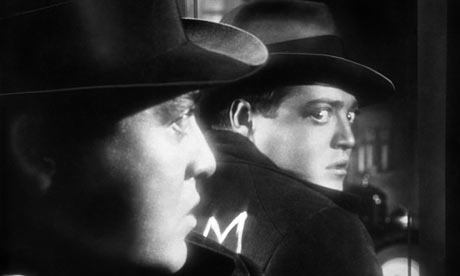 Directed by Fritz Lang.
1931. Not Rated, 117 minutes. German.
Cast:
Peter Lorre
Otto Wernicke
Frau Beckmann
Inge Landgut
Theodor Loos
Rudolf Blümner
Georg John
Ernst Stahl-Nachbaur
A child murderer has been terrorizing the town for quite some time. Everyone is on edge. The police are working day and night on seemingly never-ending shifts to find the killer. Still, children keep disappearing. Honest citizens become suspicious of one another. Dishonest citizens are upset that added attention from the law is hurting their businesses. Our killer taunts the authorities with letters to them and to the press. Yet, he remains undetected.
What follows are multiple and exhausting investigations that come to run simultaneously. We see the police using every available tool to apprehend the murderer and try explaining themselves to an impatient public when they don’t. Criminals have meetings to decide how they will deal with the situation. The task of catching the guilty party saturates every second of every day.
From time to time, we get to see this monster for ourselves. Though those around him know nothing, his identity is no mystery to us. We get to know what triggers his most heinous actions and how he operates. Before it’s all over, we hear his explanation. It’s a plea for sympathy. However, he is not only pleading with those in the movie. He’s also pleading with those watching.
That the killer is caught is not a spoiler. Indeed, it eventually becomes a mere matter of time before he is. The real question becomes who will catch him and what will they do with him. In most films, his capture would serve as our climax. Here, it is the axis that turns our tale. This is what makes M special. Even now, 80 years since its release, it refuses to be strait-jacketed into cliché. It still has the strength to go beyond the point where most pictures quit. Those movies are content to leave us with the tidy, happy ending. M is not. It has questions to ask you. It wants to know what you believe in.
Sunday, March 6, 2011
Cool Hand Luke

1967. Not Rated, 126 minutes.
Cast:
Paul Newman
George Kennedy
Strother Martin
J.D. Cannon
Lou Antonio
Jo Van Fleet
Clifton James
Robert Drivas
Dennis Hopper
Drunk, and possibly bored, Luke (Newman) gets busted for cutting the heads off about a dozen parking meters. He is sentenced to a prison where he has to work on the chain-gang every day. For you young’uns, there was a time when prisoners did much more on the highways and by-ways than picking up the trash. Being convicted of a crime meant physically exhausting work on those roads on a daily basis. Luke enters just such a place.
Luke also has a smug attitude and unwillingness to conform that tends to rub people the wrong way, at first. Upon his arrival, neither the officers nor his fellow inmates care much for him. Soon, his unbreakable spirit wins over the other prisoners and even most of the guards. However, it also earns him some trouble. Eventually, the movie becomes a battle of wills between Luke and his captors.
The man in the lead role facilitates the battle, perfectly. Paul Newman shows once again why he is a Hollywood icon. His trademark smirk shows just enough arrogance for us to be hesitant about liking him. Arrogance soon reveals itself to really be the type of confidence that attracts people. Then, somehow despite his movie star looks, he never feels like a pretty boy. He’s simply magnetic.
As good as Newman is here, George Kennedy is his equal. As Dragline, Kennedy is charismatic, funny and a commanding presence. His rapid-fire, rumbling voice practically scores the film. Indeed, he seems to do a great deal more talking than our hero, Luke. Dragline is the one that seems to come around on Luke, first in spite of the rocky start they get off to. His near constant chatter helps everyone else do the same.
From the outside looking in, we grow to love Luke just like the inmates. Early on, before us or them is really on his side, Luke finds himself in a fistfight with Dragline. Luke is pitifully overmatched. He gets knocked down so often you’d think it was his mission in life. However, it’s what happens between knock-downs that is his real purpose. He gets up. He gets up, over and over again. He keeps getting up even when it doesn’t seem to be in his best interest. It’s just who he is. Who he is endears him to us. We wish we had his courage. That’s why, during the latter parts of the movie, our sentiments echo those of the convicts during that lopsided fight. From our seats we feel helpless, yet we keep begging him. Stay down, Luke. Stay down.
Wednesday, January 5, 2011
12 Angry Men

1957. Not Rated, 96 minutes.
Cast:
Henry Fonda
Lee J. Cobb
E.G. Fiedler
Ed Begley
Joseph Sweeney
Jack Klugman
6 other angry men
Plot: The 12 jurors of a first-degree murder trial deliberate the case.
The Good: Acting.This is a movie that's all about the actors. Without strong performances it would fall apart. Thankfully, this movie gets a good performance out all 12 guys. The writing is also exceptional as it has to be to carry such a claustrophobic movie. All but a couple minutes at the beginning & the very end take place in the deliberation room or adjoining restroom. The characters don't so much develop as they do reveal themselves. It becomes a very effective tool saving its most powerful moment for last. Director Sidney Lumet's pacing is also remarkable. Even though the scenery never changes and there are no action scenes to speed things along, the movie moves along rather quickly without rushing itself. His best trick however may be that for the most part he stays out of his actors' way.
The Bad: A couple of the guys really don't do much. Not really a detractor because it's awfully tough to write major parts for 12 different characters without making the movie excruciatingly long.
The Ugly: When the jurors all turn their back, quite literally, on one of the jurors spouting off his prejudices. Ugly in such a good way.
Recommendation: If you're a fan of courtroom dramas, this is an absolute must-see. If you just want to see a movie with some great acting and writing this is also for you. Skip it if you're under the distinct impression that every movie has to have either an explosion &/or love story
MY SCORE: 10/10
Wednesday, December 15, 2010
The 400 Blows

Directed by Francois Truffaut.
1959. Not Rated, 99 minutes.
Cast:
Jean-Pierre Leaud
Claire Maurier
Albert Remy
Guy Decomble
Young Antoine Doinel (Leaud) navigates his tough childhood without much guidance from his largely apathetic parents. Part of appreciating this movie is understanding why it was made. This is the directorial debut of Truffaut. Prior to getting behing the camera, he was one of France's top movie critics and had become increasingly disappointed with the way movies were being made. Instead of continuing to complain about the matter, he simply made a movie himself, setting out to do something different than what he'd been seeing. On top of that, its largely autobiographical as well. In the process, he helped kick off what became known as the French New Wave. Read more about it, here. It is a real slice of life, feeling like you're simply spending time with our young hero, not necessarily watching a movie with a traditional plot and conflict, though both eventually become apparent. Nor is it manipulative melodrama, intent on getting you to cry as it so easily could've been. That its unobtrusively shot without a ton of fancy editing tricks helps foster the illusion. The natural feel of the writing and acting work heavily in its favor, also. Though each performance is effortlessly realistic, including that of our child star Leaud, the actors never seem to preen for the camera. Finally, in true slice of life fashion we get a stopping point moreso than an ending. The possibilities of what could happen next are endless, both good and bad. This gives the movie more resonance than your typical happy ending does. If you're an artsy-fartsy film buff, you must see this movie. If the sight of a black-and-white movie instantly puts you to sleep and the thought of reading subtitles turns your stomach stop reading this review now and forget I ever mentioned this flick. Yup subtitleophobes, we're speaking French.
MY SCORE: 10/10
Saturday, November 27, 2010
Double Indemnity

1944. Not Rated, 108 minutes.
Cast:
Fred MacMurray
Barbara Stanwyck
Edward G. Robinson
Jean Heather
An insurance agent (MacMurray) falls in love with the wife of a client (Stanwyck). The two then hatch a plan to kill her husband so they can collect the insurance money and be together. This is Film Noir 101. All of the elements of the genre: the narration, dame that gets ultra-cool guy in hot water, murder and slick slang are not only present but have seldom, if ever, been done better. The dialogue is insanely sharp, filled with sexual innuendo, humor and thoughtfulness at appropriate times. The story keeps you on your toes, introducing elements that subtly change your idea of what you think will happen up until right before the climax. At that point, our hero tells you what's going to happen, or at least what he plans on, and instead of it being a let down it intrigues us even more because we've seen how his plans have worked out so far. MacMurray and Stanwyck are both marvelous in the lead roles and have great chemistry with one another. Robinson, not getting top billing for the first time in a career which was starting to wane by this point, conveys a fierce determination the couple in question must fear. He does so with one of his more subdued, but no less excellent performances. Any fans of film noir, or film buffs in general, must see this movie. This is the movie most recent efforts of the genre take their cues from, even something so over the top as Sin City or as experimental as the underappreciated Brick.
Sunday, November 14, 2010
The Killing

Directed by Stanley Kubrick.
1956. Not Rated, 89 minutes.
Cast:
Sterling Hayden
Elisha Cook Jr.
Marie Windsor
Vince Edwards
Ted de Corsia
Jay C. Flippen
Joe Sawyer
Colleen Gray
Fresh out of prison after a five year bid, Johnny (Hayden) very quickly tries to bring a master plan together. He and a couple guys who work there are going to rob the local racetrack right when its at its busiest. Also involved are a dirty cop and a couple random thugs Johnny from his time on the inside.
Aside from Johnny and the two hoods, the others aren’t really crooks but have been driven into criminal behavior by circumstance. The cop is in deep to a bookie and another guy has a sickly wife he desperately wants to take care of. The last guy, George (Cook Jr) is the one we focus on most. He’s married to Sherry (Windsor), a woman out of his league. He earned her hand based on the promise he was going to strike it rich. Five years later, her every word to him is a reminder he hasn’t and she can’t stand it any longer. He correctly suspects her of having an affair but lacks the spine to call her on it. Instead, he merely pleads with her not to “do anything stupid” while he’s out meeting with the boys. He also does something else that proves to be detrimental to the heist, but I’ve already said too much.
Written and directed by the legendary Stanley Kubrick, The Killing is a fascinating, yet rigid heist movie. The crime and the various subplots unfold nicely. The whole thing comes to a head with a “wow” ending. The rigidity comes from the fact that it’s shoe-horned into an hour and a half. Honestly, there could be an hour more to this movie. Instead of being shown everything, half the movie is read to us off the page by a narrator. He’s not exactly reciting beautiful poetry, either. We’re talking stodgy prose of the “At 3:32 PM, Johnny arrived at the hotel” variety.
Its flaws are the reason this is a movie I could actually like to see remade. The story is already excellent, yet there is much room for growth. The characters could be given more room to flourish and/or fail. As it is, it works fine. It’s even better than fine and hailed by some as a classic. I’m greedy. I want more.
MY SCORE: 7.5/10
Thursday, October 28, 2010

Friday, October 8, 2010
Bride of Frankenstein

1935. Not Rated, 75 minutes.
Cast:
Boris Karloff
Colin Clive
Valerie Hobson
Ernest Thesiger
Elsa Lanchester
Gavin Gordon
Una O’Connor
O. P. Heggie
As soon as Bride of Frankenstein starts, it brazenly lets us know it’s pulling a fast one on us. It shows us “Frankenstein” novel author Mary Shelley (Lanchester, who also plays the bride) and some of her inner-circle chit-chatting about, and essentially recapping the events of her legendary story. Just when they’re wrapping it up, she basically says to forget all about that wonderfully Shakespearean ending. They ain’t dead. Normally, this is an early warning sign that you’re about to watch a sequel that shouldn’t even exist and of a quality that suggests the same. Luckily, we get a sequel that actually outdoes the original.
Our new villain, the even more brilliant and crazier Dr. Pretorius (Thesiger) recruits Dr. Frankenstein (Clive), against his will, to help him in creating a companion for Frankenstein’s original monster. By the way, the monster (Karloff) roams the countryside terrorizing, and occasionally killing folks until he stumbles into a lonely blind man. This plays out much better than it sounds.
As mentioned, this film has a clear cut villain, Pretorius, and reluctant accomplice in Dr. Frankenstein. However, instead of an actual hero, we get a victim in Frankenstein’s monster. This works incredibly well as we’re properly set up for another doozy of an ending which finally includes the unveiling of the bride. Without having watched it, the knowledge that the title character doesn’t appear until very near the end of our tale seems like a terrible idea. When you do see it, you’ll realize it works perfectly.
Subscribe to:
Posts (Atom)