

Dell slaves over a hot Blu-ray player for the good of mankind.
Showing posts with label Lonette McKee. Show all posts
Showing posts with label Lonette McKee. Show all posts
Monday, December 15, 2014

Saturday, June 8, 2013
Luv

Directed by Sheldon Candis.
2012. Rated R, 94 minutes.
Cast:
Michael Rainey Jr.
Michael Kenneth Williams
Russell Hornsby
Hayward Armstrong
When all of your partners in crime know that you received a
twenty year prison sentence, yet you’re home in eight, they’re going to be
suspicious of you. This is just one of the issues Vincent (Common) has. As far as he’s
concerned, it’s a small one. He’s much more focused on going straight. He wants
to open up his own crab shack. To so, he’s trying to secure a $150,000 loan,
legitimately. With his mother’s blessing he’s going to use her house as
collateral. It’s Friday morning and he’s headed to the bank to get the verdict.
On his way, he’s supposed to drop off his ten year old nephew Woody (Rainey Jr.)
at school. After an unsatisfactory chat with the lad, he decides to take Woody
with him and show him how business is handled. At the bank, he finds out mom’s
house is $22,000 in arrears and about to go into foreclosure, obviously making
a loan out of the question. However, with assurances he’ll be approved if he
gets the money by Monday, he sets out to raise the capital the only way he
knows how. Vincent, with Woody in tow, confronting the trust issues of his
former colleagues ensues.
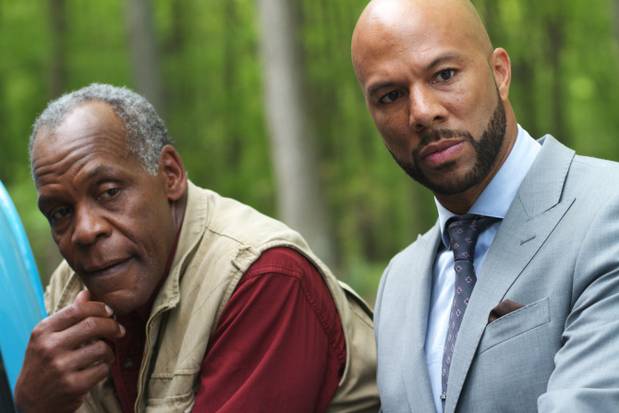
More than once on these pages I've noted I’m a fan of Common’s
music, not his acting. That’s not the case, here. For the first time, he
delivers a truly compelling performance. He really inhabits the role, bringing
his character fully to life in a three dimensional manner. Vincent is not only
the center of attention, Common helps him command that attention. Most
impressively, he still shines when sharing the screen with such thespians as
Danny Glover, Charles S. Dutton, and a super slick Dennis Haysbert, who sells
something that definitely isn't car insurance. This is a leap forward in the
evolution of Common as an actor. Of course, it helps that he has such a layered
character to play. This is a guy who has obviously made some bad life
decisions. He’s in the midst of another terrible choice, but his grand scheme
includes a justifiable end. We root for him.
However, we don’t root for Vincent entirely because we want
him to succeed. We just want his nephew to be okay. We hope Woody can somehow gleam
the best from the often questionable lessons his uncle is giving. We fear it’s
all too much for him. We pray that whatever’s next isn't. As good as Common is
in his role, Michael Rainey Jr. stays with him step-for-step. Though asked to
do some grown-up things we never get the sense we’re watching a small adult
like in many other movies. He seems like a real kid, albeit one who grows up
rapidly. His scenes with Common are endlessly fascinating as the two play quite
well off one another.
Through all the harrowing situations and man-to-not-yet-man
talks, a number of issues are dealt with. Still Luv,
cheesy title aside, never gets preachy, weaving things into the
ever-progressing plot. Just by being and feeling earnest, it provides us a
welcome alternative to the type of urban movies of which we’ve become
accustomed. There’s humor here, but this is no zany comedy. There’s also
violence and we are dealing with a guy who received his education on the
streets, but we’re not watching Menace II Society, either.
It’s a well-told story that deserves to be seen.
Monday, November 5, 2012
Sparkle (1976)

1976. Rated PG, 98 minutes.
Cast:
Dwan Smith
Dorian Harewood
Mary Alice
Tony King
Beatrice Winde
Paul Lambert
DeWayne Jessie
In 1958 Harlem, local guy Stix (Thomas) dreams of making it
big in the music biz. To this end, he’s a singer/songwriter/manager/promoter.
Shortly, it becomes apparent the best vehicle to make his fantasy become
reality is being in a group with his best friend, his girlfriend and her two
sisters. It’s chauvinistic of me to start from the male perspective since this
really is about the girlfriend and her sisters so we’ll get back to Stix later.
Stix’s girl gets top billing. Her name, of course, is
Sparkle (Cara). She’s the youngest of the three sisters and the quiet one.
Middle child Delores (Smith) is a budding militant so she’s a bit more mouthy,
no boyfriend. The real star of the show is the eldest sister named…um…Sister
(McKee). She’s obviously a lot more worldly than the others: chain-smoking,
getting it on in the back of her boyfriend’s car and dispensing sage advice
about birth control. By the way, her boyfriend is Stix's best friend Levi
(Harewood). And yes, the girls all live with their mom Effie (Alice).
Inspired after attending an all-night music revue, the gang
decides to go full steam ahead at this singing thing. They win a local talent
show and become a popular act around town. Predictably, success proves to be
problematic. So, too, is the cost of taking the next step on their road to
stardom.

Sparkle functions simultaneously as a
cautionary tale and a love story. It intertwines tragedy and triumph in a way
that feels organic, for the most part. Age has only served to enhance this
aspect. There’s a grittiness that gives off a vibe of authenticity. Even our
villains help in this regard. There’s Satin Struthers (King), a local Harlem
gangster and Max Gerber (Lambert), a mobster we meet in the latter portions of
the film. Neither is the flamboyant, cartoonish type often depicted in black movies of the era. They seem a realistic threat to what our heroes are trying
to accomplish.
Despite the title, the movie doesn’t become about Sparkle
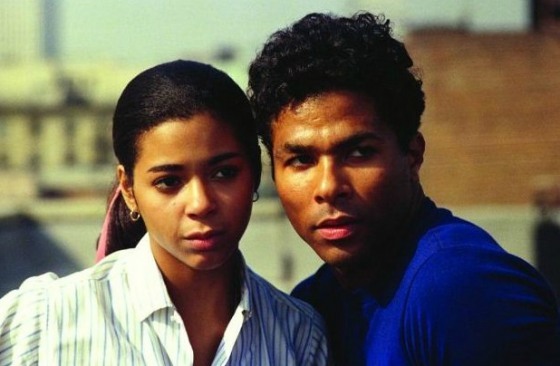
until the third act. Until then, this is really about Sister. A riveting
performance by Lonette McKee carries this part of the picture. Every word she
says and movement she makes feels exactly right. It is she, not Sparkle, that
keeps us vested. Even during that final act, our title character doesn’t really
take over. From this point on, we’re rendered powerless by the charisma and
megawatt smile of Philip Michael Thomas. Folks my age will know he went on to
greater fame as Det. Tubbs on the legendary Miami Vice TV
series. On that show, he mostly played second fiddle to Don Johnson. Here, he’s
pure charm, swagger and “good hair”.
If you couldn’t already tell, Sparkle herself is not as
important to the proceedings as one would think. She’s written as meek, unsure
of herself and seeking the approval of others as a real 15 year old might. This
is a good thing. The problem is she never really breaks out of her shell. There
is no evidence she ever has an original thought in her head. She isn’t so much
heroine as she is beneficiary and blank slate onto which we can project our own
feelings about what’s going on with the characters around her, feel happy or
sad for their successes and failures. From this standpoint, she remains the
perfect conduit for the audience over 30 years since. On the other hand, she
also helps mark the movie as a relic. Her relationship with Stix is out of
whack with our 21st century sensibilities. True, it was even
questionable then, but not quite condemned as the act of sexual predators the
way it is now. As mentioned, she’s 15. Stix most certainly has 15 well behind
him and it is explicitly noted they’ve done much more than hold hands.
The other characters and the portrayals of them vary in
importance, but aren’t earth-moving. Of these we get two very good
performances, one from Dorian Harewood as Levi and the other from Mary Alice as
mom, Effie. There is also a very bad one. Dwan Smith plays Delores with the
vocal inflections and body language of a small child stomping away from her
parents after being sent to her room, no matter what the situation. It gets to
be an annoyance rather quickly.
Last, but certainly not least, is the music. It’s a mashup
of two eras that’s far more effective than it has any right to be thanks to the
late great genius Curtis Mayfield. Sonically, the songs are crafted to sound
like the time in which the movie is set. The instrumentation is something you’d
expect from the 1950s. Lyrically they’re pure 70s, loaded with ultra-thinly
veiled dirty talk. This works brilliantly with what’s going on in the movie.
Sister serves as lead singer and is constantly pushing the envelope on stage
and off. It helps tremendously that they simply sound good. Many of the numbers
have become R & B classics, rightfully so.
Sparkle may be almost 40, but it still
holds up pretty well. Both sides of its story still resonate. It doesn’t feel
sugar-coated or overblown. There are a couple loose ends and one miraculous
development right at the end but they’re not so troublesome they detract from
the rest of the film. That makes this a fun, but flawed rollercoaster. It’s
main strength is that it gives us something we can feel.
Subscribe to:
Posts (Atom)