Showing posts with label Colman Domingo. Show all posts

Friday, February 21, 2014

Lee Daniels' The Butler

Directed by Lee Daniels.
2013. Rated PG-13, 132 minutes.
Cast:
Oprah Winfrey
Jane Fonda
Vanessa Redgrave
Clarence Williams III
Elijah Kelley
David Banner

We proceed through the life and times of Cecil Gaines (Whitaker). Mr. Gaines works in the White House as a butler beginning during the Eisenhower (Williams) administration and finishing during the Reagan (Rickman) years. As a very young child he witnesses atrocities in the Jim Crow South while working as a cotton picker on a plantation. Due to one specific tragedy, he is made a house servant. When he gets older, he leaves the plantation and heads north a bit where he works as a server in a private club. He is so good that he lands that White House gig. At home, things between he and his wife Gloria (Winfrey) are strained by all of his long hours at work. He also has a contentious relationship with his eldest son Louis (Oyelowo). The two see the world very differently. Part of our story follows Louis as he is literally becomes a major part of just about every front of the Civil Rights struggles of the 20th century. The rest, of course, deals with Cecil's duties in the White House, the stress on his marriage and plenty of acrimony between he and Louis.

Right away, we're told The Butler is inspired by a true story. Let's tackle this first. The key word is "inspired." The real butler is a man named Eugene Allen. He most certainly did serve in that capacity in the White House for 34 years. However, not much else is rooted in fact. If you're wondering what is and what isn't, I'll not go into too many details to maintain some form of brevity. Suffice it to say most things that happen outside the White House are fiction wrapped in a cloak of history while what happens inside it is plausibly, possibly, kinda, sorta true. From what I've read, our hero's relationship with the Reagans is the most factual, followed by his rapport with the Kennedys. However, none of this should cloud your judgement. In my opinion, you shouldn't deem the movie to be better or worse than it actually is because more or less of it is true than you think. Let's move on.

What the movie does best is position Cecil against the people he loves. He is a man that works long and hard to provide for his family in a material sense. On the other hand, he's absent from them emotionally. We watch his marriage falter and wonder if he is even aware of what's happening. He does know of her battle with the bottle, but there is more going on than that. With his oldest son, it is a never-ending war of wills. They bark disagreements at one another until it eventually becomes too much for them to occupy the same room. Even though both situations are overly melodramatic, this is where The Butler is most consistently good. Star Forest Whitaker and David Oyelowo are sufficiently angry and deliver fine performances. However, it's a truly remarkable Oprah Winfrey that glues this kitchen sink drama together and makes it go. Hers is the film's most complex and satisfying portrayal.


The movie stumbles over the one thing that was hyped before it was even released: its highlight reel of Black History. It simply fails to pack the punch necessary to give the film its intended power. Much of it is sped through and oversimplified, but doesn't linger long enough to impact the viewer who hasn't already been impacted. In other words, our prior knowledge, or lack thereof, plays heavily into how we feel without much prompting from the film. Early on, we're shown an earth-shattering event. However, that's really it. It's just a moment. Following this, the movie goes into 'tell us stuff we already know' mode by using Cecil to narrate. He basically says "This sucks. I'm outta here," just in a lot more empty words. The only historic part where the movie slows down and breathes is during Louis' time as a Freedom Rider. We see him go through the intense training for and then the harsh reality of staging a sit-in. After that, it's back to warp speed as there's a brief mention of Malcolm X, a stint in the Black Panther Party (incorrectly lumped together as being of identical philosophies, I might add), and failed political endeavors. What this does is sticks closely to mainstream America's very broad ideas of the many facets of the movement which helped shape society. In doing so, it commits a common error. That mistake is pushing the belief that only the aspects of the Civil Rights Movement that were associated with, and/or under the direction of, Martin Luther King Jr. are worth discussing. At least on the surface.

Beneath the surface, what's really going on is that the movie is simply using all of this as a plot device to develop the romance between Louis and Carol (Alafia, formerly Da Costa), a young woman he meets in college and goes through most of his phases with him. Even this is botched, often feeling awkward and eventually unnecessary as it ends unceremoniously without the 'oomph' the movie seems to be reaching for at all times. The one good thing we get out of it is an explosive dinner scene when the two visit Louis' parents. Again, thank Oprah for making this moment.

The Cliff Notes treatment is given to Cecil's younger son Charlie (Kelley) and another major event in our nation's history, The Vietnam War. The poor kid is barely in the picture. He and the war can be summed up in three short sentences. People didn't know why we were there. People protested. Soldiers died. Something else we already know. By sticking to this, the movie telegraphs its blow and fails to make me care as much as I should. The punches that floor you are the ones you don't see coming. This one starts with a huge wind-up that's impossible to miss. The truth of the matter is some of the issues could have been alleviated by telling the story through Louis' eyes. That would likely force some things to be fleshed out instead of skimmed over. Besides, Louis is a far more interesting character than his one-note father. Of course, this might give us a completely different film than the director intended.


Fortunately, all parts of The Butler are well acted. Terrence Howard gives us a great slimeball while Cuba Gooding Jr. shines as the comic relief. Also funny is Liev Schreiber as an abrasive Pres. Lyndon B. Johnson. James Marsden does a spot-on JFK, but it's Minka Kelly as Jacqueline Kennedy that gives us one of the movie's most heartfelt moments. It's another instance nearly ruined by too much narration, but it still manages to work.

By the end, this is a movie that feels oddly bloated and deflated all at once. The stronger parts of the movie are a bit overdone while the weaker parts are half-baked. The narration usually states the obvious, robbing prior or upcoming scenes of power. Finally, it wraps itself up in a nice, neat bow of sentimentality. Honestly, given the importance of the occasion, I can hardly blame it. However, the impact of these scenes depends largely on how you already feel about that occasion. They don't supply any of their own juice. Thankfully, the whole thing is well performed and very well paced. The run time flies by and we enjoy the people with whom we're spending time. This makes it a solid movie that takes looks at important parts of our collective past. Just understand that, for the most part, these are fleeting looks.

Wednesday, February 5, 2014

Red Hook Summer

Directed by Spike Lee.
2012. Rated R, 121 minutes.
Cast:
Clarke Peters
Jules Brown
Toni Lysaith
Heather Simms
Thomas Jefferson Byrd
De'Adre Aziza
Colman Domingo
Tracy Camilla Johns
James Ransone

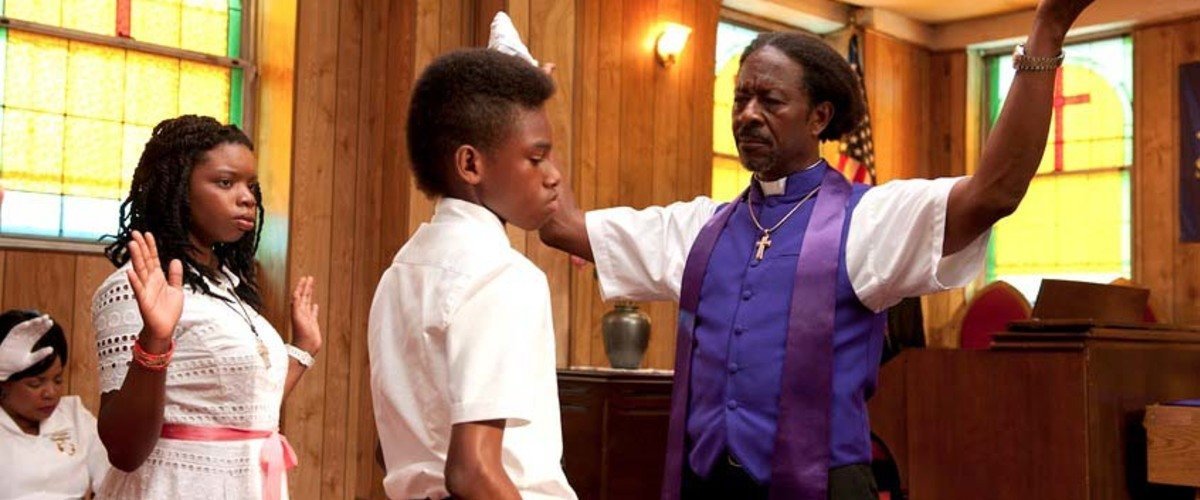
Silas (Brown), aka Flik, has lived all of his very young life in Atlanta with his mom. This summer he's going to spend his vacation from school with his grandfather Bishop Enoch (Peters), whom he's never met before. To say the two are different is a massive understatement. The bishop lives in Brooklyn's Red Hook housing projects, is an intensely devout Christian, pastors Little Piece of Heaven, the neighborhood church, and is fully embedded in the community. He is also most definitely old school in his ways. All of them. Silas' house in Atlanta is in the suburbs, it seems he's never been to church, he walks around recording everything on his iPad and wants nothing more than to go back home. Nonetheless, he's stuck for a couple months. The two trying to understand each other while Silas learns the ropes of surviving in Red Hook ensues.

For director Spike Lee, it's a return to his Brooklyn roots. He even includes a brief reprisal of his role as Mookie from the classic Do the Right Thing. It's a place he knows exceedingly well and loves despite whatever blemishes it may have. This much is evident throughout the film. It is most easily identifiable during the totally unnecessary montage that closes the movie. Spike lets his cameras take longing looks at both his beloved borough and the entire city of New York. However, where Spike's movie really shines is when he's using that camera to create statements and metaphors. Simply put, there are some amazing shots in Red Hook Summer. The most poignant of these deal with the ceiling lights at Little Heaven. A section of them forms a cross and figures prominently in three very powerful shots. Between these shots is perhaps Lee's most frightening double-dolly sequence ever. If you're familiar with the director's work then you've seen the double-dolly shots, the portions of his films where the camera will be in tight enough on a character, or characters, that only the upper portion of their body is visible. He/she will be moving toward us viewers in a way that makes it seem as if they are floating. This is his signature move. Here, the movement is more subtle than usual, but grows in intensity, and has just a bit of shaky cam thrown in. It may only be ten or fifteen seconds of the movie, but it is a brutal moment.

Camera tricks are nice, but most people will be more concerned with the story and whether or not it holds their interest long enough for us to care by the time we get to the finale. The answer is yes...and no. The yes part is easy. Bishop Enoch is a rich character, full of faith, stubbornness, fear, and mystery. To many in the movie, he represents what's good about the community and he has uncompromising values. Still, he's leery of the local rif-raf even as he occasionally approaches them and tries to nudge them in the right direction. However, the most anyone knows of him before his arrival in Red Hook is that he came from "down south." Clarke Peters wraps all of this up into one dynamite package. He plays the role perfectly, both in the bishop's quieter moments and at his most boisterous, brandishing fire and brimstone.


The no part is a bit trickier. Much of it has to do with Silas and Chazz (Lysaith), the girl he hangs around. For starters, his story isn't sufficiently explored. After his mom drops him off in Brooklyn during the film's opening scene, she disappears from the movie for all but one brief scene an hour or so later. She could potentially add much in the way of context for Silas, but gives almost none. Similarly, little is done with what is revealed about his father. All we really get is that the boy is homesick. That's fine, but he whines so much about it, he's tough to like. Chazz is a much more fun personality with her unmistakably Brooklyn attitude and an interesting take on the world around her. The biggest problem with both of these characters is that they are poorly acted. Brown and Lysaith sound like they're using what they think to be their acting voices, like you might here in a school play. Many of their movements are too deliberate, artificial looking. It feels like Spike should have told them in rehearsals to just speak and act naturally. Since their exploits comprise a large chunk of the movie, it can be quite distracting.

The climax of the movie is where it will completely grab you or totally lose you. While this is true of lots of movies, the feeling is amplified here. The shot I spoke of earlier, which contains the big reveal, is the lightning rod moment. It may seem over the top and coming in from way out deep in left field. If that fits your line of thinking, you might just tune it out right then and there. If this is an "oh wow" moment for you, you'll be pulled into the fold, far more invested than you were before this instant. It turns into the sort of harsh social commentary Spike Lee is known for.

But is it too harsh? Viewed through the prism of the director's public distaste for Tyler Perry, it is hard not to see this as at least a partial backlash against the message Perry aggressively pushes throughout his body of work, a deconstruction, if you will. In that vein, it may feel heavy-handed and overly reactionary. However, I believe in judging each film on its own merit. Red Hook Summer makes no overt references to anyone else's work, so what I've written is pure speculation. Juicy, it may be, but still speculation. As a stand-alone, it ultimately succeeds by offering Bishop Enoch up for debate. Is his story one of redemption or does it end in eternal damnation? There is also the nagging question of how all of this affects Silas. While not among his best work, it is far from his worst. His return to Brooklyn seems to have re-invigorated him. RHS is intriguing, yet uneven. It is also the most passionate film he's made in years.