

Dell slaves over a hot Blu-ray player for the good of mankind.
Showing posts with label War. Show all posts
Showing posts with label War. Show all posts
Tuesday, November 20, 2018

Friday, January 19, 2018

Sunday, July 16, 2017

Thursday, September 1, 2016

Wednesday, November 11, 2015
Wednesday, September 16, 2015

Tuesday, September 1, 2015

Monday, November 25, 2013
Kinyarwanda

Directed by Alrick Brown.
2011. Not Rated, 100 minutes.
Cast:
Cassandra Freeman
Hadidja Zaninka
Mazimpaka Kennedy
Edouard Bamporiki
Cleophas Kabasita
Hassan Kabera
Abdalla Uwimana
Marc Gwamaka
Mutsari Jean
Kena Onyenjekwe
The Rwandan genocide of 1994 has been, and continues to be,
widely documented. It has even made its way to mainstream American cinema with
2004’s Hotel Rwanda which starred Don Cheadle. In case
none of this rings a bell, I’ll give you a quick and oversimplified history lesson.
People of the two predominant ethnicities in Rwanda, the Hutu and the Tutsi’s
were engaged in a civil war. Even though the Hutu comprise a much larger
portion of the country’s population, the Tutsi controlled the government for
much of its history. However, in 1994, the Hutu had been in power for roughly
thirty years. Rebel Tutsi’s organized in an effort to seize power, thus
resulting in war. After Hutu leader Juvénal Habyarimana was assassinated, members
of a powerful Hutu group known as the Akazu initiated the mass killings of
Tutsi’s. Through pointed and unfiltered propaganda, they convinced many that
the Tutsi’s aim was to enslave the Hutu and for this, all of them should be
exterminated. They openly referred to Tutsi’s as “cockroaches.” Also targeted
were any Hutu who opposed these genocidal tactics, were thought to be hiding
Tutsi, and of course, those who were married to someone of Tutsi descent. They
were labeled traitors. Over a period of 100 days (from early April to mid-July
of ’94) men, women, and children alike, often whole families at once, were
murdered in the streets, in their homes, schools, churches, and wherever else
they might be by Hutu death squads. Many of these squads were part of the Hutu
military, but a disturbing number of them were made up of civilians taking up
arms against their neighbors. Often, these executions were carried out by
machete leaving maimed those who didn’t die from their attack. When it was
over, somewhere in the vicinity of one million people had perished. That is an
estimated twenty percent of the country’s entire population at the time. Most
of them were Tutsi’s. Imagine if one of every five people you know were
violently murdered over the summer. Eventually, the RPF (Rwandan Patriotic
Front), a mostly Tutsi rebel group defeated the Hutu army and seized control of
the country. This is the backdrop for our movie.

The tale of Kinyarwanda is told mostly
through three intertwining plot lines. The firs involves a young girl named
Jean (Zaninka). She is half-Tutsi and returns home from a day hanging out at a
friend’s house to find that the rest of her family has been slaughtered. The
next has us follow Father Pierre (Kennedy), a Tutsi Catholic priest who is
highly sought after by the Hutu since he is viewed to be in a position of
leadership. Finally, we ride along with Lt. Rose (Freeman), a female officer in
the RPF, as they try to extract people from dangerous situations. Each story is
well told. The danger within them is undeniably real, helping invest us in the
fate of these people. Also helping is the almost constant playing of the radio.
During this time, Hutu run stations blatantly advocated the mass killing of
Tusti through incendiary broadcasts. Hearing the call for murder is, in
itself, a scary thing. Much more frightening is then seeing ordinary citizens
answering that call. It’s the worst of mob mentality on an exponentially larger
than normal scale. Therefore, we realize death is almost always quite literally
right around the corner.
Through jumps back and forth in time, the movie also sets up
a redemption tale. Parts of the movie take place some time after the genocide
with many of the Hutu perpertrators we’ve met in some sort of de-programming or
re-education camp. It is run by Lt. Rose. Here, we get some heart-wrenching
group counseling sessions. We worry that the mental state of at least one
person is not healing so well. We try to put ourselves in the shoes of the
Tutsi survivors and figure out if we could forgive such atrocities. This is no
easy task.
The are some small dings in the movie’s armor. Most
noticeably, the acting is not quite top notch. In fact, many of the performers
are first-timers. This renders the individual stories just a bit less powerful
than they should be. None of the individual actors reach out and grab us by the
throat, the way this material is begging someone to. Also, the Hutu characters
need to be fleshed out a little more. We only get to know anything about one of
them as the they were before they took up killing as a mission. It works
wonderfully, but it is a tactic not applied elsewhere. This also may have
strengthened Kinyarwanda even further. However, these are
somewhat minor in the grand scheme of things. It overcomes its flaws to deliver
a truly harrowing tale worthy of your attention.
Monday, November 11, 2013
Favorite War Movies
Truth told, war movies are not my favorite genre. That said, there is nothing quite so visceral as a well done battle scene, and not much as gut-wrenching as a film that cuts to the heart of war. The simple fact of the matter is that war is, unfortunately, one of the most innately human things depicted on the screen. That said, I have to say thanks to all of my fellow vets out there. Enjoy Veteran's Day and check out one or more of my...
5 Favorite War Movies


Some other great war movies (chronologically)...
Paths of Glory (1957)
The Battle of Algiers (1966)
Patton (1970)
Das Boot (1981)
A Soldier's Story (1984)
Platoon (1986)
Flags of Our Fathers/Letters from Iwo Jima (2006)
The Hurt Locker (2008)
Zero Dark Thirty (2012)
5 Favorite War Movies

5. Apocalypse Now
(1979)
General: Francis Ford Coppola
Conflict: The Vietnam War
This is Francis Ford Coppola at a time when he could seemingly do no wrong. We follow Benjamin L. Willard, played by an amazing Martin Sheen, go on a manhunt for one of the United States' own, Col. Walter E. Kurtz. Apparently, Kurtz has gone crazy and needs to be eliminated. Marlon Brando delivers the goods as the nutso colonel. The rest of the cast also turns in stellar work. Included are Harrison Ford, Robert Duvall, and a pubescent Laurence Fishburne. They help deliver Coppola's anti-war vision to the screen. This is arguably the best movie ever made about Vietnam.
4. Glory
(1989)
General: Edward Zwick
Conflict: The Civil War
An oft-neglected component of American history, both educational and cinematic, is the contribution of black soldiers to the efforts of the Union Army during the Civil War. More than any other, Glory is the film that drives home the point that African Americans were not merely spectators in the decisive battle over the legality of slavery. Cpt. Shaw (Matthew Broderick) is tasked with heading up an all black company. They are given only menial task which gives us ample time to get to know them. Boy, do we ever, thanks to stellar work from Denzel Washington, Morgan Freeman, and Andre Braugher (making his big screen debut), among others.
3. Schindler's List
(1993)
General: Steven Spielberg
Conflict: World War II
Schindler's List is different from most war movies in that the focus is not on the people actively fighting. Here, our protagonist is Oskar Schindler (Liam Neeson). He's a German businessman who is a member of the Nazi party. However, his life becomes saving Jews from persecution and execution while maintaining the appearance of loyalty to the Nazi's. It's an epic in every sense of the word. This includes its villain, Amon Goeth, played by Ralph Fiennes being as unlikable as is humanly possible.
2. Full Metal Jacket
(1987)
General: Stanley Kubrick
Conflict: The Vietnam War
Let's just get this out of the way, now. The opening half of Full Metal Jacket is the best depiction of boot camp ever committed to film, period. What R. Lee Ermey does as Gunnery Sergeant Hartman is nothing short of perfect. The same goes for Vincent D'Onofrio as Private "Pyle". I've seen both men in many things since but whenever I do, this movie immediately comes to mind. The second half, which includes neither, has been so overshadowed, people seem to forget it even exists. I'm not here to tell you it's just as good as the first half, but I will say that is excellent in its own right.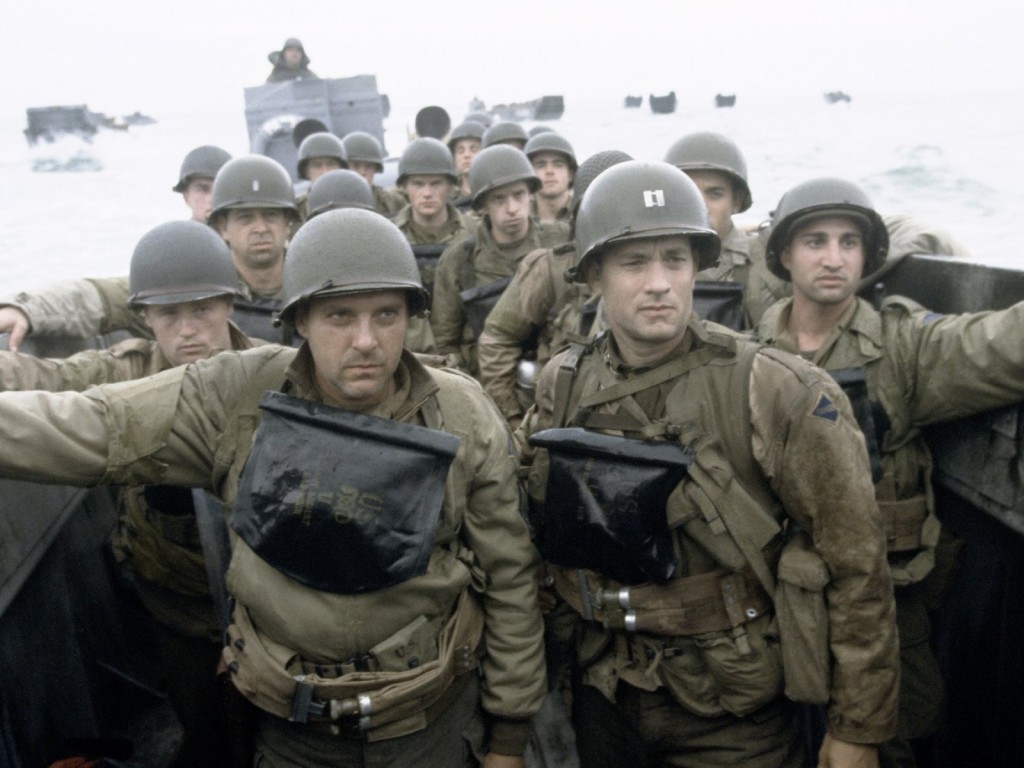
1. Saving Private Ryan
(1998)
General: Steven Spielberg
Conflict: World War II
What Saving Private Ryan does better than perhaps any movie not made during the silent film era is tell its story through action. Sure there's plenty of exposition in the name of character development, but it's the battle scenes that not only thrill us, they tell us what's going on. Of course, what's going on is the seemingly impossible extraction of one soldier, Private Ryan (Matt Damon) from the front lines of World War II after it is learned that his three brothers have all been killed. Damon is good, but as his commanding officer, Tom Hanks is great. It's some of his best work, in my opinion. The rest of the cast is also great and too numerous to name. And yes, the Omaha Beach scene that opens the movie is the most tense battle scene of them all.Some other great war movies (chronologically)...
Paths of Glory (1957)
The Battle of Algiers (1966)
Patton (1970)
Das Boot (1981)
A Soldier's Story (1984)
Platoon (1986)
Flags of Our Fathers/Letters from Iwo Jima (2006)
The Hurt Locker (2008)
Zero Dark Thirty (2012)
Monday, August 5, 2013
Zero Dark Thirty

Directed by Kathryn Bigelow.
2012. Rated R, 157 minutes.
Cast:
Jennifer Ehle
Edgar Ramirez
Harold Perrineau
It’s quite simple, really. This is all about the almost decade long hunt for Osama bin Laden after the events of 9/11. Maya (Chastain) joins the CIA’s effort early on and eventually comes to spearhead it. We see her and her colleagues feverishly gathering intelligence and note the differences in how this is done before and after the general public found out about waterboarding. We see Maya persevere in the face of waning support from her superiors. Finally, we see…well, you know how this ends.
Movies based on true stories generally have to contend with
the audience already knowing the outcome. Here, the problem is multiplied
because a) it is more well-known than most and b) it’s still pretty fresh in
our collective memory. The devil has to be in the details, and so it is. To
that end, we get a procedural chronicling Maya’s difficult path to victory. It’s
an atypical war movie in that it’s all about a chess match on the grandest
scale, not an all out depiction of battle. However, there are bursts of
violence sprinkled throughout and the culmination of all of our heroine’s work
is the operation performed by Seal Team Six. By the way, this is done with
great accuracy, according to everything I've heard or read about it.

Before we get to that finale, it’s all about war waged on
multiple fronts. Most obviously, there is the overall war on terrorism. Within
that broader scope, there is the war between the CIA and the White House over
what procedures are acceptable and which are not. Then there is the war between
Maya and her own bosses over whether or not to keep her pursuit alive. Speaking
of alive, there is also the war to keep her that way once her identity becomes
known to her enemies. As Maya, Jessica Chastain is nothing, if not fierce. Her
ferocity is drawn from unwavering conviction. She is the type of person we
viewers might not like if we had to work with/for her, but we’d appreciate her
and be glad she’s on our side. It’s not that she’s mean or even inaccessible.
It’s that to call her dedicated to the mission is like saying that Oprah has a
little money tucked away.
Through Chastain’s performance, an excellent script and
supporting cast, and the gravity of the situation, director Kathryn Bigelow
crafts an engrossing film. It grabs hold of us as it explains the hows of the
whats we already know. We’re intrigued by the process. When we get to the last
scene, we do as Maya does. We exhale.
MY SCORE: 9/10
Monday, May 27, 2013
Red Dawn (2012)

Directed by Dan Bradley.
2012. Rated PG-13, 93 minutes.
Cast:
Josh Peck
Adrianne Palicki
Connor Cruise
Edwin Hodge
Alyssa Diaz
Julian Alcaraz
Will Yun Lee
Brett Cullen
Fernando Chien
Kenneth Choi
The first person we meet is Matt Eckert (Peck). He’s a
hotshot high-school quarterback who selfishly puts himself before his team, the
Wolverines. Hint: this will be a recurring theme. We next meet his father Tom
(Cullen), the local tough guy cop and his tough guy brother Jed (Hemsworth),
home on leave from the military. Blanks are filled in by an assortment of
locals. You know the locals: the girlfriend, the geek, the other girl(s), the black
guy, etc. In a shocking nod to diversity, we actually get two black guys. Of
course, neither one…well, I’m getting way ahead of myself. Most of the locals
are teenagers and friends of the boys, but there are a few strangers who find
themselves in this ragtag bunch due to the circumstances. What circumstances?
North Korea has invaded the United States and are hitting the town of Spokane,
Washington pretty hard. A daring escape forms the aforementioned bunch, without
dad, by the way. One thing leads to another and before you know it, they’ve
become a resistance known as…wait for it…wait for it…the Wolverines! Yayyy! If,
like me, you’re old enough to actually remember the last decade of The Cold War
then you probably know this is a remake of the 1984 original which stars
Patrick Swayze, Charlie Sheen, and a number of the day’s hottest young stars.
Like its predecessor, Red Dawn is a
relentless barrage of blood-soaked patriotism. Not that there’s anything
inherently wrong with national pride, but that’s pretty much all there is. Some
effort is made to develop the relationship between the brothers, but I've
already told you everything there is to know. Everyone else is a cardboard
cutout either part of and/or helping the resistance, or they’re traitors,
saving their own hides by helping the enemy. Speaking of the North Koreans,
that’s just it – they’re North Koreans. The idea, drilled home by all the news
blurbs that open the film, is that their current real-life leadership is not
only crazy enough to invade they actually make that move. From there, we get a
depiction of how we Americans like to think we’d react to such a situation.

Of course, such a depiction requires lots of action.
Red Dawn does lots of things well in this department. For
starters, there’s lots of it. The next supposedly covert operation is never far
away. It should go without saying that each one erupts in gunfire. These scenes
do a surprisingly decent job of creating tension. If nothing else, we know that
a number of North Koreans (and their supporters) will die along with one of our
heroes. Guessing which “good” guy gets it is where the tension is. The problem here, like with the
rest of the movie, is we might be emotionally invested in the cause (provided
we’re American or anti-North Korean), but not in any character not named Matt
or Jed. Therefore, ancillary characters dying is of little concern to us. Even
worse, when the movie tries to manipulate us one last time with a major
decision made by one of these people, we’re just thankful he made the choice on
his own because we wouldn't hesitate to shoot him, otherwise. Our lack of
compassion for this character further proves that our roster of freedom
fighters is made up of types rather than actual people. Magical Negro, anyone?
Okay, so depth is not found here. It’s a shoot ‘em up,
popcorn flick designed by Americans for Americans and uses no uncertain terms.
At being precisely this it succeeds. Note for note, it’s practically identical
to the clunker Battleship. This one swaps out space aliens
for North Koreans. Otherwise, they’re virtually the same. Somehow, this is
still better. Perhaps because we can more readily identify with menaces from
another country than another planet. More likely, this one removes just enough
cheese and other Michael Bay-isms (I know he didn't direct Balttleship)
to be a more believable, if still implausible tale. The action looks better and
the run time is a good deal shorter, avoiding most of the long, boring
stretches where nothing is really happening. Things are happening here all the
time. This makes it a fun watch that uses our fears to create an action-filled
adventure. There is no cinematic genius on display, so I wouldn't call it good.
It’s just a better movie than Battleship constructed from
the same parts.
MY SCORE: 5/10
Wednesday, February 27, 2013
Lincoln

2012. Rated PG-13, 150 minutes.
Cast:
Gloria Reuben
James Spader
Bruce McGill
Lee Pace
Gulliver McGrath
Having just been re-elected as President of the United States, with the Civil War still raging on, Abraham Lincoln (Day-Lewis) focuses his efforts on getting the 13th Amendment to the Constitution passed which will abolish slavery in America. As with most laws that most presidents want passed, there is almost total support from his own party, Republican in this case, and almost none from the other. Some swaying must be done. To complicate matters, he wants it to pass in a rather short period of time since the South appears ready to negotiate an end to the war. However, he knows that any agreement they settle on would have to include the survival of slavery. Amidst pressure from everyone around him, Lincoln stays his course.
As has been said so many times already, Daniel Day-Lewis inhabits the character to such a degree he is truly lost within Abraham Lincoln. We see him as a man who, in his professional capacity, has an enormous presence. He fills the room both literally and figuratively. If not always complete confidence, he oozes authority. Leadership seems to come easy for him. We can see why people follow him. On the other hand, we can also see he's flawed. Political opponents see him as abusive of his power and/or chasing a pipe dream. Privately, his marriage is contentious and he's completely stifling his older son Robert (Gordon-Levitt) in order to protect his wife's well-being since she teeters on the verge of a complete breakdown. In the role of First Lady Mary Todd Lincoln, Sally Field is nearly her leading man's equal, coming apart at the seams one moment and the very picture of composure the next. When neither of those two are on the screen, the movie is carried by a magnificent Tommy Lee Jones who give his most inspired performance in years playing Republican Congressional Leader Thaddeus Stevens.

Carrying the weight of history, the plot unfolds in a riveting manner. This is because the supporting cast is allowed ample room to breathe. In a departure from most contemporary films, especially biopics, much happens when our hero is not on the screen. He spends large chunks of the movie off-camera while we watch the bickering going on in the House of Representatives. These spirited debates mostly take the place of action scenes. Though there are a few actual battle scenes, the high powered pontification on display is more entertaining. These guys, led by the aforementioned Jones, don't just argue. They scream, shout and string together fifty cent words all to the cheers and jeers of a crowd. Then there's the covert vote-grabbing operation going on initiated Secretary of State William H. Seward (Strathairn). There are a few times when the movie drags as the same arguments are repeated but usually something else happens that snaps us out of it.
For director Steven Spielberg, in my very humble opinion, this is his easily his finest directorial outing since Munich and quite possibly his best since Saving Private Ryan. The Adventures of Tintin, the best of his three movies since Munich is merely okay. It has it's moments. The last Indiana Jones flick left a lot to be desired. Finally, War Horse was somehow nominated for Best Picture last year but is just a dreadful, overwrought, unstoppable force of cheesiness. Lincoln also has its share of the director's trademarked sentimentality and even some corniness. The opening scene where soldiers take turns reciting the president's most famous speech to him comes to mind. Thankfully, that sort of stuff is ratcheted down a thousand notches from War Horse. We're left with a wonderful biopic and Daniel Day-Lewis' performance for the ages.
MY SCORE: 9/10
Monday, January 14, 2013
Red Tails

Directed by Anthony Hemingway.
2012. Rated PG, 125 minutes.
Cast:
Cuba Gooding Jr.
Nate Parker
David Oyelowo
Tristan Wilds
Marcus T. Paulk
Leslie Odom Jr.
Andre Royo
World War II marked the first time in American history that units of black soldiers were put on the front lines against a foreign enemy. Eventually, this would include a unit of fighter pilots. Some credit for this is due to the simple necessities of winning a war. However, it’s still a near-miraculous achievement given the climate of our country at the time. As the quote that appears at the beginning of Red Tails tells us, blacks were thought to be genetically deficient in the areas of intelligence and courage with not enough of the former to fly a plane and not enough of the latter for any facet of war. Of course, this ignores the fact that all-black units fought 80 years earlier in The Civil War (see Glory). Then again, racism often ignores logic. How ridiculous is it that the military so purposefully segregated itself that thousands of its members practically had to beg to fight for their country even though they all signed up with the knowledge that dying in the line of duty is a distinct possibility.
To prove the theory of white superiority, the U.S. government commissioned a sociological study. A number of students from the all-black Tuskegee University were sent through the same rigorous testing and training hopeful white pilots underwent. The hypothesis going in was that all of these guys would wash out, thus proving the inferiority of the black race. After all, if the cream of the crop couldn’t rise to the occasion who would? Of course, many Tuskegee kids successfully completed the program. They were then maligned to their little squadron, the 332nd, and charged with flying practically meaningless patrols hundreds, if not thousands, of miles away from the action. They were bored and itching to prove themselves. This is where Red Tails picks up.
Pretty quickly, we meet our cast of would-be heroes. There’s the curmudgeonly old leader Major Stance (Gooding Jr.), the reserved squad leader Easy (Parker), we’re going with nicknames here, the talented but rambunctious loose cannon Lightning (Oyelowo), the super-southern hillbilly Smokey (Ne-Yo) and an assortment of other stock characters. These are all fun folks, but lack any sort of depth. They are personas already fully formed by whatever baggage they with them into the Tuskegee. The things they go through during our time with them is mostly generic stuff recycled from too many movies. What should be a collection of truly compelling men is reduced to a group of clichés in blackface. Only their leader, the crusading Colonel Bullard (Howard) escapes this fate. However, his screen-time is severely limited.

It would have helped if the movie had picked up earlier in the proceedings. By not seeing them go through the training program, we never get a real sense of their struggle. An old adage of storytelling is that it’s better to show than tell. RT would be a much more effective film if it had shown us what these people went through rather than just mentioning it once or twice. This means the audience is left to draw on whatever their own knowledge and opinions about race relations in America both now and during the first half of the 20th century. Therefore, how we feel about the characters is open to a broad range of interpretations from raging militant support to disinterested apathy. We’re left with something that should be, but is not more than an action flick about fighter pilots.
In fact, RT hangs its hat on the action sequences. They are beautifully shot and exciting. Planes get shot down, crash and burn pretty good. The same goes for trains, ships and even an entire base. Mid-battle banter between our heroes is cheesy, but in an entertaining way. It gives us a few chuckles to go with the violent eye-candy. These scenes come at a fast enough rate that even though the movie doesn’t connect with us the way it wants to, it doesn’t bore us, either.
For what it actually is, RT really isn’t that bad. Sure, it feels like rehashed material but the guys are pleasant enough to root for and those “dog fights” are excellent. It’s light, forgettable fare that zips by like one of the Germans’ (then) new-fangled jet planes.
Unfortunately, because of the subject it chooses to tackle, we have to judge this particular film on what it is not. RT is not a gripping historical drama. It offers very little perspective, if any, on what these men meant to their country or race. I fear its shortcomings as a potential teacher are behind the extremely negative reviews. While certainly not a great movie, it isn’t the scourge of cinema it’s made out to be. Though, to be fair, HBO made a better movie on the same subject, The Tuskegee Airmen (1995), in which (a much younger) Cuba Gooding Jr also appears. I encourage you to seek out that one. It will give you a better feel for what these men went through. RT is just sorta fun.
Friday, December 7, 2012
War Horse

Directed by Steven Spielberg.
2011. Rated PG-13, 146 minutes.
Cast:
Jeremy Irvine
Emily Watson
David Thewlis
Niels Arestrup
Benedict Cumberbatch
Of course, a horse is a horse, of course. Well, except for Joey. Joey is a bit different. After all, they made this movie about him. To be fair, it’s about him and his human Albert (Irvine). They get together when Albert’s dad Ted (Mullan) spends just about all of the family’s money on Joey at an auction. The problem is, being farmers with a particularly rough patch of land, they need a big, strong plow horse. Joey is small and sleek. Ted, a heavy drinker, only bought Joey because he sees something special in the animal. He’s just not sure what. This upsets his wife (Watson) who realizes the landlord is breathing down their necks and farming is their only source of income. They need Joey to work a miracle and plow this land. Ted has a bum leg and can’t train the horse for the job, if that’s even possible. Therefore, Albert steps up to take on the task. Quite literally through an act of God, Albert and Joey get the field plowed. The end.
Okay, that’s really just the beginning. All of that is to show us the special bond between the boy and the horse. It also scratches the surface on Joey’s incredible intelligence. The real conflict happens when World War I has come to Britain and the British army is looking for horses. Since that whole farming thing didn’t quite pan out, due to another act of God, Ted sells Joey to the army so he can pay the rent. This is in spite of Albert’s relentless pleading. The horse is off to battle while the boy, still too young to legally join the war effort, finagles his way into the service in hopes of a reunion with his one true love. Okay, I may be reading a bit much into it, but that’s the way it feels. Luckily for you, and I think for Albert, I’m not sure Joey trots that way. Thankfully, we’ll never find out for sure.

The battle scenes are harrowing. We alternate between watching Joey and Albert in their own separate dangerous situations. Many bombs go boom, kicking up much dirt as various unnecessary characters die. Even in the midst of war, Joe and Albert manage to form bonds with some of their fellow soldiers. Yes, Joey becomes good pals with another horse and even saves his equine buddy’s life. At this point, the great and powerful Spielberg commands you to cry. Disobedience will only bring about even more menacing sappiness. Never mind, you’ll get that no matter what.
If you can’t tell, War Horse is nearly two and a half hours of manipulating you to make liberal use of the tissue of your choice. The story is well-told, as is most of Spielberg’s work. However, the cheese is piled so thick it makes his last Indiana Jones movie look edgy by comparison. The difference is this movie seems to think it is not a shameless piece of fluff when that’s precisely what it is. It takes itself seriously despite the silliness of it all. Admittedly, it’s a beautiful looking movie with top notch cinematography and some wonderful individual scenes. Unfortunately, when it all comes together, War Horse crumbles under the weight of its own corniness.
MY SCORE: 5/10
Thursday, June 21, 2012
Act of Valor

Directed by Mike McCoy, Scott Waugh.
Emilio Rivera
Ailsa Marshall
Gonzalo Menendez
U.S. Navy SEALs
U.S. Navy Special Warfare Combatant Crewmen
Ailsa Marshall
Gonzalo Menendez
U.S. Navy SEALs
U.S. Navy Special Warfare Combatant Crewmen
Act of Valor is billed as a movie made by U.S. Navy SEALs for U.S. Navy SEALs. The rest of us can either take it or leave it. I have a feeling that anyone into action and/or war flicks will take it. Our tale follows a team of SEALs whose mission is to rescue undercover CIA agent Lisa Morales (Sanchez). She’s been kidnapped after her cover is apparently blown by Cristo (Veadov), the international drug dealer she’s been investigating. Pretty quickly, it’s discovered that this is merely the tip of the iceberg. Unsurprisingly, our heroes find themselves efforting to stop a major terrorist plot with eyes on multiple locations within the United States. Before any of this happens, frontline defenders of the free world do what they must. They have a get-together at the beach to say goodbye to their loved ones, maybe even confide in one another in hopes of resolving any last minute personal issues. For Lt. Rorke, the team’s leader ,it’s an especially difficult time to be deployed. His wife is expecting their first child. He doesn’t want anyone to know, but his bestest buddy Chief Dave is a bit of a blabbermouth. Everyone knows.
With that, we’re on to the part of the movie that keeps us on the edge of our seats: watching the SEALs in what becomes a global operation to end a threat against us, here at home. This isn’t Rambo or Commando impossibly and singlehandedly mowing down hundreds of bad guys and dropping corny one-liners. This is a team of highly trained seamen who are excellent at what they do, but will take help whenever they can get it. The action scenes feel real. We see them implementing their training. Save for possibly one moment involving an RPG, there are no superhuman feats. It helps maintain tension during these sequences. Our sense of danger is palpable. If there is a drawback, it’s that the first person shooter angle is overused. It comes across gimmicky and not as clear as it needs to be.

Wisely, there aren’t endless soliloquys of exposition. Explanations are given in a succinct, no-frills fashion. It’s basically, “This is what we know and that is where you’re going. Go get ‘em, boys!” The one piece of story AoV does use lots of words on is what’s going on with Lt. Rorke. This is repeatedly hammered into our head to ensure our proper response at the end. The writers don’t seem to understand that it doesn’t need to be so heavy-handed. Trust me, we get it. With a little less time on this, the ending would still have the same effect. Less time here would also benefit the performers. Lt. Rorke and Chief Dave get most of the lines among the good guys. Believe me, neither is in line for an Oscar. A Razzie, maybe.
AoV manages to overcome its flaws to deliver a movie that’s exhilarating, sad and controversial. It entertains, but not merely for entertainment’s sake. It doesn’t dwell on the rights and wrongs of war. Instead, it just presents us with the reality of these men’s lives. However, in doing so it may come across as pure propaganda and more than a bit militaristic. The actual U.S. Navy is said to look upon this as a recruitment tool. That said, the action still carries the day. Narratively speaking it’s average or less in comparison to other action flicks. In terms of combat scenes, it’s much more.
MY SCORE: 6.5/10
Thursday, December 29, 2011
The Men Who Stare at Goats

Directed by Grant Heslov.
2009. Rated R, 94 minutes.
Cast:
George Clooney
Ewan McGregor
Jeff Bridges
Kevin Spacey
Stephen Lang
Robert Patrick
Waleed Zuaiter
Nick Offerman
Cast:
George Clooney
Ewan McGregor
Jeff Bridges
Kevin Spacey
Stephen Lang
Robert Patrick
Waleed Zuaiter
Nick Offerman
Reporter Bob Wilton (McGregor) follows Lyn Cassady (Clooney) around the Middle East in hopes of writing an exposé about a secret military program to train soldiers with paranormal abilities. As the movie itself tells us, “more of this is true than you would believe.”
Clooney gives us another of his quirky, paranoid performances. Think O Brother, Where Art Thou? It’s one of the two types of roles he’s perfected, the ultra suave cynic being the other. He knows how to work us with excellent comic timing. Most of the movie’s best moments are his. The rest belong to Jeff Bridges who lets us know what The Dude from The Big Lebowski would be like as a soldier.
It wants to be a great oddball comedy. It’s definitely oddball but not consistently funny enough to keep us from noticing just how silly all this is, even though we’re not laughing. Ewan McGregor turns rather bland work. Part of the problem is he shares so much screentime with Clooney he never gets a chance to shine despite the movie being about his character. Finally, Kevin Spacey is underused as our villain if, for no other reason than it’s Kevin Spacey. Forgive me, I’m all about some Spacey.
It’s a premise with loads of potential that just doesn’t quite hit the mark. Unfortunately, even if it had it still may have been too strange for some.
MY SCORE: 5.5/10
Tuesday, May 3, 2011

Friday, September 17, 2010
The Messenger

Directed by Oren Moverman.
2009. Rated R, 112 minutes.
Cast:
Ben Foster
Woody Harrelson
Samantha Morton
Jena Malone
Steve Buscemi
Jahmir Duran-Abreau
Staff Sergeant Will Montgomery (Foster) has been sent home from the War in Iraq. Something I won’t spoil has left him with damage to one of his legs, one eye and presumably, his psyche. In a move that doesn’t seem like a good idea for a guy who seems fragile, he’s assigned to work with Captain Tony Stone (Harrelson) on a casualty notification team. In addition to his normal duties, he has to go with Cpt. Stone whenever needed to notify a soldier’s next of kin that their love one has been killed in defense of the country.
In keeping with a recent tren in war movies like The Hurt Locker and Jarhead, there is much less plot and much more slice of life. We see two guys working through a number of issues and develop a friendship. Among those issues is the mess of Will’s love life and Tony’s alcoholism, which both men seem to willfully complicate. However, there is no big rush to resolve something. There is no villain to be foiled, nor day to be saved. It’s just two guys. Still, these two guys worm their way into our hearts. We empathize deeply with them. We start to really understand them even though they hardly bother to explain themselves. Well, Will doesn’t. Tony likes to explain a lot of things.
What we love most about them is what we most hate: their job. We love them for doing it. We hate that it has to be done. It is intrinsically terrifying, perhaps almost as much as actually going to war. Though I’m a vet, I’ve never been to combat, so forgive me if I’m way off base, here. It just seems going into combat causes an anticipatory fear, but once you’re there, there is a chance you’ll live. After being in it for awhile, the fear doesn’t go away, but it subsides enough for you to focus on survival. With these guys, there’s no life or death involved in their current station in life. However, day after day they’re tasked with telling someone they will never see their child, husband or wife ever again. If you’ve ever had to break that news to someone, you know how difficult that is. Now imagine having to knock on a stranger’s door and do it every day.
The scenes of the men going about their business are masterful depictions of human drama. They’re simply gripping and like the rest of the movie, acted perfectly. Woody Harrelson deserved the nomination this role earned him for Best Supporting Actor. Ben Foster’s work has been largely overlooked, but is no less brilliant. Perhaps even more stunning than either of our two heroes is Samantha Morton’s work as a newly widowed mom. Her pain bleeds all over every scene but she’s never loud or showy about it. It’s a subtle performance that mirrors Foster’s. It may even be more poignant because she doesn’t have the military to look after her the way he does.
Don’t watch this if you’re looking for a traditional war movie. In fact, there is no war to be seen. There are only two guys. They are two guys you have to see.
The Opposite View: Noel Murray, The Onion (A.V. Club)
What the Internet Says: 7.4/10 on imdb.com (9/17/10), 90% on rottentomatoes.com, 78/100 on metacritic.com
MY SCORE: 9/10
Saturday, September 4, 2010
The Caine Mutiny

1954. Not Rated, 125 minutes.
Cast:
Humphrey Bogart
Fred MacMurray
Van Johnson
Robert Francis
Jose Ferrer
Lee Marvin
May Wynn
E. G. Marshall
Tom Tully
Warner Anderson
When Captain Queeg (Bogart) takes over the USS Caine during WWII, he finds his inherited crew mirrors his dilapidated ship, completely slack and barely, if at all, worthy of the United States Navy. However, it soon becomes apparent to them that their new captain may have spent a few too many days at sea. The question is do they muster enough evidence and gumption to relieve him of his duty before he gets them killed, without approval from further up the chain of command. If they do, what will the consequences be?
Those are intriguing questions and the movie tackles each as it transforms from a doomed-at-sea epic to a courtroom drama. Both portions are outstanding and keep you on the edge of your seat. The situations that arise aboard the Caine really capture the essence of a crew constantly walking on eggshells. In court, it’s a real question of whether these men who did what seems to be the right thing will become victim to the law.
There is one portion of the movie that doesn’t work for me. The romance between young Ensign Keith and his gal at home, May Wynn (herself) feels flat. It hints at an almost Oedipal relationship between he and his mother but never really becomes anything substantial. It feels shoved in so the movie doesn’t completely alienate female viewers. Yes, I realize the movie is based on a novel which included this part of the story, as well. However, if it were all left on the cutting room floor it wouldn’t change the movie one iota.
That said, TCM is still a true American classic. It achieves such status mostly on the back of one Humphrey Bogart. I’m one of those blasphemers who really isn’t impressed by Bogart. To me, he’s wildly overrated. Granted, he’s been in some great movies but I’ve never felt they were great because of him. In my eyes, he wasn’t the best thing about any of them. His acting largely seems to consist of holding the cigarette he’s smoking in one hand while having the other hand in his pocket and delivering his lines in something barely more than a monotone manner with a blank stare on his face. That is not the case, here. As the unstable captain, he’s simply dynamite. He commands the screen and is truly mesmerizing. For my money, it’s one of his best performances and worthy of the Best Actor nom he received.
If you’re a film buff, this is a must-see. It deserves its spot as one of the great cinematic achievements.
Monday, August 30, 2010

Subscribe to:
Posts (Atom)