

Dell slaves over a hot Blu-ray player for the good of mankind.
Showing posts with label Cuba Gooding Jr.. Show all posts
Showing posts with label Cuba Gooding Jr.. Show all posts
Thursday, September 1, 2016

Thursday, February 26, 2015

Wednesday, January 21, 2015

Wednesday, June 4, 2014
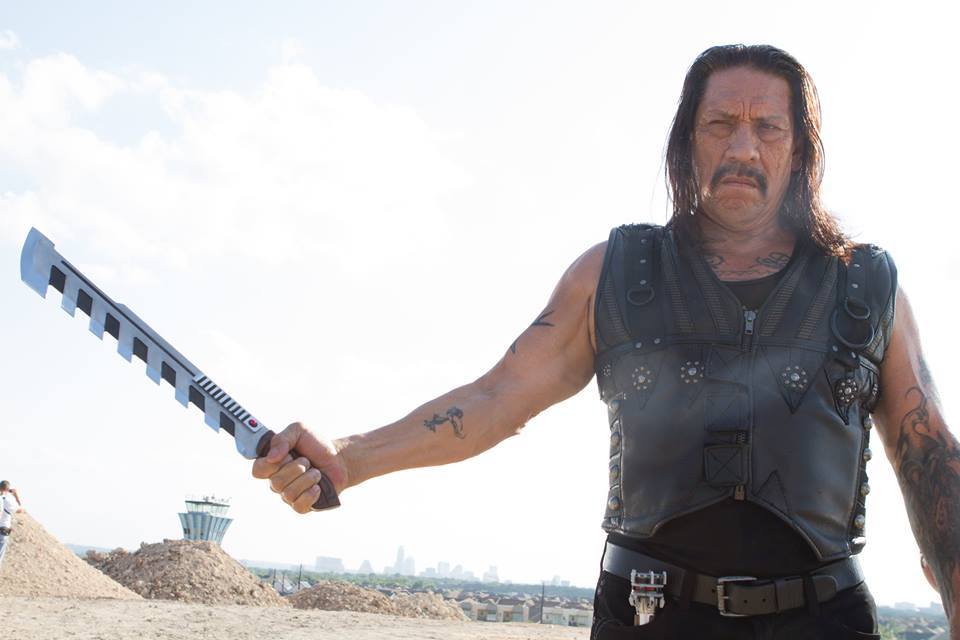
Machete Kills
Directed by Robert Rodriguez.
2013. Rated R, 107 minutes.
Cast:
Danny Trejo
Demian Bichir
Mel Gibson
Sofia Vergara
Amber Heard
Charlie Sheen/Carlos Estevez
Michelle Rodriguez
William Sadler
Walton Goggins
Cuba Gooding Jr.
Antonio Banderas
Lady Gaga
Vanessa Hudgens
Jessica Alba
Machete (Trejo), our favorite ex-Federale, is back. As sequels must, things start off on a sour note for our hero as his partner/girlfriend Sartana (Alba) is killed during a bust gone bad. He himself is about to be taken out by corrupt Texas law man Sheriff Doakes (Sadler) (are there any other kind in a Machete movie?), when the phone rings and none other than the Commander-in-Chief himself, Pres. Rathcock (Sheen/Estevez), demands that he be flown to White House immediately. Once there, the president asks Machete to go to Mexico and assassinate Mendez (Birchir), an ex-cartel member who has acquired a nuclear bomb he is threatening to use on the U.S. Machete's pay for this job? His criminal record will be expunged and he will immediately be granted full citizenship in this country. Mayhem ensues.
The citizenship angle is important, or at least it would be, if this were the first movie. That one immersed itself in nearly all of the issues associated with the immigration debate. This one starts down that same road, but it rather quickly detours, concerning itself with being as zany as possible. Unfortunately, what's left has no gravity and our tale goes spinning off into the atmosphere. Literally. As in we wind up in space. Don't worry, that's no spoiler. We are told right at the beginning that the next installment in the franchise will be Machete Kills Again...in Space. Without the weightiness of an issue to hold it together, the movie never connects with us on any level. Its predecessor consistently went hard at the issue it attacked. Even if you disagreed with its basic stance, there was something to grasp. Here, there is not.

Like the first movie, we get a never ending succession of jokes. The difference is that in its predecessor, with the immigration issue as its anchor, it shaped itself into a sharp, if ultra-violent and exploitive, political satire. Instead, this aimlessly throws as much against the wall as it can and hope some of it sticks. Some of it does. Director Rodriguez really stretches his imagination to come up with a plethora of outrageous occurrences. Some of them make us say 'wow,' while others make us laugh. The problem is that rather than being part of a cohesive whole and sustaining its humor, these jokes are all stand alones, fleeting moments of comically presented gore. The one strand of consistency is that no matter where we are in the movie, we'll soon get a reference to an older movie. Most often, and most overtly that reference is to Star Wars. This usually works. Other times, we get the director paying homage to his own past work which is a bit narcissistic, to say the least. This usually doesn't work.
It's not all bad, though. We do have some fun performances. Danny Trejo is once again spot on perfect as the titular Machete. It's a wonderful deadpan that would make Steven Wright proud. YouTube him, young'uns. William Sadler gets to go over the top as that crooked law man and does a nice job. It was nice to see him just cut completely loose. The same can be said for Mel Gibson in a bad guy role. As much as we say we hate him these days, he was pretty good in this flick. Weirdly, Walton Goggins, Cuba Gooding Jr., Antonio Banderas, and Lady Gaga all play the same person (La Cameleon). It doesn't quite fit anything that's going on and is odd more than it is good, but is interesting. For the top prize, there is a tie between Charlie Sheen and Sofia Vergara. Sheen, billed under his birth name of Carlos Estevez in a nod to the whole immigration thing, is wonderfully cast as the most fun president the United States has ever had. While not realistic in any way, he's still a blast to watch. Vergara chews scenery with reckless abandon, playing every scene to the hilt. It helps that she's often outfitted with some of the director's versions of biological weapons, including the pecker gun he used in From Dusk 'Til Dawn. She makes every bit of it work and is the most fun part of the film, along with Sheen.

Friday, February 21, 2014
Lee Daniels' The Butler

Directed by Lee Daniels.
2013. Rated PG-13, 132 minutes.
Cast:
Oprah Winfrey
Jane Fonda
Vanessa Redgrave
Clarence Williams III
Elijah Kelley
David Banner
We proceed through the life and times of Cecil Gaines (Whitaker). Mr. Gaines works in the White House as a butler beginning during the Eisenhower (Williams) administration and finishing during the Reagan (Rickman) years. As a very young child he witnesses atrocities in the Jim Crow South while working as a cotton picker on a plantation. Due to one specific tragedy, he is made a house servant. When he gets older, he leaves the plantation and heads north a bit where he works as a server in a private club. He is so good that he lands that White House gig. At home, things between he and his wife Gloria (Winfrey) are strained by all of his long hours at work. He also has a contentious relationship with his eldest son Louis (Oyelowo). The two see the world very differently. Part of our story follows Louis as he is literally becomes a major part of just about every front of the Civil Rights struggles of the 20th century. The rest, of course, deals with Cecil's duties in the White House, the stress on his marriage and plenty of acrimony between he and Louis.
Right away, we're told The Butler is inspired by a true story. Let's tackle this first. The key word is "inspired." The real butler is a man named Eugene Allen. He most certainly did serve in that capacity in the White House for 34 years. However, not much else is rooted in fact. If you're wondering what is and what isn't, I'll not go into too many details to maintain some form of brevity. Suffice it to say most things that happen outside the White House are fiction wrapped in a cloak of history while what happens inside it is plausibly, possibly, kinda, sorta true. From what I've read, our hero's relationship with the Reagans is the most factual, followed by his rapport with the Kennedys. However, none of this should cloud your judgement. In my opinion, you shouldn't deem the movie to be better or worse than it actually is because more or less of it is true than you think. Let's move on.
What the movie does best is position Cecil against the people he loves. He is a man that works long and hard to provide for his family in a material sense. On the other hand, he's absent from them emotionally. We watch his marriage falter and wonder if he is even aware of what's happening. He does know of her battle with the bottle, but there is more going on than that. With his oldest son, it is a never-ending war of wills. They bark disagreements at one another until it eventually becomes too much for them to occupy the same room. Even though both situations are overly melodramatic, this is where The Butler is most consistently good. Star Forest Whitaker and David Oyelowo are sufficiently angry and deliver fine performances. However, it's a truly remarkable Oprah Winfrey that glues this kitchen sink drama together and makes it go. Hers is the film's most complex and satisfying portrayal.

Beneath the surface, what's really going on is that the movie is simply using all of this as a plot device to develop the romance between Louis and Carol (Alafia, formerly Da Costa), a young woman he meets in college and goes through most of his phases with him. Even this is botched, often feeling awkward and eventually unnecessary as it ends unceremoniously without the 'oomph' the movie seems to be reaching for at all times. The one good thing we get out of it is an explosive dinner scene when the two visit Louis' parents. Again, thank Oprah for making this moment.
The Cliff Notes treatment is given to Cecil's younger son Charlie (Kelley) and another major event in our nation's history, The Vietnam War. The poor kid is barely in the picture. He and the war can be summed up in three short sentences. People didn't know why we were there. People protested. Soldiers died. Something else we already know. By sticking to this, the movie telegraphs its blow and fails to make me care as much as I should. The punches that floor you are the ones you don't see coming. This one starts with a huge wind-up that's impossible to miss. The truth of the matter is some of the issues could have been alleviated by telling the story through Louis' eyes. That would likely force some things to be fleshed out instead of skimmed over. Besides, Louis is a far more interesting character than his one-note father. Of course, this might give us a completely different film than the director intended.

Fortunately, all parts of The Butler are well acted. Terrence Howard gives us a great slimeball while Cuba Gooding Jr. shines as the comic relief. Also funny is Liev Schreiber as an abrasive Pres. Lyndon B. Johnson. James Marsden does a spot-on JFK, but it's Minka Kelly as Jacqueline Kennedy that gives us one of the movie's most heartfelt moments. It's another instance nearly ruined by too much narration, but it still manages to work.
By the end, this is a movie that feels oddly bloated and deflated all at once. The stronger parts of the movie are a bit overdone while the weaker parts are half-baked. The narration usually states the obvious, robbing prior or upcoming scenes of power. Finally, it wraps itself up in a nice, neat bow of sentimentality. Honestly, given the importance of the occasion, I can hardly blame it. However, the impact of these scenes depends largely on how you already feel about that occasion. They don't supply any of their own juice. Thankfully, the whole thing is well performed and very well paced. The run time flies by and we enjoy the people with whom we're spending time. This makes it a solid movie that takes looks at important parts of our collective past. Just understand that, for the most part, these are fleeting looks.
Monday, January 14, 2013
Red Tails

Directed by Anthony Hemingway.
2012. Rated PG, 125 minutes.
Cast:
Cuba Gooding Jr.
Nate Parker
David Oyelowo
Tristan Wilds
Marcus T. Paulk
Leslie Odom Jr.
Andre Royo
World War II marked the first time in American history that units of black soldiers were put on the front lines against a foreign enemy. Eventually, this would include a unit of fighter pilots. Some credit for this is due to the simple necessities of winning a war. However, it’s still a near-miraculous achievement given the climate of our country at the time. As the quote that appears at the beginning of Red Tails tells us, blacks were thought to be genetically deficient in the areas of intelligence and courage with not enough of the former to fly a plane and not enough of the latter for any facet of war. Of course, this ignores the fact that all-black units fought 80 years earlier in The Civil War (see Glory). Then again, racism often ignores logic. How ridiculous is it that the military so purposefully segregated itself that thousands of its members practically had to beg to fight for their country even though they all signed up with the knowledge that dying in the line of duty is a distinct possibility.
To prove the theory of white superiority, the U.S. government commissioned a sociological study. A number of students from the all-black Tuskegee University were sent through the same rigorous testing and training hopeful white pilots underwent. The hypothesis going in was that all of these guys would wash out, thus proving the inferiority of the black race. After all, if the cream of the crop couldn’t rise to the occasion who would? Of course, many Tuskegee kids successfully completed the program. They were then maligned to their little squadron, the 332nd, and charged with flying practically meaningless patrols hundreds, if not thousands, of miles away from the action. They were bored and itching to prove themselves. This is where Red Tails picks up.
Pretty quickly, we meet our cast of would-be heroes. There’s the curmudgeonly old leader Major Stance (Gooding Jr.), the reserved squad leader Easy (Parker), we’re going with nicknames here, the talented but rambunctious loose cannon Lightning (Oyelowo), the super-southern hillbilly Smokey (Ne-Yo) and an assortment of other stock characters. These are all fun folks, but lack any sort of depth. They are personas already fully formed by whatever baggage they with them into the Tuskegee. The things they go through during our time with them is mostly generic stuff recycled from too many movies. What should be a collection of truly compelling men is reduced to a group of clichés in blackface. Only their leader, the crusading Colonel Bullard (Howard) escapes this fate. However, his screen-time is severely limited.

It would have helped if the movie had picked up earlier in the proceedings. By not seeing them go through the training program, we never get a real sense of their struggle. An old adage of storytelling is that it’s better to show than tell. RT would be a much more effective film if it had shown us what these people went through rather than just mentioning it once or twice. This means the audience is left to draw on whatever their own knowledge and opinions about race relations in America both now and during the first half of the 20th century. Therefore, how we feel about the characters is open to a broad range of interpretations from raging militant support to disinterested apathy. We’re left with something that should be, but is not more than an action flick about fighter pilots.
In fact, RT hangs its hat on the action sequences. They are beautifully shot and exciting. Planes get shot down, crash and burn pretty good. The same goes for trains, ships and even an entire base. Mid-battle banter between our heroes is cheesy, but in an entertaining way. It gives us a few chuckles to go with the violent eye-candy. These scenes come at a fast enough rate that even though the movie doesn’t connect with us the way it wants to, it doesn’t bore us, either.
For what it actually is, RT really isn’t that bad. Sure, it feels like rehashed material but the guys are pleasant enough to root for and those “dog fights” are excellent. It’s light, forgettable fare that zips by like one of the Germans’ (then) new-fangled jet planes.
Unfortunately, because of the subject it chooses to tackle, we have to judge this particular film on what it is not. RT is not a gripping historical drama. It offers very little perspective, if any, on what these men meant to their country or race. I fear its shortcomings as a potential teacher are behind the extremely negative reviews. While certainly not a great movie, it isn’t the scourge of cinema it’s made out to be. Though, to be fair, HBO made a better movie on the same subject, The Tuskegee Airmen (1995), in which (a much younger) Cuba Gooding Jr also appears. I encourage you to seek out that one. It will give you a better feel for what these men went through. RT is just sorta fun.
Subscribe to:
Posts (Atom)