

Dell slaves over a hot Blu-ray player for the good of mankind.
Showing posts with label Tom Hanks. Show all posts
Showing posts with label Tom Hanks. Show all posts
Monday, June 24, 2019

Tuesday, April 30, 2019

Tuesday, April 26, 2016

Wednesday, August 20, 2014
Saving Mr. Banks

Directed by John Lee Hancock.
2013. Rated PG, 125 minutes.
Cast:
Emma Thompson
Tom Hanks
Paul Giamatti
Colin Farrell
B.J. Novak
Jason Schwartzman
Ruth Wilson
Annie Rose Buckley
Melanie Paxson
Bradley Whitford
Even if you've never seen Mary Poppins, chances are you're familiar with the character. Based on a children's novel and released in 1964, it quickly became an iconic piece of cinema, raking in all sorts of money at the box office and an armful of Oscars for good measure. Our plot revolves around the struggles of the great Walt Disney (Hanks) to get the book's author P.L. Travers (Thompson) to let him bring it to the big screen. The problem is she's so attached to her creation she can't bear to see anyone embellish it any way and is willing to fight tooth and nail about it. We get to see how Disney and his team of merry makers charmed her enough to get her to loosen the reins. This is no small feat considering she starts adamantly against him making it one of his "silly cartoons" and absolutely does not want it to be a musical. A power struggle with a seismic shift ensues.
The film benefits from a wonderful performance by Emma Thompson in the lead role. She is a perfect blend of standoffish, defensive, and rude. At the same time, we know that she is fiercely protecting something she loves. We respect that immensely even if we disagree with her methods. Thompson commands the screen whenever she is on it which is most of the time. Her strong presence pulls us in. She makes us understand that she feels wronged by Disney and his people at every turn. We're also glad when she begins coming around.
From the other side of things, we feel the frustration of the people who are trying to give cinematic life to Travers' book. Despite what you've heard, Disney is not really key to conveying this life. He's just the muscle brought in when the rest of his team is at their wits end. They spend much more time with her, and with us. It's their pain we feel. Mostly, this is thanks to a pair of wonderful turns. One is B.J. Novak, the other by Jason Schwartzman. They play the two songwriters who compose the music for the movie. Their battles with her take on an epic quality that serves the movie well. As for Hanks as Disney, he gets two scenes where he goes for the gusto, but otherwise isn't given a whole lot to do. To his credit, he makes it work when he's called upon.

Where Saving Mr. Banks lacks most is in the tension department. Given that we all know Mary Poppins got made, the movie can't generate any whatsoever. P.L. Travers can rant, rave, stomp, and shout all she wants to, we're never going to think she's actually going to stop the production. It's like watching a sporting event when you already know the final score. Sure, seeing how it got that way can be fun, but it never generates the same excitement as not knowing how it ends. Even with lots of movies that we can predict the ending, that shred of doubt that says we might be wrong can keep us interested. This movie never affords us that.
The movie does do a decent job combating this problem by using flashbacks to Travers' life as a child. It's a history most viewers aren't familiar with. We don't know how her relationship with her dad (Farrell) plays out. We hope it works out for the best. Unfortunately, this is still only a subplot. The overriding focus is on whether or not a movie will be made, a question to which we already know the answer. That said, I have to give Colin Farrell credit, for turning in some very nice work as the author's dad. It is him and his character that provide the movie's most emotional moments.
As the movie comes to a close, we're left with the feeling we watched a nice movie that is very well made. We really enjoy the performances by Emma Thompson and Colin Farrell, as well as those of actors with smaller roles. This includes Tom Hanks, disarmingly charming when he needs to be. However, its iconic subject matter serves as an anchor. The movie can never pull it along enough to build up any serious momentum. It just moseys along, pluckily doing things we can appreciate, but aren't necessarily thrilled by. I hate to say it, but we have an enjoyable and pleasant watch that is bound to be forgotten.
Friday, May 23, 2014
Captain Phillips

Directed by Paul Greengrass.
2013. Rated PG-13, 134 minutes.
Cast:
Tom Hanks
Barkhad Abdi
Catherine Keener
Faysal Ahmed
Chris Mulkey
Michael Chernus
David Warshofsky
Yul Vazquez
Corey Johnson
Max Martini
Captain Phillips is leading a cargo ship full of food and other supplies around the horn of Africa to be delivered in Mombasa. Also roaming the same waters is a band of Somali pirates. They are led by Abduwali Muse, also known as Skinny. Despite the best efforts of the captain and his crew, Skinny and his buddies manage to get on board. Phillips tries to keep his crew safe while Skinny efforts to get his hands on whatever treasures the ship may hold.
Very early on the director manages to create a great deal of tension. He does this first by making us aware of the apprehension Cpt. Phillips has about the task at hand. Hanks is a great help in this area, subtly conveying his feelings with his face and the tone of his voice more so than through the dialogue he's speaking. In a masterful performance, he carries this tactic throughout. director Paul Greengrass and his crew return the favor by framing the actor's face in an emotionally suggestive manner. He also does this with our villain. Skinny's unwavering gaze is met by the camera's refusal to back away. The combination is powerful, endowing Skinny with a thoroughly compelling intensity.
The intensity of our bad guy is one of the major tools Greengrass uses to accomplish the movie's biggest feat. That feat is taking the tension he creates early and not only maintaining it, but gradually increasing it throughout. There never really is a moment where we think the situation is under control. As things get progressively worse, we fear they will go irredeemably wrong at any moment. This is no easy task considering that many viewers will come in to the movie with at least some knowledge of the story and it's outcome. However, Greengrass knows that the devil is in the details. He uses them to fray our edges and bring our bottoms halfway off the front of our seats.

Another effective tactic in maintaining and ratcheting it up is, ironically, not doing something at all. That something is cutting away to the captain's wife to watch her wring her hands. Doing this would likely have sucked all the air out of the balloon. Instead, she's introduced early so we know that she exists and Captain Phillips definitely has someone worried sick about him. Our idea of what must be going through her head, or what's going on in our own heads for that matter, is far greater than any physical performance of this could hope to be. In this case, less is more. The same principal applies to the characters involved in trying to help our hero. Rather than being bogged down with learning about these people, which would only serve to muddy up the plot and dissolve that precious tension, they show up and work on the task at hand without show stopping, attention grabbing moments, just the way the real military does it. Everything feeds our anxiety over how this will play out.
Narratively, this is a sharply focused piece of cinema that almost never veers from trying to jangle our nerves. It is highly successful doing just that. The genius part of it all is that it starts long before our bad guys board the captain's ship. Since it persists from wire to wire, we're stuck trying to roll with the punches, but having a hard time getting out of the way. In this case, that's a good thing. It keeps us engaged, bracing ourselves for the next development. Hanks protrays Phillips as a wise, grizzled vet of the sea, yet still "everyman" enough for us to relate to and empathize with him. On the other end of the spectrum is Barkhad Abdi. He plays Skinny as a guy whose smart, cold, calculating, fully aware of his slight build and (over)compensating for it with an easily detectable strength. It's what gives him some form of control over his crew. Watching the back and forth between these two guys with life and death hanging on every word is fascinating theater.
Monday, November 11, 2013
Favorite War Movies
Truth told, war movies are not my favorite genre. That said, there is nothing quite so visceral as a well done battle scene, and not much as gut-wrenching as a film that cuts to the heart of war. The simple fact of the matter is that war is, unfortunately, one of the most innately human things depicted on the screen. That said, I have to say thanks to all of my fellow vets out there. Enjoy Veteran's Day and check out one or more of my...
5 Favorite War Movies


Some other great war movies (chronologically)...
Paths of Glory (1957)
The Battle of Algiers (1966)
Patton (1970)
Das Boot (1981)
A Soldier's Story (1984)
Platoon (1986)
Flags of Our Fathers/Letters from Iwo Jima (2006)
The Hurt Locker (2008)
Zero Dark Thirty (2012)
5 Favorite War Movies

5. Apocalypse Now
(1979)
General: Francis Ford Coppola
Conflict: The Vietnam War
This is Francis Ford Coppola at a time when he could seemingly do no wrong. We follow Benjamin L. Willard, played by an amazing Martin Sheen, go on a manhunt for one of the United States' own, Col. Walter E. Kurtz. Apparently, Kurtz has gone crazy and needs to be eliminated. Marlon Brando delivers the goods as the nutso colonel. The rest of the cast also turns in stellar work. Included are Harrison Ford, Robert Duvall, and a pubescent Laurence Fishburne. They help deliver Coppola's anti-war vision to the screen. This is arguably the best movie ever made about Vietnam.
4. Glory
(1989)
General: Edward Zwick
Conflict: The Civil War
An oft-neglected component of American history, both educational and cinematic, is the contribution of black soldiers to the efforts of the Union Army during the Civil War. More than any other, Glory is the film that drives home the point that African Americans were not merely spectators in the decisive battle over the legality of slavery. Cpt. Shaw (Matthew Broderick) is tasked with heading up an all black company. They are given only menial task which gives us ample time to get to know them. Boy, do we ever, thanks to stellar work from Denzel Washington, Morgan Freeman, and Andre Braugher (making his big screen debut), among others.
3. Schindler's List
(1993)
General: Steven Spielberg
Conflict: World War II
Schindler's List is different from most war movies in that the focus is not on the people actively fighting. Here, our protagonist is Oskar Schindler (Liam Neeson). He's a German businessman who is a member of the Nazi party. However, his life becomes saving Jews from persecution and execution while maintaining the appearance of loyalty to the Nazi's. It's an epic in every sense of the word. This includes its villain, Amon Goeth, played by Ralph Fiennes being as unlikable as is humanly possible.
2. Full Metal Jacket
(1987)
General: Stanley Kubrick
Conflict: The Vietnam War
Let's just get this out of the way, now. The opening half of Full Metal Jacket is the best depiction of boot camp ever committed to film, period. What R. Lee Ermey does as Gunnery Sergeant Hartman is nothing short of perfect. The same goes for Vincent D'Onofrio as Private "Pyle". I've seen both men in many things since but whenever I do, this movie immediately comes to mind. The second half, which includes neither, has been so overshadowed, people seem to forget it even exists. I'm not here to tell you it's just as good as the first half, but I will say that is excellent in its own right.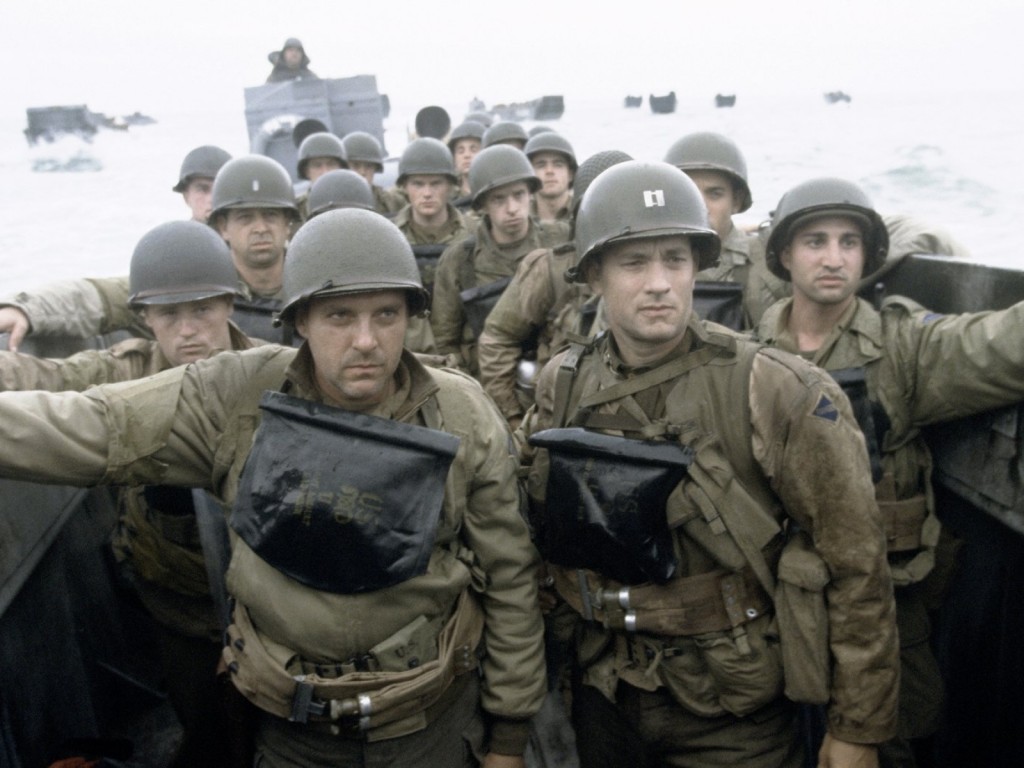
1. Saving Private Ryan
(1998)
General: Steven Spielberg
Conflict: World War II
What Saving Private Ryan does better than perhaps any movie not made during the silent film era is tell its story through action. Sure there's plenty of exposition in the name of character development, but it's the battle scenes that not only thrill us, they tell us what's going on. Of course, what's going on is the seemingly impossible extraction of one soldier, Private Ryan (Matt Damon) from the front lines of World War II after it is learned that his three brothers have all been killed. Damon is good, but as his commanding officer, Tom Hanks is great. It's some of his best work, in my opinion. The rest of the cast is also great and too numerous to name. And yes, the Omaha Beach scene that opens the movie is the most tense battle scene of them all.Some other great war movies (chronologically)...
Paths of Glory (1957)
The Battle of Algiers (1966)
Patton (1970)
Das Boot (1981)
A Soldier's Story (1984)
Platoon (1986)
Flags of Our Fathers/Letters from Iwo Jima (2006)
The Hurt Locker (2008)
Zero Dark Thirty (2012)
Friday, September 6, 2013

Thursday, August 30, 2012
Extremely Loud and Incredibly Close

Directed by Stephen Daldry.
2011. Rated PG-13, 129 minutes.
Cast:
Thomas Horn
Zoe Caldwell
Oskar (Horn) is a happy little boy who does everything with his father Thomas (Hanks). Much of their time together is spent on fanciful excursions like looking for New York’s “lost sixth borough.” Dad uses these to bolster the boy’s confidence and develop his social skills since it seems the boy suffers from some form of autism (the movie half-heartedly kinda sorta rules out Asperger’s Syndrome). The two get along swimmingly. However, bliss is not eternal and Thomas dies during the tragic events of 9/11. A year later, he finds a key his father had hidden in a vase. Oskar then embarks on his own expedition all over the Big Apple to find out what it unlocks.
Though we hardly see her, Oskar does have a mother. She’s played by an appropriately worn looking Sandra Bullock. Nearly every word she says is laced with a defeatist attitude. Neither she nor her son are taking her husband’s death well. Basically, she lies in bed while he traverses the city trying to dig up remnants of his dad. Eventually he gets some company on his daily treks from the old guy known only as The Renter (von Sydow). The Renter doesn’t talk but rents a room from Oskar’s grandmother who lives across the street.

There are some interesting things going on in Extremely Loud. Oskar encounters some interesting people on his travels. The relationship between he and the old man is endearing. All thanks for this is due to the wonderful Max von Sydow. He expresses so much without ever uttering a sound. His is a remarkable piece of work. A couple other performances also shine in the brief time they’re allotted. I’ll not divulge any further details as this may give too large a hint about the outcome.
As we inch nearer that outcome things fall apart. The movie becomes too transparent in its attempts to manipulate. It tries to play on our inherent sympathy for children and soon has Oskar bursting into tears every so often in hopes that we’ll do the same. Some of us will. For the rest of us, however, Oskar’s proven to be kind of a jerk. We’ve humored him out of sympathy for his quest, but we’re not ready to sob with him. To combat this, we’re next hit with a seriously contrived and overly gooey conclusion that somehow excuses mom’s highly questionable parenting tactics. It’s clearly meant to have us bawling at the notion of sweetness and enveloped by the warmth of closure. Instead, I merely felt violated as it kept trying to touch my sensitive areas without permission.
MY SCORE: 5/10
Tuesday, August 7, 2012
Larry Crowne

Directed by Tom Hanks.
2011. Rated PG-13, 99 minutes.
Cast:
Tom Hanks
Julia Roberts
Cedric the Entertainer
Bryan Cranston
George Takei
Pam Grier
Taraji P. Henson
Gugu Mbatha-Raw
Wilmer Valderrama
Rob Riggle
Nia Vardalos
Cast:
Tom Hanks
Julia Roberts
Cedric the Entertainer
Bryan Cranston
George Takei
Pam Grier
Taraji P. Henson
Gugu Mbatha-Raw
Wilmer Valderrama
Rob Riggle
Nia Vardalos
Our story starts with 50-something Larry Crowne (Hanks) losing his job at big-box store U-Mart. It’s an obvious downsizing move but he’s told that since he didn’t go to college he has virtually no chance for advancement within the company and it’s against policy to limit their employees in such a manner. That runs counter to what I’ve seen and experienced. Such people are a gold mine because they become experts at their jobs and the company has a built in excuse for not promoting them. This saves the company money since they don’t have to give that person a raise nor hire and train a new person to take their place, but I digress. With all of his newfound free time since he can’t find a job, Larry does indeed decide to go to college to keep this from happening to him in the future. Once there, he’s encouraged to take Speech 217 because it’s a life-changer. It doesn’t hurt that he’s given a huge hint that the instructor is hot. When he gets there, he agrees she’s hot. She is Mrs. Tainot (Roberts), pronounced Tay-no, she emphasizes. Note the Mrs. Prefix but understand her marriage sucks. We spend a good deal of time in her class.
Lest you go thinking Speech is his only class, we also spend lots of time with Larry in Econ 1, taught by Dr. Matsutani played by George Takei AKA Mr. Sulu. He pimps his book, laughs at his own jokes and confiscates Larry’s cell phone repeatedly. It’s an odd, somewhat creepy but still enjoyable performance. Before he gets to either class, Larry runs into Talia (Raw). She’s young, pretty and vibrant. She’s also capable of overrunning men in mere seconds, bringing to life the term “killing them with kindness.” Almost immediately after meeting Larry she changes everything about him: his wardrobe, his hair, the way his furniture is arranged, even his name. She insists upon calling him Lance because she thinks it fits him better. He’s so smitten, he lets it all happen. We’re told she has this effect on all men.

Most of the movie just trots by without much in the way of joy or pain. When I say trot, I should say prance because it is shamelessly bland. There are some exceptions, of course. We bristle, or at least I did, whenever Talia is busy recreating Larry. It’s like a horror movie with some happy-go-lucky psycho taking over your life. On the other hand, the scenes with Mr. (Cranston) and Mrs. Tainot are much more enjoyable. The story of their deteriorating marriage is an interesting subplot we’re tempted to try and separate from the rest of the movie. Their scenes are funny, melodramatic and infinitely more intriguing than anything else going on. It could possibly have made a nice dark comedy.
Alas, it is not to be. We’re stuck with Larry Crowne as is. It wants to have something deep to say about the economy but doesn’t. It wants to be an enthralling romantic comedy, but isn’t. Larry gets not one, but two “game-winning” moments that are anti-climactic to the point of being boring. Even the plucky neighbor routine is botched. Cedric the Entertainer and Taraji P. Henson play the happily married couple that lives next door to Larry and makes their living by having a yard sale every single day. Seriously. Ced is supposed to dispense sage advice and make us laugh as he haggles price on everything. Instead, he just says a lot and most of it is unfunny. As he’s running off at the mouth, Ms. Henson just hangs out in the background collecting a paycheck for doing nothing. Good for her, managing to get paid while participating in this mess as little as possible.
Monday, March 12, 2012
The Great Buck Howard

Directed by Sean McGinly.
2009. Rated PG, 90 minutes.
Cast:
John Malkovich
Colin Hanks
Emily Blunt
Ricky Jay
Steve Zahn
Adam Scott
Debra Monk
Tom Hanks
Matthew Gray Gubler
Cast:
John Malkovich
Colin Hanks
Emily Blunt
Ricky Jay
Steve Zahn
Adam Scott
Debra Monk
Tom Hanks
Matthew Gray Gubler
Mentalist Buck Howard (Malkovich) makes his living performing effects in small, dingy, rundown, half empty theaters all across the nation. He seems to think he’s a bigger star than he actually is. Once upon a time, he really was a big deal. As he’s quick to tell you, he appeared 61 times on “The Tonight Show” with Johnny Carson. He stresses the fact that it was with Carson and not Leno, whom he despises. He also stresses he’s a mentalist, not a magician. He despises them, also. If you couldn’t tell, Buck is rather insufferable. He’s arrogant, bossy and quick-tempered. Because he is “The Great” Buck Howard, we are somehow beneath him.
Young Troy Gable (Colin Hanks) has just dropped out of law school. He only went because it was his father’s dream for him. His father is played in a small role by Colin’s real life and more famous dad Tom Hanks. Law school made Troy miserable, so he’s trying to find his own way in life.
Troy gets hired to be Buck’s new road manager. The guy he’s replacing is supposed to train him but refuses after a big blowup with Buck. Along with Troy, we learn that big blowups are an almost daily occurrence in Buck’s world.

John Malkovich plays the role perfectly. We can see the patience for us mere mortals leaving his face when things aren’t going exactly according to plan. This, combined with the near constant ravings of a disillusioned man creates tension and comedy. Perhaps the best example of this is when one of his adoring fans (he does, in fact, have a loyal following) who happens to run one of the theaters he plays decides to do an impromptu introduction of him instead of using his pre-taped one. His reaction is priceless. He makes the movie fun to watch.
Despite all this, The Great Buck Howard is hardly about Buck Howard. It’s more about Troy and the lesson Buck teaches him. Thankfully, it does a good job of making us wait for that lesson. It also manages to transform the unlikeable Buck into a sympathetic figure. By the way, for fans of magicians…er…mentalists, Buck is loosely based on The Amazing Kreskin (google is your friend, here).
It’s not a comedy for most of the Hot Tub Time Machine crowd, but it is funny. The story is told well and provides us with plenty of ups and downs. Every time it seems he’s set things up perfectly to get his next big break, something goes wrong. Almost everytime, but I’ll say no more. Best of all and perhaps key to Buck as a character, try as we might, we never find out just how Buck Howard manages to be so great.
MY SCORE: 7.5/10
Tuesday, November 2, 2010
Toy Story 3

2010. Rated PG, 103 minutes.
Cast:
Tom Hanks
Tim Allen
Joan Cusack
Ned Beatty
Don Rickles
Estelle Harris
Jodi Benson
Michael Keaton
John Ratzenberger
Emily Hahn
John Morris
Now that Andy (Harris) is all grown up, Woody (Hanks), Buzz (Allen) and the rest of the gang try to come to grips with what their future may hold.
As expected, our heroes find themselves on another adventure. This time, their own self-worth and mortality may be in greater jeopardy than ever before. In keeping with franchise tradition, the world toys inhabit when humans aren't looking is a vibrant, fascinating place. The comedy works without feeling forced and the action sequences exude a palpable sense of danger. Particularly near the end, our dread and anticipation brings us to the edge of our seats.
Getting back to that comedy for a moment, the visuals and the back and forth between characters work hand in hand to make it go. Of course, Hanks and Allen continue to complement one another flawlessly. Barbie (Benson) and Ken (Keaton) have been added to the mix and their relationship provides some wonderful moments. There is also lots of mileage gotten by poking fun of Ken’s masculinity, or lack thereof.
What really brings it all home is Lotso (Beatty). His look, voice and backstory come together perfectly. Equally as perfect is the creepy, mostly silent Big Baby. His tattered mid-section and lazy eye look exactly like a doll my sister once had. That thing moving around on its own is just frightening. What’s so remarkable about that, is it just is where Chucky and other movie dolls had to try really hard to be.
Visually, without the aid of 3D (I saw it in 2D), it is still high quality Pixar, just not awe-inspiring. With an established template, there is only so much that can be done to the series without drastically altering the look we’ve come to expect and love. However, I will say humans seem to be better rendered, this time around.
Overall, this is a great way to extend, or end, the series. Unlike so many other sequels, it doesn’t fell like a money-grab, whether it is or not. It feels like the logical next chapter of a great book. With three outstanding entries, it firmly places itself among the best cinematic trilogies of all time. I would be hard pressed to keep it out of the top handful. Even better than that, there could logically be a TS4. Why yes, I’d be pumped for that, too.
MY SCORE: 10/10
Subscribe to:
Posts (Atom)