

Dell slaves over a hot Blu-ray player for the good of mankind.
Showing posts with label Boxing. Show all posts
Showing posts with label Boxing. Show all posts
Wednesday, May 31, 2017

Monday, June 13, 2016
Sunday, June 5, 2016

Wednesday, May 11, 2016

Monday, January 18, 2016

Friday, August 22, 2014

Wednesday, June 25, 2014
Million Dollar Baby

Directed by Clint Eastwood.
2004. Rated PG-13, 132 minutes.
Cast:
Hilary Swank
Clint Eastwood
Morgan Freeman
Jay Baruchel
Anthony Mackie
Brian F. O'Byrne
Margo Martindale
Michael Pena
Mike Colter
Lucia Rijker
Riki Lindhome
Maggie (Swank) has been boxing for a while and is looking for a trainer to help her learn the proper techniques and possibly take her to the big time. She walks into the gym owned by grizzled vet cut-man turned trainer Frankie Dunn (Eastwood). Dunn manages and trains Willie Jones (Colter), an up-and-coming fighter on the cusp of a title shot. The place is actually kept running by Eddie "Scrap Iron" Dupris (Freeman), Frank's bestest buddy. Frank tells Maggie he doesn't train girls and tries to ignore her. However, after Willie moves on to a new manager, and at Eddie's urging, Frank reluctantly takes her on.
Right from the beginning, Million Dollar Baby establishes that every relationship it depicts will be a battle of wills. The most prominent of these is that of Maggie and Frank. Frank is the immovable object trying to stave off Maggie's irresistible force. Irresistible being the key word. She is a big ball of warm and fuzzy. Frank is not. The differences don't end there. As a man whose been burned on numerous occasions by the sport he loves, Frank is overly cautious. His gruff exterior belies the fact he's deathly afraid of taking chances. this is something Maggie has no issues with. Being careful appears not to be in her nature. Consequences be damned, she's going after what she wants with both fists flying. It stems from her one true fear, ending up with a bushel of children and grandchildren while being dependent on welfare, like her mother (Martindale). I don't recall even a mention of her father. This makes seeking out Frank's expertise a matter of gravity, not logical thinking. Frank is similarly pulled. He sees qualities in her that he wishes he had. More importantly, she becomes a stand-in for his estranged daughter. Whatever happened in the past between he and his own child is something for which he desperately wants to atone. Maybe Maggie holds the key to his salvation. She is sure he holds the key to hers. It is their separate needs that binds them. However, Frank resists as best he can. This makes the exchanges between the two cinematic gold as each plays their role perfectly. Swank deservedly took home an Oscar for her work, here.

As I've alluded to, Frank and Maggie's battles is hardly the only one playing out before us. There is Frank and Willie, Frank and Eddie, and also Maggie against her own mother. Perhaps most intriguing, aside from the main event between our two leads, involves two seemingly expendable characters: Shawrelle (Mackie) and Danger (Baruchel). Shawrelle is a pro fighter who hasn't been terribly successful. Around the gym, though, he's a motor-mouthed bully. Danger is his exact opposite. He dreams of becoming a champion, but has no boxing ability whatsoever. He just hangs around the gym pantomiming his imaginary victory over fight legend Thomas Hearns. He's also Shawrelle's favorite target. On the surface, it's an extraneous, if fun, subplot. Juxtaposed with our protagonist, it becomes the breathing embodiment of the journey Maggie's spirit makes. The name Danger represents the arduous road she chooses to travel. They share highs and lows. her real life triumphs prove as fleeting as Danger's made up ones. Their defeats work in concert to illustrate the point Eddie makes to Danger after she suffers a very real and painful loss: "Anybody can lose one fight." This leads us back to Maggie. We know that she loses one fight. The question is does she lose the fight after that, as well. Whether she does isn't easily discerned. It could be argued both ways. Even if you accept her as victorious in the end, you know it's not an indisputable fact.
Eastwood's direction holds it all together in a tight package that never rushes, but also doesn't meander. It moves from setup to action to climax at a wonderful pace. the entire time it is pulling us deeper into Frank and Maggie's world. there is one little, but troubling plot hole for fight fans that might turn some off to the movie as a whole. It's the way our heroes first meet. Given all we're told of her skill level a short while later, it makes no sense. However, it's small enough that the removal and/or changing of just a few lines of dialogue would fix the issue. The bigger problem for those of us with a decent amount of boxing knowledge are the fight scenes. The choreography of them is just horrible in that all-too-Hollywood way. Each pugilist takes turns beating their opponent from one side of the ring to the other with seemingly endless successions of landed punches. Either that, or someone gets knocked in about five seconds. It just doesn't work like that. It's the one artificiality that snaps me out of the movie on several occasions. Thankfully, the narrative snags me from the brink of tuning out each time and swaddles me in layers of its fabric. Once we get beyond all the fight scenes, it never lets me go.
Wednesday, April 20, 2011
The Fighter

2010. Rated R, 115 minutes.
Cast:
Mark Wahlberg
Christian Bale
Amy Adams
Melissa Leo
Mickey O’Keefe
Jack McGee
Melissa McMeekin
Bianca Hunter
Frank Renzulli
Micky Ward (Wahlberg) has lost his last three fights and is at a crossroads in his professional boxing career. He is trained by his brother Dicky (Bale). Dicky is a local legend, having been a former fighter himself. He’s quick to tell anyone within earshot that he once knocked down Sugar Ray Leonard (who has a brief cameo as himself). Dicky is also extremely unreliable due to his addiction to crack. His pro career combined with his drug habit have brought him to the attention of cable network HBO. They have a camera following him around. He tells everyone they are making a documentary about his comeback, though he doesn’t seem to be working towards one. He is the center of attention, just the way he likes it. However, his demons threaten to sabotage his brother’s career.
Micky’s mom, Alice (Leo) also serves as his manager. She’s well meaning but not the best at either job. She’s often preoccupied with Dicky’s misadventures. With everyone except Dicky, she’s a domineering matriarch ruling her clan with an iron fist. In Dicky’s case, she’s a pushover. The entire family is this towards Dicky. This includes a litter of sisters. Micky’s dream of being a champion is in their hands.
The family dynamic plays itself on a loop in Micky’s life. He’s at the gym, ready to work, but his brother is nowhere to be found until hours after they were supposed to have started training. Alice gets him bad fights with little or no strategy for actually building his career. Micky’s father George (McGee) tries to be the voice of reason. He clearly sees that what’s going on isn’t benefiting his boy. Unfortunately, he’s always shouted down by Alice. Eventually, Micky has to fend for himself. More accurately, he has to have better people fend for him. When this starts to happen is when the family suspects there is a problem. How dare he go outside their numbers for support without him?
We watch this drama unfold in a fashion that feels excruciatingly real. This is where the power of The Fighter lies. We’re either a part of, or have known families exactly like this. If we’re a part of such a family, our empathy for Micky is boundless. If we’ve only know families like this, he has out sympathy. We wish we could save him. We root hard for Charlene (Adams) because she is obviously trying to do just that. We cheer her every action during her run-ins with Alice and the sisters.
Carrying out such a display of not always humane humanity requires great acting. This movie has it in spades. Much has been made of Christian Bale’s work as Dicky. It’s well deserved, he’s magnificent. However, it’s the battle of wills between Alice and Charlene that drives the movie. Leo and Adams each play their roles with undeniable conviction. Every rolling of the eyes, raising of the voice, expressing of concerns, swilling of a shot and puffing of a cigarette rings true. More than becoming familiar with them, we really know them. We know that they both feel they are right beyond a shadow of a doubt. In the lead, Wahlberg gives a perfectly subtle performance. When he finally explodes emotionally, it’s not some overly showy display of acting. It’s completely within the realm of how we think he would behave.
For the uninformed, this is based on a true story. I don’t think I’m spoiling anything by saying there is an eventual triumph. In this way, it’s much like hundreds of other sports movies. Rocky leaps to mind, for obvious reasons. So too, does Invincible, another Wahlberg flick and The Blind Side. They’re both football movies based on true stories. Those two are built one cliché after another until the inevitable feel-good finale. Invincible is more or less average in every way. The Blind Side has the benefit of a remarkable performance by Sandra Bullock. They both feel like a Hollywood version of what really happened, smoothed over and watered down. The Fighter utilizes many of the same conventions. Somehow though, it makes them feel much more real.
Sunday, December 26, 2010
Requiem for a Heavyweight

1962. Not Rated, 95 minutes.
Cast:
Anthony Quinn
Jackie Gleason
Mickey Rooney
Julie Harris
Stanley Adams
Val Avery
Herbie Faye
Muhammad Ali
Jack Dempsey
After 17 years in the ring and 111 fights, Mountain Rivera (Quinn) is a shot fighter. In his last fight, he takes a beating at the hands of one Cassius Clay, a very young Muhammad Ali playing himself even before his famous name-change. Rivera is left with damage to his left eye. It is enough that the doctor present at the arena tells his manager he won’t allow Mountain to fight ever again. His speech has become permanently slurred from all the pounding his head has taken. With that, almost no formal education and no skill beyond boxing, Rivera has to try to find his way in normal society.
Rivera’s manager, Maish (Gleason) is in deep to a bookie after a startling bet doesn’t pan out. Since his mule can no longer work, his mad quest to come up with the money he owes, and just what he owes it for, hangs over the proceedings.
Owing is a huge factor in everything that goes on. Just who owes who is the cause of much debate and the reason for many of the actions taken. When the film ends, the scale has been tilted to one side, but we’re saddened by the way in which this comes about. It’s odd that the person we come to hate the most gets a sort of come-uppance, yet we’re still not happy.
The movie weaves its way up to that amazing conclusion through a tapestry of great writing and outstanding performances. Strangely enough, it’s written by Rod Serling. To people of my age and older, that name is forever linked to The Twilight Zone, not hard-hitting human drama. At only 95 minutes, Requiem for a Heavyweight is wound tight as a drum, yet still lets us know these people intimately. We know what drives them, what scares them and what repels them. We have strong feelings about each of our four principals.
Our strongest feelings are reserved for Mountain. It seems his whole life has been spent being used to get what other people want. Even at this stage, he’s torn between two people who want very different things for and from him. What does he want for himself? That’s hard to say. Other than know what he doesn’t want, he seems to lack original thought. To pull this off, Anthony Quinn gives one of the best performances I’ve ever seen. His work here is pretty clearly a major inspiration for the way Sylvester Stallone would portray Rocky Balboa fourteen years later.
Much to their credit, Quinn’s supporting cast is never overshadowed. They, themselves, turn in powerful portrayals. Mickey Rooney (Army) is our mouthpiece. He says what we’re thinking with blunt honesty. Julie Harris (Ms. Miller) is Mountain’s possibly bright future, full of happiness and love. Then there’s Maish, played by the incomparable Jackie Gleason. I’ll just say he’s as brilliant as he always is and leave it at that.
The passage of time has given RfaH great irony. The easiest to spot is the cameo of Muhammad Ali, then known as Cassius Clay. He’s since become Mountain Rivera, in a physical sense. He was once so verbose and articulate that even in a post-ESPN, soundbite driven world his rantings and spontaneous verse remain among the most famous quotes in sports history. Yet, who really knows how many too many fights have robbed him and us of his vibrance, rendered him seemingly less than a shell of his former self. Luckily for Ali his legacy sustains him, both financially and in our mind’s eye. We’ll never forget him floating like a butterfly and stinging like a bee.
Mountain Rivera has no such luxuries. The game of boxing that he loves so much has robbed him of many possibilities outside the ring and keeps taking from him. How many boxers over the years have suffered the same fate? Many of them aren’t even as lucky as Rivera. He’s enjoyed a measure of success most never do. As he would proudly tell you, in 1952 they ranked him number five in the world.
Another fairly obvious irony is the fact that it’s a boxing movie with almost no boxing. It all takes place in the first few minutes. A greater irony is how this mirrors the entire sport today. There is much talk of boxing’s demise and very little actual boxing, at least on the biggest stages. Boxing’s speech is slurred, it’s movements no longer sharp as MMA has it on the ropes poised to deliver a knockout blow. It’s fighting for its survival, trying to make its way in a ready to move on without it, much like Mountain Rivera.
Sunday, December 19, 2010
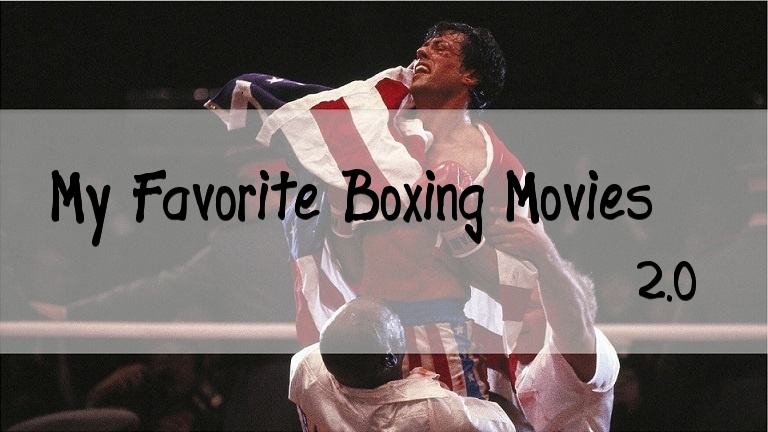
Favorite Boxing Movies

This weekend, one of the most hyped sports movies in recent memory has been released. That movie is The Fighter, starring Mark Wahlberg as former welterweight champ Mickey Ward. Though I haven’t seen it yet, I am anxious to. To me, boxing movies reign supreme in the genre of sports films. It seems that the folks who give out awards agree with me. The only two sports movies to ever win the Oscar for Best Picture were both about boxing. Don’t worry, I’ll name them as I get to them.
Truth told, none of these movies are truly about boxing. They’re about the triumphs and tragedies of an individual. They’re about one person trying to pull themselves up by their bootstraps which earns our vested interest in whether they succeed or fail. They’re about winning and losing, both in the ring and in life.
I haven’t seen every boxing movie. In fact, while researching this topic I found there are a great number of them I’ve missed. Therefore, this is not a comprehensive “Greatest” list, it’s a “Favorites” list. As in, of the dozens I’ve seen these are my favorites. Oh, and why 12 instead of the normal 10? When I was growing up, championship fights lasted 15 rounds. In an effort to make the sport safer that number was reduced to 12. Initially, I was going to do 15, here. However, in the interest of your safety I’ve limited myself to…
My 12 Favorite Boxing Movies
(Quick Key:
The Key
Promoter = the director
Fighter = the person starring as the boxer
Weight Class = Fighting weight class of the boxer)
12. The Hurricane (1999)
Fighter: Denzel Washington
Weight Class: Middleweight
Promoter: Norman Jewison[/size][/color]
Based on the life and times on middleweight contender Rubin “Hurricane” Carter, who was wrongly convicted of murder and the subsequent fight to prove his innocence. In the title role, Denzel Washington gives a fantastic performance that elevates the movie past other contenders. However, as good as he is, take away a point for him being much bigger than any middleweight.
11. Tyson (2008)
Fighter: Mike Tyson
Weight Class: Heavyweight
Promoter: James Toback
Former Heavyweight champion of the world, Mike Tyson basically psychoanalyzes himself. He displays the intelligence he’s hardly given credit for possessing. He also has some his own version of the truth and his sanity is very much in question. It’s hardly a traditional boxing movie but an intriguing watch, nonetheless.
10. Ali (2001)
Fighter: Will Smith
Weight Class: Heavyweight
Promoter: Michael Mann
Instead of trying to chronicle Muhammad Ali’s entire life, this focuses on the period between 1964 and 1974, culminating with his historic fight in Zaire against then unbeaten and menacing champ George Foreman. It’s probably the most underappreciated movie on the list. Audiences and critics alike were rather apathetic towards it. Still, Will Smith’s powerful portrayal of “The Greatest” garnered him an Oscar nomination for Best Actor.
9. Rocky II (1979)
Fighter: Sylvester Stallone
Weight Class: Heavyweight
Promoter: Sylvester Stallone
Somehow, people conveniently forget that in the original Rocky our hero didn’t actually win the big fight. This is the movie where Rocky actually turned the trick. When he finally does, we let out two movies worth of exhilaration. Thus, some have proclaimed this to be the best in the series. I disagree, but it’s a pretty clear cut second as the series took a sharp turn in tone and slathered on the cheese even heavier starting with Rocky III.
8. Cinderella Man (2005)
Fighter: Russell Crowe
Weight Class: Heavyweight
Promoter: Ron Howard
Here, we get a biopic on Heavyweight champ James J. Braddock. More than anything we watch him try to hold his family together through the Great Depression. Bills piled up and money stopped coming in, but through it all our champ remained a gentleman. Russell Crowe is as compelling as always. The only real knock is Braddock seemed a little too perfect. Still, it works.
7. Let’s Do it Again (1975)
Fighter: Jimmy Walker
Weight Class: Middleweight
Promoter: Sidney Poitier
This is the most unique movie on the list. It’s the only comedy and the fighter has little to do with our enjoyment of the film. That fighter is super scrawny Bootney Farnsworth played by Jimmy Walker, better known as J. J. from Good Times. It’s really about a couple guys pulling a con on a pair of gangsters to raise funds for their lodge. Those two guys are played brilliantly by the one of the 1970s greatest comedic duos, Bill Cosby and Sidney Poitier. As for our champ, well, let’s just say the power of positive thinking is taken to new heights. Hip Hop culture owes this movie a debt, as well. One of the gangsters is named Biggie Smalls, the original and still more popular moniker the late MC, The Notorious B.I.G.
6. Unforgivable Blackness: The Rise and Fall of Jack Johnson (2004)
Fighter: Jack Johnson
Weight Class: Heavyweight
Promoter: Ken Burns
Ken Burns’ epic documentary on the first Black Heavyweight champion of the world, Jack Johnson, is a sprawling, enthralling masterpiece. It’s the only movie here that might not qualify as such. It originally aired in two parts on separate nights on PBS and totals about four hours making it a made-for-TV flick, at best. That’s okay. Quality transcends medium. Through Johnson, we get a palpable sense of the political and racial climate of the late 19th and early 20th century and we get to see a man who, for the most part, embodied a song Frank Sinatra would make decades later: “I Did it My Way”.
5. Million Dollar Baby (2004)
Fighter: Hilary Swank
Weight Class: Welterweight
Promoter: Clint Eastwood
One day, a fighter walks into Frank’s gym asking to be trained by him in hopes of one day winning a title. First off, the fighter’s already 31 years old. The bigger problem: the fighter is a woman. Frank refuses, but she keeps coming back until he relents. From there, we get a fantastic boxing movie. Along with Swank as our champ, Maggie, and Clint bringing his usual gruffness to his role as Frank, we get a great supporting turn from Morgan Freeman. In case you’ve forgotten, this is one of only two sports movies to ever win an Oscar for Best Picture. It’s only movie featuring a female to make this list.
4. When We Were Kings (1996)
Fighter: Muhammad Ali
Weight Class: Heavyweight
Promoter: Leon Gast
Back when he was young enough to do so, Muhammad Ali played himself in the autobiographic film The Greatest. It’s a solid movie in its own right that culminates with the champs win over George Foreman. Years later, Will Smith would play Ali in the movie of the same title and earn an Oscar nod for doing so. That movie also ended after the Foreman fight. Between the two is this documentary that takes us much deeper inside the making of that legendary fight. We see Ali realize that he is, and comfortably step into the role of an international figure. Meanwhile, Foreman struggles with having the cloak of a villain practically forced upon him. It’s a spectacular piece of work.
3. Requiem for a Heavyweight (1964)
Fighter: Anthony Quinn
Weight Class: Heavyweight
Promoter: Ralph Nelson
After taking a beating at the hands of Cassius Clay, a young Ali playing himself in a cameo (he’s all over this list), Mountain Rivera finds out that was his last fight. Damage to his eye has caused the doctor in attendance to forbid him to fight any longer. He’s been a fighter for 17 years, that’s all he knows. We watch him struggle to make his way in the world while the people close to him tug him in different directions. It’s a heart-breaking picture that’s just perfect all the way through, including the wonderful performance of Anthony Quinn as Mountain.
2. Rocky (1976)
Fighter: Sylvester Stallone
Weight Class: Heavyweight
Promoter: John G. Avildsen
This is where we first meet and fall in love with Rocky Balboa. At this point, he’s not even a has-been, he’s a never-was fighter trying to make ends meet on the mean streets in Philly. He lucks into a shot at the heavyweight title when the guy scheduled to fight the champ breaks his hand. From there, we get arguably the most imitated movie in history. Hundreds, if not thousands of movies have followed its template and not all of them are sports movie. For creating something so iconic, Sylvester Stallone never gets enough credit. After so many sequels and so many other not nearly as thoughtful movies, we forget that Stallone didn’t just play Rocky, he created the character and wrote the screenplay. Oh yeah, this was the first sports movie to take home the Oscar for Best Picture.

1. Raging Bull (1980)
Fighter: Jake La Motta
Weight Class: Middleweight
Promoter: Martin Scorcese
Former middleweight champ Jake La Motta has far more in common with Mike Tyson than Rocky. He pretty much defines “self-destructive.” He’s also destructive to those around him, too. He views them all like they’re his opponents, wary of every move they make, fearing they’re trying to land the knock out blow. He treats them as such and it costs him big. Here is a brutal movie about a brutal man in a brutal sport. To bring Jake to life, Robert De Niro gives what might be the best performance of his career. This didn’t win Best Picture, but it should’ve in my opinion. C’mon Academy! Ordinary People? For my money, this is the best sports movie ever made.
Other Contenders:
The Great White Hope (1970)
The Champ (1979)
Rocky IV (1985)
The Great White Hype (1996)
Resurrecting the Champ (2007)
Facing Ali (2009)
Monday, June 21, 2010
Facing Ali

2009. Rated R, 100 minutes.
Cast:
Ron Lyle
George Foreman
Joe Frazier
George Chuvalo
Sir Henry Cooper
Ken Norton
Earnie Shavers
Larry Holmes
Leon Spinks
Ernie Terrell
Former boxers discuss their experiences during and surrounding their fights with Muhammad Ali. Though it amounts to little more than a love letter, there is still lots of insight to be gained. Most of the fighters talk about the technique they used against Ali as well as what he did to them. They also talk about the circus atmosphere he often created before fights and how their bouts with him impacted their lives going forward. His stance against the Vietnam War is also a big topic of conversation since it is a large part of the Ali legend.
Three men dominate the proceedings, and rightfully so. George Chuvalo is the most intriguing. He doesn’t just kiss up to Ali. He very matter of factly tells us what he likes and dislikes about the champ. He also tells stories of how certain fights came about or turned out. Of course, the infamous “phantom punch” that floored Sonny Liston is Ali’s second fight with him is a big sticking point with him. Whether you believe him, or not, Chuvalo comes across as giving a first-hand account of the shadowy side of boxing history. He also seems to be the healthiest of the battle-worn bunch.
No less clear-headed is Ron Lyle. He has a certain intensity in his gaze and speech that make you listen. He’s also keenly aware and appreciative of the fact that his place in boxing history is based on the fact he gave Ali a tough fight.
All of the fighters are interesting, in their own way. However, it’s the last fighter we meet, Leon Spinks that lifts us from the seemingly endless streams of deadpan seriousness. Nevermind that his speech is so raspy and occasionally garbled the filmmakers saw fit to put up subtitles when he spoke (the same goes for Ken Norton, by the way). He’s so obviously excited to be doing an interview, he infectiously heightens our spirits. He’s unfiltered and honest, not only when he says that Ali was his idol growing up, but also when he says he never understood why it was so important for Ali to change his name from Cassius Clay. He even mocks many in the black community who followed suit when Ali announced his faith and new moniker. Spinks also drops in four-letter words, broad smiles and hearty laughter. He just feels natural.
Overall, this is great for boxing buffs and Ali aficionados. If you’re neither and didn’t grow up during the sixties or seventies, it may not hold much weight for you. I did, it does for me.
Subscribe to:
Posts (Atom)