

Dell slaves over a hot Blu-ray player for the good of mankind.
Showing posts with label Philip Seymour Hoffman. Show all posts
Showing posts with label Philip Seymour Hoffman. Show all posts
Monday, July 27, 2015

Wednesday, April 15, 2015

Friday, April 25, 2014
The Hunger Games: Catching Fire

Directed by Francis Lawrence.
2013. Rated PG-13, 146 minutes.
Cast:
Katniss (Lawrence) and Peeta (Hutcherson) are the darlings of the twelve districts after winning the most recent Hunger Games in rather unconventional fashion. President Snow (Sutherland) is quite pissed about it. After all, it was their suddenly blooming love that forced the games to end in such an unorthodox fashion, leaving him and the Capitol looking a bit foolish. This wouldn't be quite so bad if his instincts didn't tell him, correctly, that their relationship is a fraud. He tells Katniss they better play nice for the cameras for the rest of their lives or heads will most definitely, and literally, roll. Those heads belong to her family and friends, of course. Since even that doesn't squash her defiant personality, and the people have made her a symbol of hope, President Snow changes the rules, putting her and Peeta into the next year's games. Their competition this time is made up of prior winners.
One of the things this movie does better than its predecessor is get to the point. That first flick took forever to actually get to the Hunger Games. I understand that in the first movie of a franchise, the setup typically does take longer than it does in sequels. However, in that first flick, it feels unnecessarily long. Like a dog dragging a broken leg, it limped along slowly while we watched Katniss is wardrobe, practicing, and being a talk show guest. Repeatedly. Thankfully, we spend much less time in talk show mode. Generally speaking, I love watching Stanley Tucci perform. In this series, as the host of said talk show, he's just an annoyance. I understand what is trying to be accomplished with this character. It's just not working for me.

Tucci aside, another plus for Catching Fire is the acting of its supporting cast. This more mature group gives us more interesting characters and better portrayals of them. The two standouts being Jeffrey Wright and Jena Malone. Malone gives us someone we're not sure how to take. Wright does what he normally does and disappears into his character. Another newcomer, the late Philip Seymour Hoffman, is his usual excellent self as the Game Master. Among the returnees, Woody Harrelson and Donald Suther land are again very fun to watch. Surprisingy, so is Elizabeth Banks, once more in full drag-queen regalia.
Unfortunately, once we get to the games, it's the stretches between action where this movie, and the series as a whole, continues to fail. These are the times when Katniss and her allies plot the next move and get to know each other a little better. It should also be the time during which the tension is building until that next burst of excitement releases it. Instead, that tension dissipates as the scenes drag on, trying and failing, to establish emotional bonds between the characters. Part of this is due to Katniss herself. We know she cares about her friends and family. However, she comes across so coldly to everyone else that no one else's plight seems to resonate with her until it becomes an imminent part of her own survival. In other words, if she doesn't really care about them until the very moment her life depends on their ability, why should we?
Finally, where the first movie positions itself as social commentary, Catching Fire seems to lack any such aspirations. This is partly due to it being the second movie of what we know will be a quadrilogy. What it is trying to say may become more transparent after subsequent installments are released. No, I didn't read the books and please, do not explain it to me. Another reason is this movie's focus on being a "bigger" movie than its predecessor. It does more, but says less. Still, it is the doing more that makes this a more enjoyable movie than its predecessor. By breezing through the setup quicker, we get a more concise effort, even though it's actually a few minutes longer than the first film. We still hit some snags, but fans of the first should be pleased.
Monday, February 3, 2014
R.I.P. Philip Seymour Hoffman

1967-2014
Unfortunately, we have to bid farewell to another one. This time, the great Philip Seymour Hoffman has left us prematurely. He was not a household name, but a household face. People who watch an average number of movies have seen him in something. This is no surprise since imdb.com gives him 62 cinematic credits (plus one TV show). More people learned his name this past summer as he became part of the Hunger Games franchise. His arrow was pointed up.
Those of us who call ourselves movie buffs know that Hoffman was no mere character actor popping up with bit roles in a lot of films. He was a master thespian, one of the finest actors of his generation. He won an Oscar and a Golden Globe for playing the titular role in 2005's Capote. He was also nominated for three other Oscars during his career.
Of those 62 movies he made, I've personally seen about a third of them. In nearly every one of them, he stood out to me as giving an enjoyable performance. This is true even in the films I didn't enjoy. For instance, take Synecdoche, New York. Lots of people love this movie. I could launch into a diatribe about why I hate it, but that's beside the point. The point is he was brilliant in the lead role. For that reason, I always look forward to seeing movies in which he is cast. Since starting this blog, I've reviewed a number of his movies and in most of them, I speak glowingly about his work. Click here to read my reviews of his work.
So long, friend Philip. You will be missed.
Sunday, November 3, 2013
A Late Quartet

Directed by Yaron Zilberman.
2012. Rated R, 106 minutes.
Cast:
Mark Ivanir
Liraz Charhi
Wallace Shawn
The Fugue is a highly successful string quartet that has
been playing together for twenty-five years. They are led by David (Ivanir),
the first violinist and an uncompromising perfectionist. Robert (Hoffman), the
second violinist is married to viola player Juliette (Keener). This seemingly
perfect square is completed by Peter (Walken), the cellist and elder statesmen.
We meet them as they’re getting ready for the start of their next season. Peter
realizes he isn't quite right and soon learns he is in the early stages of
Parkinson’s. As he contemplates his predicament, his illness becomes the
impetus for the lives of these people and their group to start coming apart at
the seams.
These are people who have intently studied every note of the
classical music they play. No subtlety or idiosyncrasy of its composers has
gone unnoticed. Fittingly, the story we’re told is very nuanced. It starts with
the double-edged dialogue spread throughout. The characters, especially Peter,
will occasionally spout little anecdotes about their lives that work on the
literal level by being amusing. Subcutaneously, they function as clever
analogies for what’s taking place on screen. The tricky part, which A
Late Quartet masters, is they don’t tell us what’s about to happen.
Instead, these tales present us a way of looking at the various situations that
informs our viewing.
Of course, we run into some predictable plot points along
the way. Thankfully, the movie deals with them in often unconventional ways.
However, it’s not doing this just for the sake of being creative, or
contrarian. They culminate in scenes that feel wholly organic to the
situations, forgoing many of the contrivances of other movies. This fosters the
notion we’re watching real people go through difficult times.
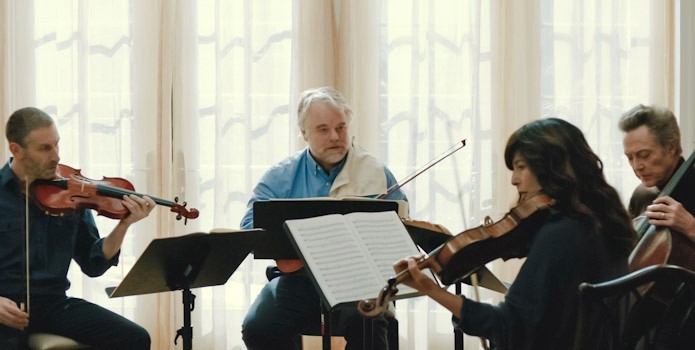
Also helping us believe in what we’re seeing is a phenomenal
cast. Among our four principals, plus Poots as Robert’s and Juliette’s daughter
Alex, there isn't a false chord struck. I’m a hug fan of Philip Seymour Hoffman
so it’s no surprise I find him to be great here. I will note that for some
reason I haven’t figure out yet, he wears his wedding band on his right hand
for the entire movie. Mistake or metaphor? Catherine Keener plays a woman
caught in the middle of multiple dilemmas. Still, it never feels like she’s
overwhelmed despite the fact all of these are potentially earth shattering.
Keener does a wonderful job conveying this. Perhaps most impressive of them all
is Christopher Walken. For starters, he steers clear of giving us the usual
Christopher Walken shtick. Admittedly, it’s served him well in many roles
including the recent Seven Psychopaths. The absence of it
works here. He really gives a poignant performance in what is ultimately a
heart-breaking storyline.
While I see Walken’s storyline as a sad one, it’s debatable
whether it’s totally so. That’s because it sets the stage for the others to
possibly end happy. Whether any of them are or are not is open to
interpretation. This is good. It leaves us something to discuss. There is
ammunition for both sides of the argument. It gives us this ammo in a way that
is not confusing, but fun to analyze.
As much as I like this movie, it isn't for everyone. It is
not the type of film that throws us into deep waters as soon as possible. We
wade in, slowly at first, and gain momentum as time passes. Even so, this is a
drama absent much of the over the top histrionics found in plenty other
pictures. Your “movie night” crowd might find it boring, especially if it is
made up of viewers with middle age still over their horizons. This is a movie
about adults with no illusions of youth who’s adventure is born of the anxiety
of breaking their decades long routines.
Thursday, September 12, 2013
The Dellies - 2012 Best Supporting Actor
For me, this next category is probably the toughest. So much great work was turned in by guys portraying secondary characters. Whittling it down to five nominees proved a difficult task, one that makes me begrudgingly admit The Academy almost got right. Almost. With that tantalizing tease, let's move on to...
2012 - Best Supporting Actor
The Real Nominees: Alan Arkin (Argo), Robert DeNiro (Silver Linings Playbook), Tommy Lee Jones (Lincoln), Philip Seymour Hoffman (The Master), Christoph Waltz (Django Unchained)
My Nominees:

Alan Arkin, Argo
In Argo, Alan Arkin is particularly exceptional. He can proudly add this to a long list of fine supporting roles.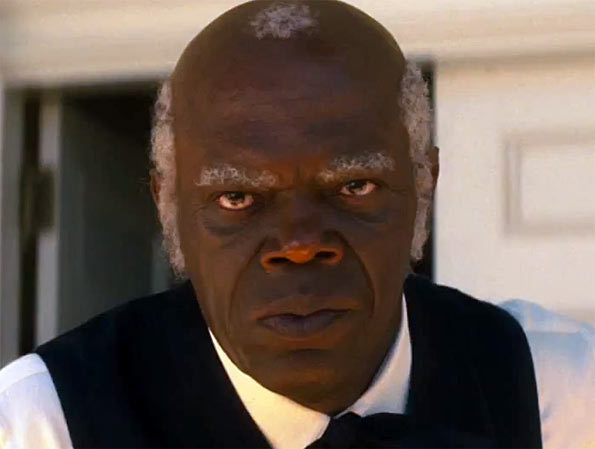
Samuel L. Jackson, Django Unchained
Jackson breathes an unbelievable amount of life into his character. He is funny, conniving, deliciously evil, and perhaps the smartest person in the movie.

Tommy Lee Jones, Lincoln
When neither Daniel Day-Lewis nor Sally Field are on the screen, the movie is carried by a magnificent Tommy Lee Jones who give his most inspired performance in years.
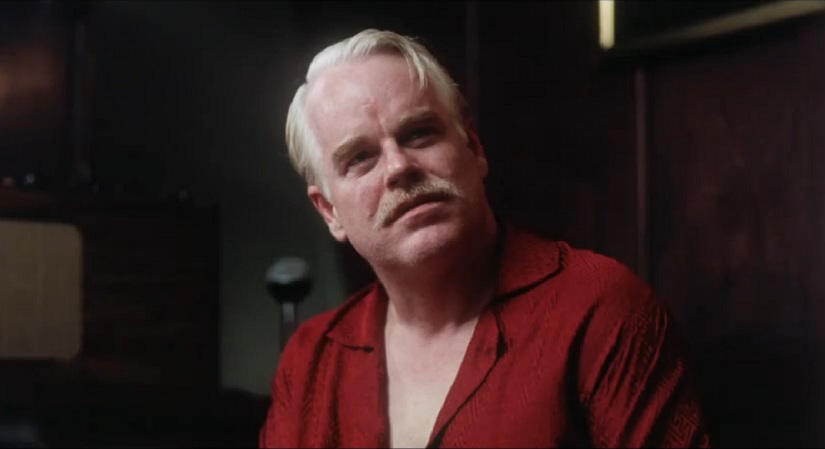
Philip Seymour Hoffman, The Master
Hoffman is perfectly charismatic as the leader of a budding way of thought, no matter how out there it may be. In an exemplary manner, he pulls off his character’s ability to instantly adapt his explanations to most lines of questioning and knack for shouting down anyone not persuaded by his answers.

Christoph Waltz, Django Unchained
Christoph Waltz switches sides of the coin, going from playing the unapologetic villain in Inglourious Basterds to a kinder, gentler man in Django Unchained, albeit one still capable of mowing down whoever stands in his way. He gives a moustache twirlingly fun performance.
Honorable Mention:
Robert DeNiro, Silver Linings Playbook
Leonardo DiCaprio, Django Unchained
Jeremy Irons, The Words
Jude Law, Rise of the Guardians
Ezra Miller, The Perks of Being a Wallflower
Hugo Weaving, Cloud Atlas
The Real Winner: Christoph Waltz, Django Unchained
And My Winner Is...

Samuel L. Jackson, Django Unchained
The portrayal I thought was best of all in a movie filled with great ones is that of Samuel L. Jackson. Every word he says, every movement of his body and shift of his eyes feels true. It’s nothing less than masterful.Monday, July 22, 2013
The Master

Directed by Paul Thomas
Anderson.
2012. Rated R, 143 minutes.
Cast:
Joaquin Phoenix
Ambyr Childers
Jesse Plemons
Rami Malek
Madisen Beaty
Lena Endre
Kevin J. O’Connor
Amy Ferguson
Joshua Close
Patty McCormack
Right away we come to understand that Freddie Quell (Phoenix) is a tad off. After serving in
World War II, reintegrating into normal society has been an issue for him. Our
natural inclination to sympathize with veterans is tested because we get the
sense he wasn't wrapped too tight even before the war. And he’s overly obsessed
with two things: getting drunk and getting laid. He manages the former
practically every night; the latter, not at all.
One drunken night, Freddie wanders into the circle of
Lancaster Dodd (Hoffman), AKA The Master to his followers. He’s written a book,
teaches cryptic lessons and performs strange rituals to enlighten us all. In
effect, he’s started his own religion which many would call a cult. From
everything I've read, the guy is based on Scientology founder L. Ron Hubbard. Makes
sense. Anyhoo, he takes a shine to Freddie and begins “processing,” or
indoctrinating him into “The Cause.” We spend the rest of the movie watching
The Master try to tame this particularly wild beast.
Charges of fraud and other improprieties against Dodd happen
from time to time. We also wonder how much control over The Master his wife
Peggy (Adams) has. These things are interesting, but neither holds our
attention like the battle of wills waged by The Master and Freddie. Therefore, our
enjoyment of this film is derived almost entirely from the dynamics between the
two men. The only other thing that really perks us up is the same battle of
wills Freddie is fighting with himself. If he simply can’t control himself, how
does Dodd ever hope to?
Facilitating our intrigue, we get a pair of wonderful
performances from Hoffman and Phoenix. Hoffman is perfectly charismatic as the
leader of a budding way of thought, no matter how out there it may be. In an
exemplary manner, he pulls off his character’s ability to instantly adapt his
explanations to most lines of questioning and knack for shouting down anyone
not persuaded by his answers. The work Phoenix turns in is flat amazing. From
the start, he fully embodies this raging man-child who is understanding of
little more than pleasure and pain. In any year in which Daniel Day-Lewis
hadn't convinced people he was actually Abraham Lincoln, Phoenix may very well
have walked off with the Oscar that he was nominated for.

Unfortunately, deciphering what we’re supposed to take from this movie is no easy task. As it rolls along, it seems to be peeling back Dodd’s many fraudulent layers, but it never follows through in any tangible way. Most notably, Dodd’s own son is presented as a non-believer, but nothing is ever done with this once we learn it. The young man just keeps going along with the program while wearing a pissed off look on his face. It might also be an examination of Freddie’s sanity, or lack thereof. Much of the film at least hints at that idea, while two scenes in particular intently focus on it. Well, maybe. The first includes a party where many of the followers are happily playing music, clapping and dancing while the very drunk Dodd sings a tune. It so happens that all the women are standing around naked. It’s shown as if this may only be Freddie’s perspective on things. However, it’s also followed by a rather strange moment between Dodd and Peggy that suggests otherwise. Later, the rather lengthy “window to the wall” scene shows that poor sap Freddie cracking up while made to walk repeatedly from one end of a room to the other. Then again, it’s more likely this is just to showcase Dodd trying to break him as he attempts on numerous occasions. It’s also entirely possible that, as the ending suggests, this is all about Freddie’s quest to get a woman into bed and just how intricately tied to his happiness the success of this mission is. Therefore, when The Master ends we may be hit by a wave of confusion as we wonder what we just watched. In this case, that’s a good thing. We have much to talk about.
Whatever it is, Paul Thomas Anderson directs it in a manner
that makes it difficult to look away from. The shots are beautiful and, as
stated, Hoffman and Phoenix command the screen. Many of their scenes together
are scintillating. The director brings this out with excellent story-telling
skills. Some people will take issue with the story he’s telling, or more
specifically, they’ll wonder what the story is about.
Tuesday, June 11, 2013
Synecdoche, New York

Directed by Charlie Kaufman.
2008. Rated R, 124 minutes.
Cast:
Philip Seymour Hoffman
Samantha Morton
Michelle Williams
Catherine Keener
Tom Noonan
Jennifer Jason Leigh
Hope Davis
2008. Rated R, 124 minutes.
Cast:
Philip Seymour Hoffman
Samantha Morton
Michelle Williams
Catherine Keener
Tom Noonan
Jennifer Jason Leigh
Hope Davis
Caden (Hoffman) is a theater director who’s life is quite
literally falling apart. After winning a prestigious grant he sets out to
create the play of all plays using what eventually becomes a life-sized model
of New York . Director/writer Charlie Kaufman is also the man who
wrote Being John Malkovich and Eternal Sunshine of the Spotless
Mind and this is similarly odd in execution. We also get treated to another
great performance by Philip Seymour Hoffman. However, I must admit I’m a big
fan of his. I’d probably enjoy him reading the phone book. Michelle Williams
also does an excellent job as Caden’s second wife Claire, as does Tom Noonan as
Sam, who gets hired to portray Caden in the play. Oh, and kudos to Kaufman for
using women in his cast that look like, well, real women.
The problem is the movie is made up of metaphor upon metaphor upon metaphor
upon…you get the point. What the directors (both the real one and his fictional
counterpart) are trying to do is fairly simple but the method is ridiculously
convoluted. Any tangible ideas are buried beneath mounds of symbolism. It’s a
classic example of why great writers shouldn't necessarily direct their own screenplays.
With no one to rein him in, it seems he took every “deep” idea that he had and
threw it up on the screen. To top it all off, he completely failed with all
those “real” looking women. The very basic question is why on Earth would
seemingly every woman he comes into contact with, except first wife Adele (Keener),
be madly in love with or be sexually attracted to this guy? Not only is he
coming apart at the seams, both physically and emotionally, everyone can
plainly see that he is. He's rather repulsive and doesn't exactly ooze sex appeal. Finally, I’m going to need someone smarter than me
to explain the constant fire in Hazel’s (Morton) house.
Fans of the aforementioned Being John Malkovich and Eternal Sunshine of the Spotless Mind should give this a look. The truth is, even though I’m a big fan of both those movies maybe I just didn't get this one. You might, and hail it a great artistic achievement. For the rest of us, not so much. It’s definitely original and quirky, but often frustrating to watch.
Friday, May 11, 2012
The Ides of March

Directed by George Clooney.
2011. Rated R, 101 minutes.
Cast:
Ryan Gosling
George Clooney
Philip Seymour Hoffman
Paul Giamatti
Marisa Tomei
Evan Rachel Wood
Jeffrey Wright
Max Minghella
Michael Mantell
Cast:
Ryan Gosling
George Clooney
Philip Seymour Hoffman
Paul Giamatti
Marisa Tomei
Evan Rachel Wood
Jeffrey Wright
Max Minghella
Michael Mantell
Stephen (Gosling) is a young hotshot in the world of campaign managing. He’s trying to help Governor Mike Morris (Clooney) win the presidential nomination of the Democrats. At this task he’s second in command to Paul (Hoffman). Together, they work against the force of evil known as Duffy (Giamatti) who manages their opponent’s campaign. The reason they get to be the good guys is because their candidate is not just a good guy, he’s a great guy. Even Duffy acknowledges this on several occasions. Stephen is so smitten, he’s sure the governor will “take back the world” should he become commander-in-chief.
Don’t worry, things aren’t all so black and white. A major conflict in the story is whether or not our young jedi will turn to the dark side. After all, you’re not really good at your job if no one else wants to hire you. Of course, there’s also a love story. Or, is it a lust story? Either way, like the rest of the movie, things start innocently enough and eventually get very messy.

Many of us are jaded enough to believe there are no heroes in politics, only villains. We think the people in all aspects of the game are all relentlessly pursuing their own best interests under the guise of working for the betterment of society. They’re constantly hiding things because they need us to believe the words coming out of their mouths. Their livelihood depends on it. Never is this more true than in a presidential election year. Jobs are won and lost. Fame and infamy are gained. The direction of the nation is swayed. This is true whether we’re talking about the politicians themselves, the people who run and work for their campaigns or the journalists who cover them. The Ides of March drags us into the muck with fantastic results.
Monday, January 30, 2012

Sunday, May 15, 2011
Mary and Max

Directed by Adam Elliot.
2009. Rated PG, 80 minutes.
Cast:
Toni Collette
Philip Seymour Hoffman
Eric Bana
Bethany Whitmore
Barry Humphries
Renée Geyer
Ian “Molly” Meldrum
Mary Daisy Dinkle (Whitmore/Collette) is an eight year old girl living in Australia in the 1970s and is often left to her own devices. She develops lots of hobbies, eats lots of condensed milk straight from the can and watches lots of her favorite show, “The Noblets.” Unfortunately, her mom is drunk most of the time, her dad is usually at working or enjoying his own hobbies in the shed and Mary has no other friends. To change this, she decides to get a pen pal. To decide who the lucky, unsuspecting person will be, she randomly picks a name out of a New York City phone book. That name is Max Horowitz. She eagerly writes the first letter and mails it off.
Max is 44 years old, lives alone in New York and in many ways, is child-like. Like Mary, he spends lots of time eating his favorite food, in his case chocolate, and watching “The Noblets.” He also attends “Overeaters Anonymous” meetings and plays the lottery ever day, always the same number. When he receives Mary’s letter he’s taken aback, at first. Soon, he musters enough courage to return the gesture.
The pair continue to exchange the letters for the next three decades, through all the ups and downs of their lives. This long distance relationship frames their existnces, eventually coming to define them. Through the letters, they get to know each other in ways most people don’t. They truly become friends. The welcome side-effect is that we get to know them intimately, as well. They become our friends. We’re happy when they’re happy. We hurt when they do. A key moment comes when we find out that Max indeed has a diagnosed mental disability. However, this isn’t revealed to draw our sympathy. The real value is showing what effect this has on Mary. The heights and depths of her adult life seem to all stem from knowledge of Max’s affliction.
The question we desperately want answered is will they ever meet face to face? How this plays out is a brilliant and touching piece of film making. It’s not something we arrive upon easily, either. It’s truly a moment many years in the making. If you’re prone to crying at movies, keep the tissue handy. If you’re looking for hyperkinetic action, toilet humor and talking animal sidekicks, you’re in the wrong place. If you want to see two fabulously intertwined character studies, stay.
Friday, July 2, 2010
Pirate Radio

2009. Rated R, 116 minutes.
Cast:
Tom Sturridge
Philip Seymour Hoffman
Bill Nighy
Kenneth Branagh
Nick Frost
Rhys Itans
Tom Brooke
January Jones
Chris O’Dowd
Emma Thompson
In 1966, rock and roll has become extremely popular. However, British radio refuses to play it, except for a handful of pirate radio stations located off the coast and broadcasting from the North Sea. None too pleased, the British government feverishly searches for a way to shut them down.
We hunker down with the crew of Radio Rock. There ship is run pretty loosely by Quentin (Nighy). He oversees the group’s lifestyle of sex, drugs and rock and roll. Our tour guide is Carl (Sturridge) who’s just been expelled from school. His mother (Thompson) has sent him to live on the boat, presumably to help straighten him out. As Quentin says, it is a “spectacular mistake.”
Mostly through Carl’s eyes we watch the group of disc jockeys lead an insane existence. It’s often very funny, sometimes sad and occasionally too ridiculous for words. No matter what the mood, music is always there to echo the sentiment. Music, more specifically bringing rock and roll to the masses, is their only care in the world. The folks making the movie care about the music, also. They did a great job piecing together the soundtrack and using songs in appropriate places.
Pretty much from top to bottom, the performances are outstanding. Bill Nighy seems to be having more fun than he has in years. Philip Seymour Hoffman is great, as usual, as the lone American DJ, The Count. For my money, the man who steals the show is Nick Frost as Big Dave. Dave is one of those guys who everyone seems to love to be around but not necessarily to really be friends with. We also discover Dave has a way with the ladies, despite his girth.
The camera work is interesting as well. Whenever we’re focused on the politicians aiming to shut Radio Rock down, everything is shot in an unnoticeably normal manner. Those scenes usually start with the exterior of some impressive building before venturing inside. The camera is usually stock still, rigid as if it were a government agent, too. On the boat, the camera is often closer to the people and slightly askew. This mirrors our heroes, packed tight and rebellious. It’s a subtle reminder of rock and roll’s roots and struggles.
The end of the movie is a bit overblown, but still effective. It should be taken more as a metaphor than a literal occurrence. When we reach the climax, we realize we’ve seen two coming of age stories, Carl’s and rock and roll’s.
Subscribe to:
Posts (Atom)