

Dell slaves over a hot Blu-ray player for the good of mankind.
Showing posts with label Nate Parker. Show all posts
Showing posts with label Nate Parker. Show all posts
Monday, November 28, 2016

Wednesday, April 1, 2015

Wednesday, November 5, 2014
Ain't Them Bodies Saints

Directed by David Lowery.
2013. Rated R, 96 minutes.
Cast:
Rooney Mara
Casey Affleck
Ben Foster
Nate Parker
Rami Malek
Keith Carradine
Charles Baker
Will Beinbrink
Annalee Jefferies
Ruth (Mara) and Bob (Affleck) are a modern day Bonnie and Clyde. They find themselves trapped in a house with one other guy who won't make it past this scene and engaged in a shootout with the law. Before going out in a hail of bullets, they decide to surrender. Since, Ruth is pregnant with their child, they agree that Bob will take all the blame. He goes off to jail and she starts living clean so she can raise their daughter. Fast-forward five years. Ruth and the child, now a little over four, have settled into a nice, quiet life. Every now and again, Bob's arresting officer Patrick (Foster) comes around to check on her. He seems to have taken a shine to her, but doesn't push the issue. The entire world is flipped upside down when news hits that Bob has escaped from prison. Thanks to the million and one love letters he wrote while incarcerated, there's no doubt in anyone's mind that he's going to try and reunite his family. The manhunt to keep that from happening ensues.
After opening with a burst of action, the movie settles into a languid pace. The idea is for us to see the growth in the relationship between Ruth and Patrick while reminding us she still loves Bob, thus creating an emotional dilemma. Unfortunately, the movie has serious problems on both fronts of its effort. On one hand, Patrick never really gets around to admitting the feelings that are apparent to us. He just keeps popping up on Ruth's doorstep and says very little. I get he's trying to maintain at least a modicum of professionalism, but at some point just doing his job feels like stalking. On the other hand, while Bob has very good reason for wanting to get back to Ruth, he's never presented as anything other than a bad guy. He feels like someone obsessed rather than thinking rationally. So now the poor girl has two stalkers, one with a badge, one without.
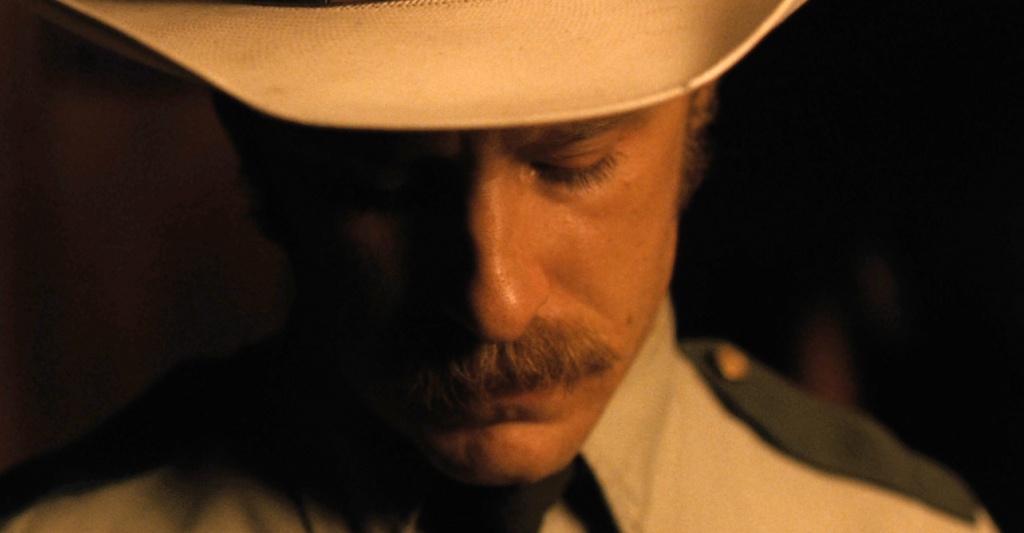
To combat these problems, the movie is atmospheric and its leading lady is incessantly contemplative. Everything is said in a somber tone, often while melancholy music scores the scene. Ain't Them Bodies Saints wants to be a deep, lyrical movie. It's got the lyrical part down pat, thanks to that marvelous pacing. It's slow, but as I hope I implied earlier, that's on purpose. We're not rushed from one thing to the next, but ushered there in a smooth, fluid manner. this is the biggest thing the movie has going for it.
If I'm being fair, then I'll have to give kudos to the cast, as well. Both Affleck and Foster play their roles well. Affleck, one of the more underrated actors, conveys his character's feelings without a showy moment. Foster gets a couple of those and brings his usual wide-eyed intensity. However, that might be part of the reason we're never as sympathetic toward Patrick as we should be. In the lead, Mara does what she can to save the material. Sadly, she has the same problem everyone else has. The material isn't that good. It's certainly not anywhere near as compelling as it thinks it is. Instead, it just barrels toward a conclusion that feels inevitable as soon as we understand what each our three main players want.
Wednesday, February 5, 2014
Red Hook Summer
Directed by Spike Lee.
2012. Rated R, 121 minutes.
Cast:
Clarke Peters
Jules Brown
Toni Lysaith
Heather Simms
Thomas Jefferson Byrd
De'Adre Aziza
Colman Domingo
Tracy Camilla Johns
James Ransone
James Ransone
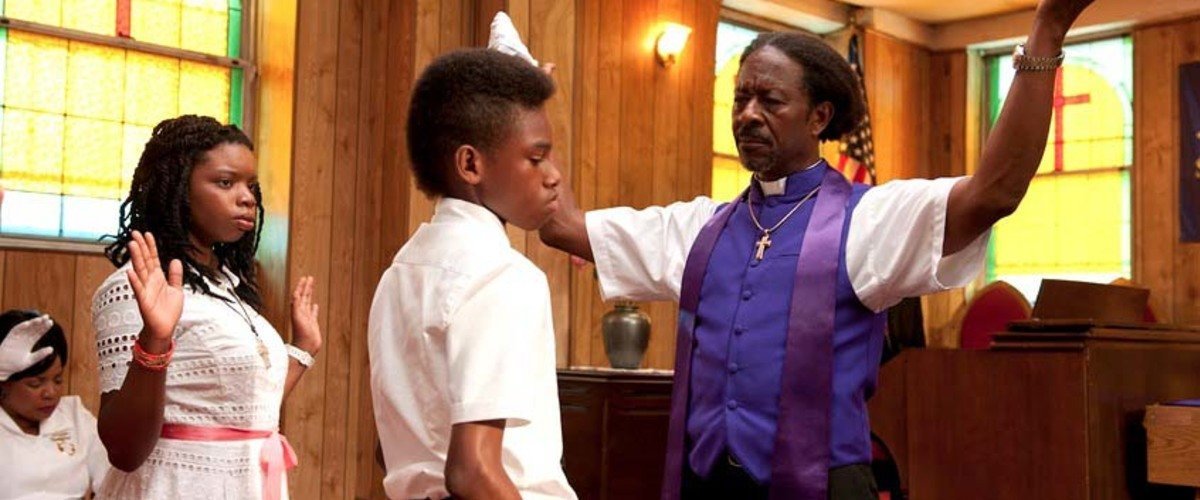
Silas (Brown), aka Flik, has lived all of his very young life in Atlanta with his mom. This summer he's going to spend his vacation from school with his grandfather Bishop Enoch (Peters), whom he's never met before. To say the two are different is a massive understatement. The bishop lives in Brooklyn's Red Hook housing projects, is an intensely devout Christian, pastors Little Piece of Heaven, the neighborhood church, and is fully embedded in the community. He is also most definitely old school in his ways. All of them. Silas' house in Atlanta is in the suburbs, it seems he's never been to church, he walks around recording everything on his iPad and wants nothing more than to go back home. Nonetheless, he's stuck for a couple months. The two trying to understand each other while Silas learns the ropes of surviving in Red Hook ensues.
For director Spike Lee, it's a return to his Brooklyn roots. He even includes a brief reprisal of his role as Mookie from the classic Do the Right Thing. It's a place he knows exceedingly well and loves despite whatever blemishes it may have. This much is evident throughout the film. It is most easily identifiable during the totally unnecessary montage that closes the movie. Spike lets his cameras take longing looks at both his beloved borough and the entire city of New York. However, where Spike's movie really shines is when he's using that camera to create statements and metaphors. Simply put, there are some amazing shots in Red Hook Summer. The most poignant of these deal with the ceiling lights at Little Heaven. A section of them forms a cross and figures prominently in three very powerful shots. Between these shots is perhaps Lee's most frightening double-dolly sequence ever. If you're familiar with the director's work then you've seen the double-dolly shots, the portions of his films where the camera will be in tight enough on a character, or characters, that only the upper portion of their body is visible. He/she will be moving toward us viewers in a way that makes it seem as if they are floating. This is his signature move. Here, the movement is more subtle than usual, but grows in intensity, and has just a bit of shaky cam thrown in. It may only be ten or fifteen seconds of the movie, but it is a brutal moment.
Camera tricks are nice, but most people will be more concerned with the story and whether or not it holds their interest long enough for us to care by the time we get to the finale. The answer is yes...and no. The yes part is easy. Bishop Enoch is a rich character, full of faith, stubbornness, fear, and mystery. To many in the movie, he represents what's good about the community and he has uncompromising values. Still, he's leery of the local rif-raf even as he occasionally approaches them and tries to nudge them in the right direction. However, the most anyone knows of him before his arrival in Red Hook is that he came from "down south." Clarke Peters wraps all of this up into one dynamite package. He plays the role perfectly, both in the bishop's quieter moments and at his most boisterous, brandishing fire and brimstone.

The climax of the movie is where it will completely grab you or totally lose you. While this is true of lots of movies, the feeling is amplified here. The shot I spoke of earlier, which contains the big reveal, is the lightning rod moment. It may seem over the top and coming in from way out deep in left field. If that fits your line of thinking, you might just tune it out right then and there. If this is an "oh wow" moment for you, you'll be pulled into the fold, far more invested than you were before this instant. It turns into the sort of harsh social commentary Spike Lee is known for.
But is it too harsh? Viewed through the prism of the director's public distaste for Tyler Perry, it is hard not to see this as at least a partial backlash against the message Perry aggressively pushes throughout his body of work, a deconstruction, if you will. In that vein, it may feel heavy-handed and overly reactionary. However, I believe in judging each film on its own merit. Red Hook Summer makes no overt references to anyone else's work, so what I've written is pure speculation. Juicy, it may be, but still speculation. As a stand-alone, it ultimately succeeds by offering Bishop Enoch up for debate. Is his story one of redemption or does it end in eternal damnation? There is also the nagging question of how all of this affects Silas. While not among his best work, it is far from his worst. His return to Brooklyn seems to have re-invigorated him. RHS is intriguing, yet uneven. It is also the most passionate film he's made in years.
Monday, April 22, 2013
Arbitrage

Directed by Nicholas Jarecki.
2012. Rated R, 107 minutes.
Cast:
Tim Roth
Laetitia Casta
Graydon Carter
Chris Eigeman
Stuart Margolin
Reg E. Cathey
Bruce Altman
Curtiss Cook
Robert Miller (Gere) is the kind of financial wizard that
graces the cover of Forbes magazine. Business is booming and he has his adult
children helping him run his ridiculously lucrative operation. He’s just turned
sixty and celebrates with some cake and ice cream with the family, including
wife Ellen (Sarandon) and then sneaks out to see his mistress Julie (Casta).
What none of them know is that everything isn't really so swell. He’s going
broke and has cooked the books to make his business look like it’s standing on
solid ground to James Mayfield (Carter), the potential buyer he’s trying to
close a deal with. Of course, this isn't something he shares freely seeing how
it may land him in prison for a very long time. Still, something somehow more troubling
takes place. He gets himself into an even more immediate bind that threatens to
get him into a jail cell even sooner than having numbers falsified which, in
turn, puts his deal in jeopardy and the financial future of lots of people who
have no clue what’s going on. A very rich man trying to weasel his way out of
trouble ensues.
At first, Arbitrage seems as if it’s
going to be strictly an economic thriller in the mold of MarginCall. While not as gripping, it was still an interesting. It then has
a rather abrupt changing of gears that works excellently, kicking the tension
up a couple notches as we wonder if and how Robert will get out of this jam. We
watch the world around him crumble. His facade begins to fade away, at least to
his family. They eventually find out there is trouble afoot with the business,
but still don’t know about his other misdeed. The police do and are desperately
trying to gather proof.

Richard Gere delivers the goods with an excellent portrayal.
He makes us understand that Robert is not just a man who believes that money
fixes all problems, but he knows there is no truer thing in all the universe.
Fittingly, he’s a character we’re not sure we can get behind. Do we see a man
who made some bad choices but is really doing these things for the greater good
or, is this an evil rich guy throwing around what monetary weight he has left?
The answer may depend on your political leanings. No. Politics is never
explicitly mentioned. Still, yours may color the goggles through which you view
this movie, particularly the ending.
The rest of the movie mixes the two story lines very well
achieving suspense without suddenly injecting unnecessary action sequences. It
sticks to it’s story in a manner that feels as if it comes from real life. In
fact, it seems like the onset of the current recession has been combined with a
Kennedy family headline. So this isn't something that comes at us from out of left
field. Though almost none of us have brokered half-billion dollar deals, we've seen lots of news of this type. This is where the power of
Arbitrage lies. It puts us inside a story we have all
heard about in some form or another.
MY SCORE: 7/10
Monday, January 14, 2013
Red Tails

Directed by Anthony Hemingway.
2012. Rated PG, 125 minutes.
Cast:
Cuba Gooding Jr.
Nate Parker
David Oyelowo
Tristan Wilds
Marcus T. Paulk
Leslie Odom Jr.
Andre Royo
World War II marked the first time in American history that units of black soldiers were put on the front lines against a foreign enemy. Eventually, this would include a unit of fighter pilots. Some credit for this is due to the simple necessities of winning a war. However, it’s still a near-miraculous achievement given the climate of our country at the time. As the quote that appears at the beginning of Red Tails tells us, blacks were thought to be genetically deficient in the areas of intelligence and courage with not enough of the former to fly a plane and not enough of the latter for any facet of war. Of course, this ignores the fact that all-black units fought 80 years earlier in The Civil War (see Glory). Then again, racism often ignores logic. How ridiculous is it that the military so purposefully segregated itself that thousands of its members practically had to beg to fight for their country even though they all signed up with the knowledge that dying in the line of duty is a distinct possibility.
To prove the theory of white superiority, the U.S. government commissioned a sociological study. A number of students from the all-black Tuskegee University were sent through the same rigorous testing and training hopeful white pilots underwent. The hypothesis going in was that all of these guys would wash out, thus proving the inferiority of the black race. After all, if the cream of the crop couldn’t rise to the occasion who would? Of course, many Tuskegee kids successfully completed the program. They were then maligned to their little squadron, the 332nd, and charged with flying practically meaningless patrols hundreds, if not thousands, of miles away from the action. They were bored and itching to prove themselves. This is where Red Tails picks up.
Pretty quickly, we meet our cast of would-be heroes. There’s the curmudgeonly old leader Major Stance (Gooding Jr.), the reserved squad leader Easy (Parker), we’re going with nicknames here, the talented but rambunctious loose cannon Lightning (Oyelowo), the super-southern hillbilly Smokey (Ne-Yo) and an assortment of other stock characters. These are all fun folks, but lack any sort of depth. They are personas already fully formed by whatever baggage they with them into the Tuskegee. The things they go through during our time with them is mostly generic stuff recycled from too many movies. What should be a collection of truly compelling men is reduced to a group of clichés in blackface. Only their leader, the crusading Colonel Bullard (Howard) escapes this fate. However, his screen-time is severely limited.

It would have helped if the movie had picked up earlier in the proceedings. By not seeing them go through the training program, we never get a real sense of their struggle. An old adage of storytelling is that it’s better to show than tell. RT would be a much more effective film if it had shown us what these people went through rather than just mentioning it once or twice. This means the audience is left to draw on whatever their own knowledge and opinions about race relations in America both now and during the first half of the 20th century. Therefore, how we feel about the characters is open to a broad range of interpretations from raging militant support to disinterested apathy. We’re left with something that should be, but is not more than an action flick about fighter pilots.
In fact, RT hangs its hat on the action sequences. They are beautifully shot and exciting. Planes get shot down, crash and burn pretty good. The same goes for trains, ships and even an entire base. Mid-battle banter between our heroes is cheesy, but in an entertaining way. It gives us a few chuckles to go with the violent eye-candy. These scenes come at a fast enough rate that even though the movie doesn’t connect with us the way it wants to, it doesn’t bore us, either.
For what it actually is, RT really isn’t that bad. Sure, it feels like rehashed material but the guys are pleasant enough to root for and those “dog fights” are excellent. It’s light, forgettable fare that zips by like one of the Germans’ (then) new-fangled jet planes.
Unfortunately, because of the subject it chooses to tackle, we have to judge this particular film on what it is not. RT is not a gripping historical drama. It offers very little perspective, if any, on what these men meant to their country or race. I fear its shortcomings as a potential teacher are behind the extremely negative reviews. While certainly not a great movie, it isn’t the scourge of cinema it’s made out to be. Though, to be fair, HBO made a better movie on the same subject, The Tuskegee Airmen (1995), in which (a much younger) Cuba Gooding Jr also appears. I encourage you to seek out that one. It will give you a better feel for what these men went through. RT is just sorta fun.
Subscribe to:
Posts (Atom)