

Dell slaves over a hot Blu-ray player for the good of mankind.
Showing posts with label Stellan Skarsgard. Show all posts
Showing posts with label Stellan Skarsgard. Show all posts
Tuesday, August 28, 2018

Wednesday, January 14, 2015

Tuesday, July 29, 2014
Thor: The Dark World

Directed by Alan Taylor.
2013. Rated PG-13, 112 minutes.
Cast:
Chris Hemsworth
Natalie Portman
Tom Hiddleston
Anthony Hopkins
Stellan Skarsgard
Idris Elba
Chris Eccleston
Adewale Akinnuoye-Agbaje
Kat Dennings
Rene Russo
Ray Stevenson
Following the events of The Avengers, Thor (Hemsworth) finds himself back home on Asgard longing for Jane (Portman), the woman he left behind in the first movie. And since a superhero's work is never done, there's a new evil to deal with. This time, all the fuss is over something called the Aether, the evil force Malakith (Eccleston) was using way back when in his quest to rule everything. He and his top dawg Algrim (Akinnuoye-Agbaje) fled before being killed. The Aether was said to be destroyed, but was just hidden really well. Lo and behold, after however many years, Jane not only finds the stuff here on Earth, but it uses her body as a host. Now that the Aether is out in the open, Malakith will stop at nothing to get it back and once again try to conquer evertything. He makes things so bad for Thor that our hero has to turn to his arch-nemesis/half-brother Loki (Hiddleston) for help.
Like the previous Thor and even The Avengers, this is a movie about the relationship between Thor and Loki more than anything else. It is a formula that repeatedly pays dividends. First of all, Chris Hemsworth continues to be the perfect Thor while Thor himself continues to show growth. His maturation process from overgrown child to a man worthy of his father's crown has been wonderfully handled across three movies. Still, a perfect Thor is almost no comparison to Loki as far as intrigue goes. The writing of the character and the performance of him by Tom Hiddleston is pure magic. Without question, he is a guy we simply love to hate. The trick is we still have a trace of sympathy for him. At his core, he is a guy rebelling against his parents because he doesn't feel wanted, particularly by his father. The hurt that feeds his hatred always shines through. Those parents, Odin (Hopkins) and Frigga (Russo) are played excellently, as well. Hopkins shows us Odin's thorough disappointment in and disdain of his son while Russo lets Frigga's motherly approach work wonders even though we can see that she's being very cautious with him.

Secondary characters, especially the human ones, don't really add much. As the damsel in distress, Portman does nothing to prove that she is the only one who should play that role. In other words, while having someone other than Gwyneth Paltrow play Pepper Potts would be a major blow to the Iron Man franchise, swapping out Portman for someone else would hardly make a difference. Don't get me wrong, she's a wonderful actress, just not given much to do. Others are there almost purely for comic relief with varying degrees of success. The relationship between the two interns played by Kat Dennings and Jonathan Howard is hit or miss. The hijinks surrounding Erik Selvig (Stellan Skarsgard) is much more successful. It helps that he actually matters to the plot. Our uber-villain Malakith and top henchman Algrim give us pretty standard bad guys and aren't particularly memorable.
No matter how the rest of the movie comes together, or doesn't, it would all be for naught if the superhero stuff doesn't work. It does. When pulled into battle, Thor mightily wields his hammer. Just as importantly, the visuals back him up. Asgard looks beautiful and parts of it get destroyed quite nicely. The action involves lots of fisticuffs and spaceships and looks great. The best part is that while Algrim isn't the most memorable henchman, he is a formidable one and poses a real threat to our hero. Later, even Rene Russo impresses us in a fight scene, making us recall her days as part of the Lethal Weapon franchise.
Marvel Studios continues to bring us comic book flicks that strike a nice balance between taking their heroes seriously and providing a fun experience. It pushes the saga of their shared universe forward without relying as much on what happened in The Avengers as Iron Man 3. It's mentioned, but not the crutch upon which the entire movie leans. the ending feels like a cheat, but I'm sure we'll get some explanation of this later. Therefore, I'm willing to let it slide until a later film sheds some light on things. If viewing this as a stand alone, I can see how it would be a pretty big knock on the movie. As part of a series, as it is, it gives us something to anticipate.
Friday, July 13, 2012
Melancholia

Directed by Lars von Trier.
2011. Rated R, 135 minutes.
Cast:
Kirsten Dunst
Charlotte Gainsbourg
Keifer Sutherland
Stellan Skarsgard
Alexander Skarsgard
Brady Corbet
John Hurt
Charlotte Rampling
Cast:
Kirsten Dunst
Charlotte Gainsbourg
Keifer Sutherland
Stellan Skarsgard
Alexander Skarsgard
Brady Corbet
John Hurt
Charlotte Rampling
Justine (Dunst) and Claire (Gainsbourg) are a pair of emotionally unstable sisters with a half of the movie Melancholia devoted to each of them. I mean this literally. It’s divided pretty much down the middle. Part 1 is called “Justine”, part 2 “Claire”. For what it’s worth, Justine is the more damaged of the two. Her problems play out across both chapters. She suffers from severe depression. At times it cripples her to the point she can’t even will herself out of bed for days on end. Though married with her own family, Claire spends lots of time tending to Justine. Perhaps she also suffers from depression. She’s prone to break down and cry when things get to be overwhelming. This seems to be at least once a day. She’s also freaked out by our pending doom. More on that, later.
As part 1 opens, Justine has just gotten married. We go on to witness one of the most bizarre wedding receptions in the history of mankind. It’s held at the luxurious estate, golf course included, by Claire and her husband John (Sutherland). The location is the only thing luxurious about this reception, though. Justine’s mom announces to everyone that she doesn’t believe in marriage and, I’m paraphrasing here, “all you people suck.” Her boss sends his newly hired nephew to follow her around to bug her about the ad campaign they’re working on. Justine herself disappears for long stretches to have weepy conversations with Claire, who’s often sent to fetch her, or one of their parents whom she seeks out. All the while she alternately teases and gives the cold shoulder to her new hubby. None of it makes a whole lot of sense except to show that Justine is indeed depressed. And trust me, I’m leaving out some of the more colorful moments.

For part 2, we switch from disheartening drama to bleak science-fiction. Sorta. This is where that pending doom thing comes in. We see the extent to which Claire goes for her sister. It’s a tiresome job that strains her marriage. Justine eventually snaps out of her funk, somewhat. Once she’s up and about she exudes the kind of attitude that makes us want to smack her. Regardless, we shift our focus to Claire who is understandably freaked out by the heavy-handedly named Melancholia, a planet suddenly very visible in our sky. It’s visible because it is racing towards us. The question is will it actually hit us and end it all. John thinks it will not. Everything on Google says it will. So essentially, this becomes a movie about whether or not you can trust what you read online. OK, maybe not, but the subtext is there. Unlike more standard sci-fi, we don’t see armies of scientists trying desperately to come up with a solution. Bruce Willis and a rag-tag bunch of drillers turned astronauts aren’t sent up to deploy a nuke. Instead, we get Claire hoping against hope that things will turn out for the best.
On its own, each part is an interesting character study. More accurately, one and a half of the two parts is an interesting character study of Justine. Up to that point, everything we see of Claire is merely a reaction to her sister. The portion dedicated to Claire is not as complex and therefore less compelling. Of course, it’s saddled with the urgency of another planet possibly slamming into Earth. The problem is, especially with the dearth of characters in part 2, it’s less an apocalyptic event than an overwrought metaphor that overwhelms the story of the two sisters rather than aid in its telling. The fate of the world is clearly less important than the sanity of these two women. The planet merely succeeds in making a film that’s already a downer even more of one. That said, Melancholia is a mixed bag for me. It’s artistic and well-made but pessimistic without even a hint of humor. It’s interesting and different, yet relentlessly dreary. In other words, just forget about feeling good for a while after watching it.
MY SCORE: 7/10
Thursday, April 5, 2012
The Girl with the Dragon Tattoo (2011)

Directed by David Fincher.
Stellan Skarsgard
Robin Wright
Yarick von Wageningen
Joely Richardson
Geraldine James
Donald Sumpter
Julian Sands
Ulf Friberg
Alan Dale
Robin Wright
Yarick von Wageningen
Joely Richardson
Geraldine James
Donald Sumpter
Julian Sands
Ulf Friberg
Alan Dale
Lisbeth Salander (Mara) isn’t your typical girl. She generally doesn’t like people and they generally don’t like her. She works for a company tthat does extensive background checks and is only used on “interesting” cases. In other words, she’s a very talented computer hacker. Despite being an adult, she’s also a ward of the state whom we’ll see jump through some very interesting hoops to get control of her own affairs. Oh, almost forgot, she has a tattoo of a dragon on her back.
Back to Lisbeth’s job as a hacker. That’s her entry point into the main plot. She’s been keeping close tabs on Mikael Blomkvist (Craig). He’s a disgraced journalist, having just been successfully sued for libel by a very powerful and high profile businessman. Lisbeth was hired by another rich and powerful guy, Henrik Vanger (Plummer). After being satisfied with what she’s found, Vanger hires Mikael to solve a mystery. Over 40 years ago, Henrik’s niece Harriet disappeared. Even though this happened on the secluded island the entire Vanger family lives on, she was never found and no one has ever been held responsible. Henrik believes someone in the family is her killer. Mikael takes on the project, but obviously can’t make any promises on such a cold case. Eventually, he decides he needs some help and hires Lisbeth, himself.
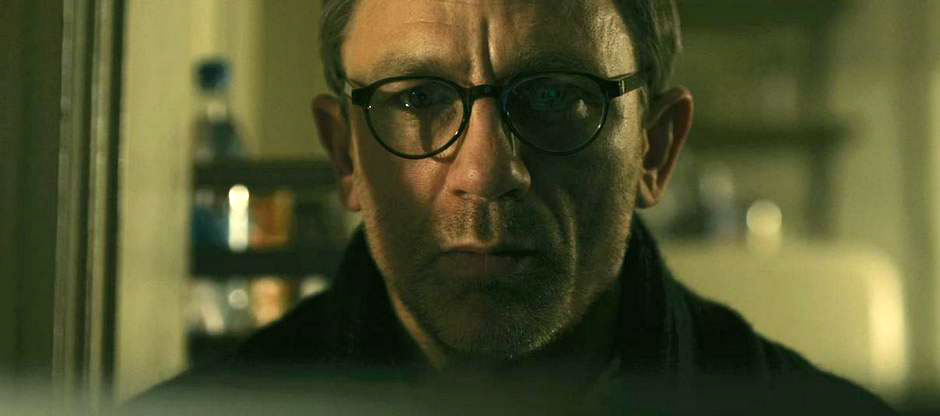
In the two lead roles, both Mara and Craig perform excellently. Mara’s Lisbeth appears fragile but is really calloused from the many blows life has dealt, and keeps dealing her. She doesn’t believe in self-pity, only penance. She takes the philosophy of “an eye for an eye” to a whole new level. On the other hand, Craig plays Mikael as the complete opposite of James Bond whom most of us will think of when he first shows up on the screen. Mikael’s a cerebral and emotional guy that’s not used to being in physical danger. Like Bond, women seem drawn to him but it has nothing to do with machismo or suaveness like it does for the super agent. Mikael also doesn’t seem to deal with pain, too well. He’s pretty much the inverse of not only Bond, but also of Lisbeth. Mikael has a tough looking exterior with a soft middle. She’s far more action hero than he.

TGwtDT is an excellent movie. However, it can’t be reviewed without comparing it to the Swedish original from 2009. To be fair, director David Fincher’s American version is not a remake, even though it bears a strong resemblance to its predecessor. Both are adaptations of the Stieg Larsson novel of the same name and the first of a trilogy. Without having read it, I’ve heard that this version is slightly more faithful to the book.
I have seen the Swedish film, though. There are some differences. Some work better in this movie while others favor the original. Two main ones stick out. Lisbeth’s guardian is one of the movie’s villains. I feel this character was better done, more thoroughly evil in the Swedish movie. This makes certain events that much sweeter in their brutality. The other is multi-faceted. It starts with the various relaitionships of Mikael. This version explores them more deeply by making the editor of his magazine much more of a factor. This leads us to an ending that better sets up the sequel. Of course, this presumes the entire trilogy will be adapted as they were in Sweden. If you put a gun to my head and force me to choose which I like better, I’ll say this one by a very slim margin.
Monday, December 12, 2011

Subscribe to:
Posts (Atom)