

Dell slaves over a hot Blu-ray player for the good of mankind.
Showing posts with label Tyler Perry. Show all posts
Showing posts with label Tyler Perry. Show all posts
Thursday, March 14, 2019

Saturday, April 28, 2018

Monday, January 5, 2015

Thursday, August 28, 2014
Thursday Movie Picks: Dramatic Scenes

Hello boys and girls. We've landed on another Thursday. It's that day when I suggest a trio of movies to you based on a theme selected by Wanderer over at Wandering Through the Shelves. It's a wonderful weekly meme that she cooked up and I've had a blast taking part in. Last week, we had more participants than ever. Feel free to join in and help us break that record.
This week's theme was a tough one for me and a change of pace for the meme. Instead of just writing about three movies, we're asked to pick three "dramatic" scenes.
Dramatic?
That's awfully vague. Therefore, I'll apologize in advance in case the scenes I pick aren't dramatic enough.
Usually, I go with three hidden gems. This week, I'm going to go with one I love, one I hate, and one hidden gem. Why? Because Wanderer said I could, that's why.
I'll start with my hidden gem. This is a big moment for me because I am about to do something I have rarely done in my entire life: praise a Tyler Perry movie. It comes from For Colored Girls, by far his most ambitious effort. Overall, it ends up just shy of hitting its mark. Even though that's the case, because it is a film where the director is stretching his boundaries I'm certainly willing to revisit and reconsider it (my full review, here). Within this is a cameo by singer Macy Gray. She plays a woman who gives abortions right out of her apartment and is paid a visit by one of the main characters. Trust me, this isn't a woman you want doing anything medical to you. I'm not sure how it plays out of context, but within the movie it's an insanely tense two minutes. It's perhaps the best scene Mr. Perry has ever filmed. In case you're unfamiliar with the movie and the dialogue sounds a little strange, it's because it's adapted from an extended dramatic poem and adapts long stretches of it verbatim.
The reason I started with the hidden gem because the scene that I love and the one I hate are related even though they are from two different movies. To begin with, they were both filmed by the same director, Michael Mann. In fact, they're actually the same scene.
Confused?
Okay, let me explain.
As far as I'm concerned, the crown jewel in Mann's filmography is the three hour, but still thrilling 1995 movie Heat starring Al Pacino and Robert De Niro. The key information here is the names of the two stars. Here's the deal: Heat is actually a remake of an earlier Mann movie, L.A. Takedown from 1989, that was actually a TV movie that was an unsuccessful pilot for a potential series. It was later given a DVD release after the success of Heat. Neither Pacino or De Niro appeared in that movie. One of the most famous scenes in Heat is the one where Pacino, the good guy is sitting in a diner with De Niro, the bad guy. The two have a tense conversation that serves as a turning point for the film. The exact same scenario plays out in L.A. Takedown. It features Scott Plank as our good guy, or the Pacino role and Alex McArthur as the bad guy, or the De Niro role. Let's just say, neither guy is giving an Oscar worthy portrayal. Just take a look...
Bad acting. Acting is bad.
You'll probably never get McArthur's unblinking death stare out of your head. Sorry 'bout that. Let's just watch the pros do it and call it a day.
Wednesday, January 8, 2014
Temptation: Confessions of a Marriage Counselor

Directed by Tyler Perry.
2013. Rated PG-13, 111 minutes.
Cast:
Jurnee Smollett-Bell
Lance Gross
Vanessa Williams
Brandy Norwood
Robbie Jones
Kim Kardashian
Ella Joyce
Candice Coke
Judith (Smollett-Bell) and Brice (Gross) first met when they
were six years old. Now in their mid-twenties, they’ve been married for six
years. Things are looking up for them. She has just started her job as the
in-house counselor at a dating service while he is pursuing his dream of owning
his own pharmacy. Like lots of couples they’ve settled into a routine. It
works, but it’s not necessarily thrilling, so she is feeling a little down about the whole thing. Brice has also forgotten his wife’s birthday which adds to her sadness. In comes fabulously
wealthy, handsome, and young Harley (Jones). He’s looking to invest in the
company Judith works for. The two have been paired together as he also works on
a computer program that can assess compatibility between clients. Doesn’t every
dating website already have this? I digress. Point is, Harley takes an
immediate liking to Judith and begins to woo her with the finer things in life.
That simple premise, maybe tweaked a bit on the details, has
been the starting point for numerous movies. We have all seen at least a few of
them. However, as writer/director Tyler Perry has consistently shown, he can
never leave well enough alone. He insists on stacking the odds much higher than
needed against his protagonist. This could have been a thorough, mature
examination of the two relationships involved, both Judith’s with Brice and
Harley. Instead, we get very easy markers that are never dealt with and
heaping helpings melodrama. Then there is always another problem to add to the
pile. Each one is not just an emotional issue, either. These are potentially
fatal problems so intently focused on our heroine the movie renders itself a
farce rather than the engaging character study of a woman in flux. Other
similar movies have subplots, occasionally lots of them. However, they
generally concern other characters. They don’t bury the lead beneath an
avalanche of earth-shattering dilemmas. It gets to the point where we realize
the movie itself doesn’t like her. This is most evident in its harsh and
cynical conclusion. Admittedly, this fits with his typically southern Christian viewpoint.
Breaking the sanctity of marriage is cause for swift and eternal damnation.
To try and deal with all those issues raised, the movie
simply shifts into hero vs. villain mode. This exposes another Tyler Perry
trait. His bad guys are so over the top they cease to seem human. They are
hissing, seething balls of rage. Harley is no exception. Robbie Jones is not a
bad actor. The material leaves him no choice but to play it with both fists
gripping ham and a mouth constantly full of scenery. This further adds to the
feeling we’re watching something comical in nature. This wouldn’t be an issue
if the movie didn’t so obviously want to be taken seriously. The mismatch of
tone and content wreaks havoc on the film.

If there is one thing Mr. Perry usually gets right, it is
wringing heartfelt performances out of his female leads. More than the zany
antics of Madea (thankfully not present here) or the sermonizing of his elder
characters, these ladies ground his movies. They provide an emotional core for
the audience to latch onto. Though she’s not yet the same caliber of actress as
Perry alums Kimberly Elise and Angela Bassett, Jurnee Smollett-Bell more than
holds her own and shows great potential. She’s been in front of a camera since
she was very young, but this is her first grown up role, as far as I know.
Hopefully, she’ll have more in her future.
Conversely, Perry could not coax even one convincing line
out of supporting player Kim Kardashian. She is just painful to watch. The few
lines she had were far too many as it sounds like she’s reading them for the
very first time. Also, the normally solid Vanessa Williams was equally as bad.
Her faux-French accent was distractingly horrendous. It also doesn’t have to be
there at all. It is merely used to set up an unfunny one-liner late in the
movie. As the husband, Lance Gross is bland, but likable. This is actually high praise since the character exists to be exactly that. The only strong
performance in the movie beside our leading lady’s is given by singer/actress
Brandy Norwood. Unfortunately, her character occasionally appears to be in a
horror movie all by herself. She eventually joins the rest of the cast in this movie during the third act.
Temptation is a movie that wants to be
a mature portrayal of a marriage in crisis and how it might play out in
biblical terms. In actuality, it is steeped in so much melodrama, its like the
actors are performing a difficult trapeze act sans net. Since what it tries to
be and what it is don’t line up it all becomes laughable. It’s also
heavy-handed with an over-simplified conclusion. All grays are removed from
this world in favor of easily contrasted blacks and whites. Judith ceases to
be a woman and becomes a blatant scare tactic used against all women.
MY SCORE: 3.5/10
Monday, December 16, 2013

Sunday, March 24, 2013
Tyler Perry's Madea's Witness Protection

Directed by Tyler Perry.
2012. Rated PG-13, 114 minutes.
Cast:
Denise Richards
Doris Roberts
Romeo Miller
John Amos
Marla Gibbs
Tom Arnold
Danielle Campbell
Devan Leos
Frank Brennan
Nelson Bonilla
Tyler Perry is back in drag, yet again. This time around, Madea’s FBI agent nephew Brian (also Perry) talks her into hiding an entire family while its patriarch George (Levy) is waiting to testify against the mob. His brood is made up of his wife Kate (Richards), their two teen aged children Cindy (Campbell) and Howie (Leos) and George’s senile mother Barbara (Roberts). Already living with her is her brother Joe (Perry the third). Finally, Jake (Miller) is always around trying to figure out how we will get the money to pay off his church’s mortgage after losing it through bad investments. Trite jokes about race and class plus an admittedly rehashed plotline from a Whoopi Goldberg movie ensues.
By now, I’m 99% immune to the character Madea. I didn’t find her all that funny all those years ago when she first took over the black theater circuit in the plays that served as a springboard to fame and fortune for her performer and creator, Tyler Perry. Now, with each installment in the canon, I find her incrementally less humorous. That’s a problem in a movie where she does lots more talking than anyone else. Obviously, since these pictures keep raking in the loot, it’s a “me” problem, but whatever. More of an issue is that no one else is particularly funny, either. Perry does have some chuckle-worthy moments as Joe, mostly because of the reactions than anything he actually says. Eugene Levy also manages a couple. In a cameo right at the beginning, Tom Arnold is really good. Wily vet Doris Roberts has the most success. She steals all of her scenes though the material she’s working with is hardly groundbreaking. Her moments with Joe are the most entertaining. Unfortunately, the jokes are all paint-by-numbers. Madea or Joe does something “black” and the family has a “white” reaction or vice-versa.
The story is similarly conventional. The next point in the arc is always easy to sniff out, especially since there is nothing that even threatens to throw us off the scent. So the movie never generates any palpable sense of danger. The one element that may have helped, the people George is protesting against are pretty much absent from the movie. This makes it impossible to see what everyone’s so afraid of. No effort is put into making me give a flip about these people. Without any real heart, Madea’s Witness Protection is just a string of jokes, almost all of which we’ve heard before.
MY SCORE: 2/10
Thursday, December 20, 2012
Alex Cross

Directed by Rob Cohen.
2012. Rated PG-13, 101 minutes.
Cast:
Edward Burns
Matthew Fox
John C. McGinley
Werner Daehn
Bonnie Bentley
Giancarlo Esposito
Alex Cross is the lead character in a series of novels written by James Patterson. He was previously brought to the big screen in 1999's Kiss the Girls and 2001’s Along Came a Spider with Morgan Freeman playing the role. Here, the honors belong to Tyler Perry. Our reintroduction to the detective/psychologist starts with him finding out that his wife (Ejogo) is pregnant with their third child. Actually, it starts with a perp chase that’s totally irrelevant to the plot except for being an easy way to introduce us to Alex’s team, but that’s neither here nor there. By the way, the team consists of Alex, his partner and best friend since forever Thomas (Burns) and fairly new to the crew Monica (Nichols). After getting the news about his family’s expansion Alex and company gets called in on a case where a very wealthy young lady and all her bodyguards were found murdered at her home. Getting his Sherlock on, our hero intuits that it was only guy responsible, he tortured the rich chick just for fun, was drawing a picture of her as she was dying, despite not actually being able to see any real evidence of this, and that she was not the main target. The drawing leads his team to dub the bad guy Picasso (they do eventually find a drawing). Trying to catch the artist ensues while he kills more women.
By now, you should see my main problem with this movie. No, it’s not the star. More on him, later. I get that Alex is a genius with immense powers of deductive reasoning. However, to figure out a lot of things in this movie he’s more psychic than psychologist. Take the drawing, for example. Granted, I’m certainly not a crime scene investigator. However, from the information before him I’m not seeing how Alex just decides this guy was drawing a picture of his victim. A few moments later, voila! Thomas finds a picture. A short while later, he’s folding the drawing in precisely the right manner to uncover a clue left by Picasso.
This gift for precise premonition isn’t limited to our hero, either. The bad guy seems able to quickly know things he really shouldn’t. In particular, he magically knows where Alex is going to be in one scene and where another cop lives in the next. It feels lazy, as if the writers just relied on the fact that similar things happen in movies all the time so we probably won’t question it.

Things eventually cycle back in Alex’s favor. This is where we get our most egregious misuse of our hero’s ability. The movie’s entire runtime is spent on the cat and mouse between Alex and Picasso, which is fine, but never clearly establishes reason and motive for the events. Instead, after what we think is the finale, Alex just suddenly knows a lot more information and we have a bit more movie to watch.
In the lead role, Tyler Perry was just fine. He won’t make anyone forget anything Morgan Freeman ever did, but he performs admirably. In roles that require him to show his own face he’s usually bland, hardly engaging. Here, those qualities work for him because it gives the analytical Cross the proper distance from most of the atrocities being committed. It is my understanding that Idris Elba was originally signed to play this role. I think Elba is the better actor, but plays even his non-action roles with too much brawn for this character. Perry’s a better fit and did a good job.
The rest of the cast also does well. Matthew Fox as our bad guy is particularly good. He gives us a solid psychopath. Filling out the rest of the roster are a bunch of folks capable of great work, but given very little to do: Jean Reno, Rachel Nichols, Giancarlo Esposito, Carmen Ejogo, and possibly John C. McGinley. Director Rob Cohen has assembled a nice group but made little use of them with a paint-by-numbers screenplay filled with easy answers.
Thursday, June 7, 2012
Good Deeds

Directed by Tyler Perry.
2012. Rated PG-13, 110 minutes.
Cast:
Tyler Perry
Thandie Newton
Gabrielle Union
Brian White
Phylicia Rashad
Eddie Cibrian
Jordenn Thompson
Beverly Johnson
Rebecca Romijn
Jamie Kennedy
Cast:
Tyler Perry
Thandie Newton
Gabrielle Union
Brian White
Phylicia Rashad
Eddie Cibrian
Jordenn Thompson
Beverly Johnson
Rebecca Romijn
Jamie Kennedy
Life is perfect for Wesley Deeds (Perry), or so it seems. He’s the CEO of a very successful company, drives a Porsche and is the apple of his mother’s eye. He’s also engaged to the beautiful Natalie (Union). The only hiccups are he works long hours and his brother Walter (White) is a jerk, feeling slighted by their deceased father who willed Wesley the company’s top spot. For Lindsey (Newton), things aren’t going quite so well. She’s the single mom of a six year old girl. Early on, they get evicted from their apartment. She can’t afford to pay rent because the IRS is garnishing her wages. With no other options, Lindsey and her daughter sleep in their car. That is, they sleep there after mom’s shift as a night janitor. Why yes, silly, she works for Wesley’s company. And yes, she finds herself cleaning his office while he’s there working late. If you don’t know where this is going you should crawl out from under your rock every once in a while.
In what’s become a pattern for writer, director and, in this case, leading man Tyler Perry, in between Madea movies he doesn’t go for laughs. It’s a welcome development, a much needed reprieve for those of us who’ve grown to despise the loud-mouthed, pistol-packin’ grandma. People who love her tend to also love anything Perry does so no problems on that front, either. Both sides might be pleasantly surprised that this is just a plain ol’ fashioned boy meets girl. As such, Good Deeds plays it totally straight. There are no extraneous buffoons hanging around nor a collection of outwardly evil men to get us all riled up. For the most part, this film is populated by “just” people.

As a romance, Good Deeds is a lukewarm affair. It plays things safe to the point of unrelenting predictability. The irony is that Wesley's fiancee spends much of the movie lamenting him for the same thing, being bland with all the spontaneity of clockwork. For both the movie and the character, our leading man is much the blame. One of Perry's great strengths is getting strong performances from his cast. However, the one actor he has the most trouble with is himself. As Madea, or anyone which requires him to physically disappear into them as much as possible, he's a bundle of hyperkinetic energy. With his own face in plain view he's exceedingly bland. His Wesley Deeds is no exception. Unfortunately, this means he doesn't generate any sparks with either Union or Newton. It doesn't help that the character is written as an impossibly good person. There is no edge to him whatsoever. His inevitable break-up is of the most cordial kind imaginable. Even his one "rebellious" fantasy is Mother Teresa-esque.
The movie is at its most passionate when it turns its eye toward the subplot of Walter being mad at the world, including his own mother played by a steely-eyed Phylicia Rashad. Too bad these are both completely one dimensional characters with a story that goes nowhere. However, they do provide us with plenty of melodramatic fireworks whenever they share a scene. White's is an angry, guttural performance of material that doesn't allow him to be anything more.
Whenever our focus is on Mr. Deeds (yes, I'm fully aware of what I did, there) and the triangle that forms around him, we simply barrel downhill until we reach the inevitable conclusion. It does so in a mostly unremarkable fashion that makes this hard to love, or hate. There are some touching scenes involving Wesley, Lindsey and her daughter Ariel (Thompson). There are some horrible scenes and transitions where things just happen too easily. However, the bulk of it is merely average.
MY SCORE: 5/10
Friday, September 23, 2011
Madea's Big Happy Family
2011. Rated PG-13, 106 minutes.
Cast:
Tyler Perry
Loretta Devine
Cassi Davis
Shannon Kane
David Mann
Tamela Mann
Bow Wow
Lauren London
Teyana Taylor
Rodney Perry
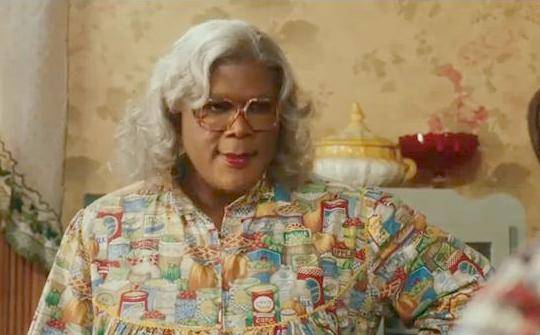
Director Tyler Perry’s most famous creation is back for another adventure. This time, the big family actually belongs to Shirley (Devine) and they are anything but happy. Shirley has come down with an almost immediately terminal form of cancer. Her doctor informs her she only has four to six weeks to live. She’s actually been battling this for seven years and was thought to be in remission. Her family knows none of this. She decides the only way to let them know what’s going on is to have them all over for a grand dinner and break the news after they’ve filled their bellies. However, as soon as her three adult children lay eyes on each other sparks fly, tempers flare and they all flee in different directions. This mix is made even more volatile by the fact that aside from their problems with their siblings they all bring and display their issues with their spouses and children, as well. The two daughters treat their husbands like dirt and the son has baby mama drama and a gold digging girlfriend. As a dear friend of Shirley’s, Madea is asked to help straighten up this dysfunctional bunch.
From the very beginning it is clear that this is classic Tyler Perry. Everything is over the top, both dramatically and comedically, problems mount at an alarming speed, and there’s plenty of sermonizing. This is the director’s tried and true formula. That formula is largely influenced by the movie Soul Food. Much of his work mimics that movie’s tone and style with Madea and/or others adding extra zaniness and homespun wisdom. Here, we practically get a remake. A television set full of money seems to be the only thing missing.
Even without understanding this, most of his core audience doesn’t even get to be surprised by all the plot developments because they’ve likely seen the play of the same name Perry created, toured around the country and sold on DVD the year before. They still flock to his movies, though. It’s become a genius marketing plan. He’s created an entire industry where duplication of product is not only expected but ravenously craved by its consumers.
From my viewpoint, Madea’s Big Happy Family is a colossal disappointment. Part of the problem is its exactly the same as every other movie with the name “Madea” attached to it, as well as a few others. What makes it feel worse than those is it comes on the hells of “For Colored Girls.” Whether you liked that movie or not, it showed Perry as an artist willing to take risks and leave his comfort zone. Even if he didn’t stray very far he still tried to stretch his wings some. Since he has the eyes and ears of so many trained on his every action. I hoped that FCG signaled the start of an artistic growth spurt. I hoped he had either found something more to say or was at least willing to try different ways of delivering his message. Lastly, I hoped he was becoming confident enough to let his audience question what they’ve seen which may in turn make them question themselves and stimulate their own growth. Instead, we get a regression to the norm. It’s a highly profitable norm, but it’s a spiritually unfulfilling one. This is particularly troublesome given the Christian slant to his work. It reaffirms what his core fans already believ in but doesn’t encourage them to do anything more than nod in agreement, laugh and wait impatiently for the next installment in the Tyler Perry canon.
For those that are fans, this is right up your alley. Madea is as outrageous as ever. Mr. Brown (David Mann), Cora (Tamela Mann) and Joe (the director in a dual role) are back for good measure. The movie moves swiftly and maintains a southern gospel tint. Every second of it is precisely who we know Tyler Perry to be. It never once threatens to be anything more. The question is does this float your boat, or not?
MY SCORE: 4/10
Friday, March 18, 2011
For Colored Girls

2010. Rated R, 133 minutes.
Cast:
Kimberly Elise
Loretta Devine
Thandie Newton
Janet Jackson
Anika Noni Rose
Kerry Washington
Phylicia Rashad
Whoopi Goldberg
Michael Ealy
Omari Hardwick
Hill Harper
Macy Gray
Three troubled women live next to one another in a walk-up apartment building. Crystal (Elise) has a live-in baby daddy who is just home from “the war." Apparently suffering from severe PTSD, he drinks all day long and slaps her and the kids around. Tangie (Newton) literally brings a different man home every night from the bar she works in, has a religious fanatic mom (Goldberg) who pops up from time to time demanding money, and a little sister she can’t stand. Gilda (Rashad) is the least troubled, but tries her best to help the younger ladies and doesn’t seem to be having much success.
Very quickly, we meet some more ladies with problems. There’s Jo (Jackson), a magazine tycoon who is suffering through a bad marriage and some sort of health problem. If you’ve paid any attention to Tyler Perry’s previous work, you should figure out what’s wrong with her in about ten minutes. Kelly (Washington) is a social worker married to a cop and has a health issue of her own. Juanita (Devine) has a part-time boyfriend who moves in and out of her apartment at will, or more accurately, at the whim of his other woman. Then there’s Yasmine (Rose), the local dance teacher. She appears to be worry free. How long do you think that will last?
The ladies struggle with their issues and often have heart-wrenching moments. These moments will lead to many to hail it as Perry’s crowning achievement, artistically. That really isn’t saying much, but the point is taken. The director takes a more adult approach to his material and actually goes straight for drama. The bit of humor that is sprinkled in is much more derived from the human condition than his usual over the top slapstick. The overzealous attempts at comedy present in his other films never show up here. There are no buffoons in loud clothing, no old people smoking weed and thankfully no signs of Perry in drag. What we’re left with are these women and their pain.
Their pain drives the movie. It’s the crutch Perry leans on, rather effectively I might add. This part is easy for him because he’s always had two things going for him. First, he knows his target audience. It is no secret that target is African-American females. He has a good feel for what moves them emotionally and how to concoct just the right amount of melodrama to rile enough of them up. Second, he always elicits strong work from his cast. Across the board, the performances are fantastic.
In For Colored Girls, Perry is a skilled illusionist. As one powerfully acted scene after another depicts painful occurrences he knows many in his audience relate to, all too well, the illusion is we’re watching a great movie. The fact is all these wonderful scenes don’t quite gel into a cohesive unit. They’re short snippets of people, mostly women, pouring their hearts out quite literally through their tear ducts. Yes, there is lots of crying. The actors eagerly and earnestly attack their lines, leaving us and them exhausted from the effort. Unfortunately, the story the scenes combine to tell is predictable and uninspired man-bashing. Far in advance, we can see what’s coming. This stems from something the Tyler Perry canon is plagued by. It seems that in his world, Black men who aren’t the embodiment of pure evil are a rare commodity, except for the clowns of his other movies, of course. What happens is the scenes eventually devolve into a string of tragedies with hardly enough triumph to notice. To help us with this as much as possible, Perry eschews his normal all curing trip to church with another chick-flick cliché remedy, the group hug. Seriously.
As much formula is evident, there is some serious ambition with regards to dialogue. The first thing is the free-flowing of four, seven and twelve letter words that earn ‘R’ ratings. For most, this is not a big deal in any way. For Perry, it runs the serious risk of alienating his most ardent fans. Within the rather large and diverse population of Black women, the seemingly unshakeable core of his audience is those who regularly attend church. His work is seen as religious, with a secular slant. This brazenly flips the agenda.
The other risk is with how much he incorporates the source material. For those that don’t know, FCG is based on the play “For Colored Girls Who Have Considered Suicide When the Rainbow is Enuf.” Written by Ntozake Shange, it’s really a collection of poems centered around several characters. It had a pretty decent run onstage in the mid-seventies, even being nominated for the “Best Play” Tony and winning a number of other awards. I was intrigued going in because even though I’ve never seen the play, I have read it. Though that’s been long enough ago to forget most of it, I was curious to see how it could translate to the big screen. It’s a wonderful piece of writing that anyone interested in poetry should give a chance. Indeed, large chunks of Shange’s work are directly inserted into the screenplay. Characters talk normally, then suddenly break out in verse. Occasionally, this works to perfection as in the scene in which we’re treated to a cameo by Macy Gray. Its perfect mix of persona and content provides us with a truly frightening two minutes. Other times, this tactic feels a bit off, or just plain odd. Still, I give him kudos for trying.
FCG is a most difficult movie for me to gauge. So much of it works, I’m tempted to join the ranks of those who swear by it. However, just as much doesn’t work. It reminds me I am a member of the “Tyler Perry Must Be Stopped” club. Approach this with guarded optimism.
Monday, June 7, 2010
Why Did I Get Married Too?

Directed by Tyler Perry.
2010. Rated PG-13, 121 minutes.
Cast:
Janet Jackson
Jill Scott
Tasha Smith
Malik Yoba
Richard T. Jones
Tyler Perry
Sharon Leal
Lamman Rucker
Michael Jai White
Cicely Tyson
Louis Gossett Jr.
Plot: Four couples reunite for their annual couples retreat. They’re unexpectedly joined by Sheila’s (Scott) ex-husband Mike (Jones) who hopes to win her heart back, even though she’s already remarried.
The Good: As in most of his movies, director Tyler Perry gets very strong work from his cast. Perhaps, it’s because his scripts offer ample opportunities for big, showy moments. With lots of screaming and/or crying, performers are simply encouraged to go for it. So far, that’s worked well for him. His female players, in particular, put the petal to the metal and hardly let up. The near-constant outpouring of emotion seems to foster a strong attachment from his audiences. There are also moments of real humor, mostly through the relentlessly loud mouth of Angela (Smith).
The Bad: The Janet Jackson character, Patricia, dominates the second half of the movie but is ridiculously written. For a relationship expert, she’s curiously incapable of maintaining one, though I’ll admit that seems to be part of the point. She’s also psychotic. Her behavior hardly feels warranted. In fact, she’s all she accuses her husband of being, yet she’s the one we’re supposed to feel for. It’s hard to empathize with a person whose problems, even dating back to the first movie (Why Did I Get Married?), are all of her own making. Another problem is the numerous breaks in real dialogue so that one character or another can deliver a PSA. It’s distracting in the sense that it sounds nothing like real people talking.
The Ugly: Everything leading up to and including the car crash.
Recommendation: As usual, if you’re a fan of TP then have at it. I will say that like its predecessor, it’s a cut above the rest of his catalogue. It’s still not as good as that one, not really even close, but delivers similar thrills.
The Opposite View: Michael Ordona, Los Angeles Times
What the Internet Says: 2.3/10 on imdb.com (#91 on Bottom 100 as of 6/6/10), 39% on rottentomatoes.com, 43/100 on metacritic.com
MY SCORE: 5.5/10
Subscribe to:
Posts (Atom)