

Dell slaves over a hot Blu-ray player for the good of mankind.
Showing posts with label James Ransone. Show all posts
Showing posts with label James Ransone. Show all posts
Monday, March 7, 2016

Tuesday, November 25, 2014

Wednesday, February 5, 2014
Red Hook Summer
Directed by Spike Lee.
2012. Rated R, 121 minutes.
Cast:
Clarke Peters
Jules Brown
Toni Lysaith
Heather Simms
Thomas Jefferson Byrd
De'Adre Aziza
Colman Domingo
Tracy Camilla Johns
James Ransone
James Ransone
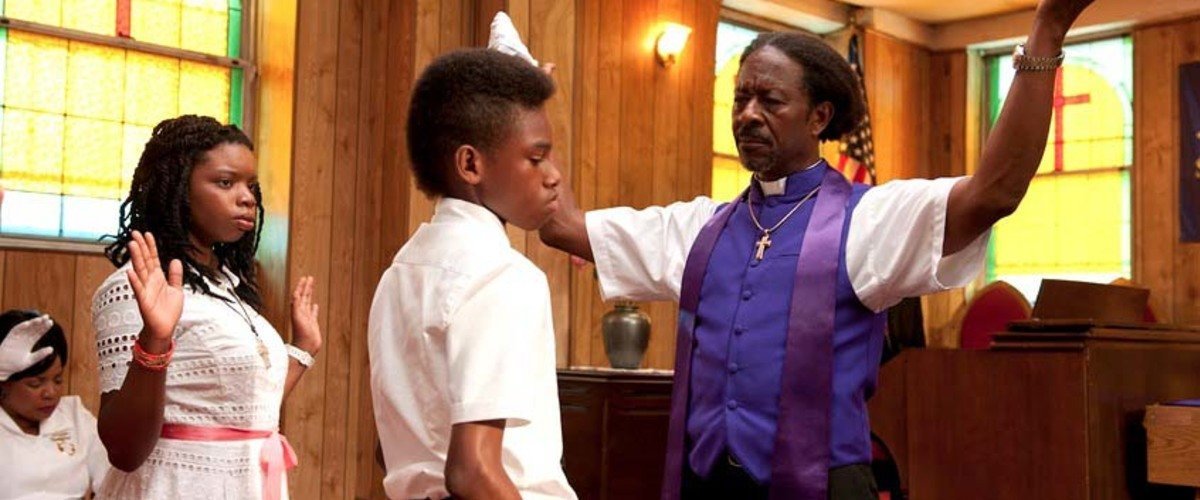
Silas (Brown), aka Flik, has lived all of his very young life in Atlanta with his mom. This summer he's going to spend his vacation from school with his grandfather Bishop Enoch (Peters), whom he's never met before. To say the two are different is a massive understatement. The bishop lives in Brooklyn's Red Hook housing projects, is an intensely devout Christian, pastors Little Piece of Heaven, the neighborhood church, and is fully embedded in the community. He is also most definitely old school in his ways. All of them. Silas' house in Atlanta is in the suburbs, it seems he's never been to church, he walks around recording everything on his iPad and wants nothing more than to go back home. Nonetheless, he's stuck for a couple months. The two trying to understand each other while Silas learns the ropes of surviving in Red Hook ensues.
For director Spike Lee, it's a return to his Brooklyn roots. He even includes a brief reprisal of his role as Mookie from the classic Do the Right Thing. It's a place he knows exceedingly well and loves despite whatever blemishes it may have. This much is evident throughout the film. It is most easily identifiable during the totally unnecessary montage that closes the movie. Spike lets his cameras take longing looks at both his beloved borough and the entire city of New York. However, where Spike's movie really shines is when he's using that camera to create statements and metaphors. Simply put, there are some amazing shots in Red Hook Summer. The most poignant of these deal with the ceiling lights at Little Heaven. A section of them forms a cross and figures prominently in three very powerful shots. Between these shots is perhaps Lee's most frightening double-dolly sequence ever. If you're familiar with the director's work then you've seen the double-dolly shots, the portions of his films where the camera will be in tight enough on a character, or characters, that only the upper portion of their body is visible. He/she will be moving toward us viewers in a way that makes it seem as if they are floating. This is his signature move. Here, the movement is more subtle than usual, but grows in intensity, and has just a bit of shaky cam thrown in. It may only be ten or fifteen seconds of the movie, but it is a brutal moment.
Camera tricks are nice, but most people will be more concerned with the story and whether or not it holds their interest long enough for us to care by the time we get to the finale. The answer is yes...and no. The yes part is easy. Bishop Enoch is a rich character, full of faith, stubbornness, fear, and mystery. To many in the movie, he represents what's good about the community and he has uncompromising values. Still, he's leery of the local rif-raf even as he occasionally approaches them and tries to nudge them in the right direction. However, the most anyone knows of him before his arrival in Red Hook is that he came from "down south." Clarke Peters wraps all of this up into one dynamite package. He plays the role perfectly, both in the bishop's quieter moments and at his most boisterous, brandishing fire and brimstone.

The climax of the movie is where it will completely grab you or totally lose you. While this is true of lots of movies, the feeling is amplified here. The shot I spoke of earlier, which contains the big reveal, is the lightning rod moment. It may seem over the top and coming in from way out deep in left field. If that fits your line of thinking, you might just tune it out right then and there. If this is an "oh wow" moment for you, you'll be pulled into the fold, far more invested than you were before this instant. It turns into the sort of harsh social commentary Spike Lee is known for.
But is it too harsh? Viewed through the prism of the director's public distaste for Tyler Perry, it is hard not to see this as at least a partial backlash against the message Perry aggressively pushes throughout his body of work, a deconstruction, if you will. In that vein, it may feel heavy-handed and overly reactionary. However, I believe in judging each film on its own merit. Red Hook Summer makes no overt references to anyone else's work, so what I've written is pure speculation. Juicy, it may be, but still speculation. As a stand-alone, it ultimately succeeds by offering Bishop Enoch up for debate. Is his story one of redemption or does it end in eternal damnation? There is also the nagging question of how all of this affects Silas. While not among his best work, it is far from his worst. His return to Brooklyn seems to have re-invigorated him. RHS is intriguing, yet uneven. It is also the most passionate film he's made in years.
Sunday, October 6, 2013
Sinister

Directed by Scott Derrickson.
2012. Rated R, 110 minutes.
Cast:
Juliet Rylance
James Ransone
Michael Hall D’Addario
Clare Foley
Fred Thompson
Nick King
Ellison (Hawke) is a true crime writer looking for his next
best-seller. About a decade earlier, his magnum opus, “Kentucky Blood,” was not
only a best-seller, it captured the national spotlight, earning him fame,
wealth, and notoriety. He likes to work close to the scene of the crime he’s researching.
This time, unbeknownst to his family, he moves them in to the actual house
where it all went down. It being the hanging of four people out of the family
of five that lived there. The fifth, the family’s youngest daughter, is still
missing and the perpetrator has not been caught. Shortly after settling in, he
finds a box of films and a projector in the attic which actually shows the
crime, along with several other killings. Pretty soon things are going bump in
the night and Ellison is freaking out.
As per the standard in such flicks, one adult is losing his
mind, the other is mostly oblivious for much of the movie, and the kids are
affected in various ways. In this case, the oblivious adult is wife/mom Tracy (Rylance).
Son Trevor (D’Addario) experiences an increase in his “night terrors,” which
means he wakes up in odd places screaming his head off and not knowing how he
got there. The daughter eventually sees stuff. Most of our time is spent with
dad as watches the films, hears something, goes to investigate, and tries to
get help from either the local deputy (Ransone), or Professor Jonas (D’Onofrio)
from the local university. Rinse. Repeat.
Despite its repetitive nature, Sinister
manages to draw us in enough to keep us interested. Ethan Hawke’s performance
helps quite a bit. His motivations are laid bare as is his increasing
fragility. The man is clearly falling apart. However, he can’t help but dive
deeper and deeper into this case. The case also has a bit of power over us, as
well. The revelations come slow, but quick enough not to lose us. That said,
reasoning is left unexplained and even undiscovered. This might be a potential
turn-off for some, but I think it works.

The acts depicted in the films our hero watches are heinous,
presented sans the over-stylization of most horror flicks. This gives them a
real feel that holds up even though, or perhaps because, we’re visually spared
the gory details. Again, Hawke does the work for us. Last second cutaways to
his reactions work perfectly. In these moments, he is our conduit. He behaves
as one might were we viewing something so despicable happening to real people
and not actors. It’s an odd tactic for an R-rated horror movie, one that I
usually rip movies for employing. Here, it works pretty well, maintaining the
illusion that our protagonist is working on a “true” crime.
Where the movie ultimately falls short is in the most basic
goal of horror. It’s entirely too hard to gauge how much danger this family is
in. Cinematic logic dictates that they’re likely the next target of whoever the
bad guy is. However, when things start to escalate, it doesn't always seem that
way. We eventually discover why that is. Sorta. By that point, well, the movie
is just about over. Until then, we can’t quite get fully vested in the welfare
of these people.
All in all, Sinister is an interesting
watch that does some interesting things. Though it is occasionally unsettling,
it never gets all the way around to submerging deep enough in our heads to make
it remarkable. We like the tone, the films within the film, Hawke’s reaction to
them, and even the ending. However, it is also tedious and, for some, the
unanswered questions will be unsatisfactory. And yes, we’re threatened with the
possibility of a sequel. This is a decent watch, but I can live without another
one.
MY SCORE: 6/10
Subscribe to:
Posts (Atom)