Friday, March 1, 2013

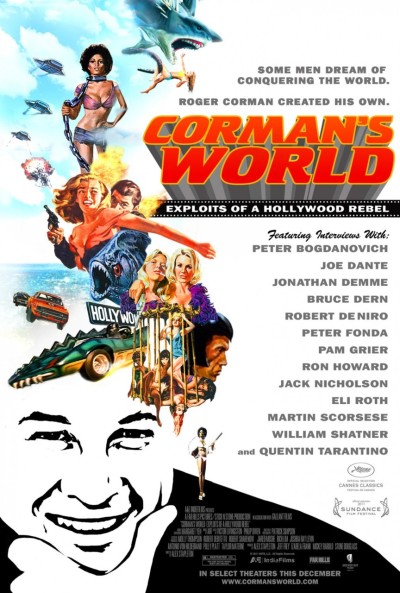
Corman's World: Exploits of a Hollywood Rebel

Directed by Alex Stapleton.
2011. Rated R, 95 minutes.
Cast:
Roger Corman
Julie Corman
Peter Bogdanovich
Jonathan Demme
Bruce Dern


With good reason, Roger Corman is known as the king of the B's, as in B movies. After all, he's had his hands on close to four hundred pictures as director and/or producer. It adds up to about fifty years of movies so bad they're awesome. Most of these were made on the cheap, filmed entirely in a handful of days or less. All but one, The Intruder turned a profit. The man knows what his audience wants and gives it to them. That's the easy assessment of Corman, the schlock-meister making money off a never ending succession of cinematic turds. However, as this documentary shows, that is an off-handed dismissal of a career that is immensely important to cinematic history.

True, Corman is a shrewd businessman who, to this day, is still churning out cheapos. Also true, his infamous guerilla-style filmmaking served as proving grounds for a number of Hollywood legends. Jack Nicholson, Martin Scorcese, Francis Ford Coppola, Jonathan Demme, James Cameron and Ron Howard all cut their teeth on his sets. Others he didn't technically "discover", but worked for him very early in their careers include Peter Fonda, Dennis Hopper, Robert De Niro. There are many others, but you get the idea. In addition, he was instrumental in bringing the work of foreign masters such as Truffaut, Kurosawa and Fellini to the United States. Thereore, his legacy is much more about perseverance and the spirit of the auteur than it is about the types of movies he made. Corman's World is about a man who has taken a most unusual path to greatness.

Wednesday, February 27, 2013

Lincoln

Directed by Steven Spielberg.
2012. Rated PG-13, 150 minutes.

Cast:
Gloria Reuben
James Spader
Bruce McGill
Lee Pace
Gulliver McGrath


Having just been re-elected as President of the United States, with the Civil War still raging on, Abraham Lincoln (Day-Lewis) focuses his efforts on getting the 13th Amendment to the Constitution passed which will abolish slavery in America. As with most laws that most presidents want passed, there is almost total support from his own party, Republican in this case, and almost none from the other. Some swaying must be done. To complicate matters, he wants it to pass in a rather short period of time since the South appears ready to negotiate an end to the war. However, he knows that any agreement they settle on would have to include the survival of slavery. Amidst pressure from everyone around him, Lincoln stays his course.

As has been said so many times already, Daniel Day-Lewis inhabits the character to such a degree he is truly lost within Abraham Lincoln. We see him as a man who, in his professional capacity, has an enormous presence. He fills the room both literally and figuratively. If not always complete confidence, he oozes authority. Leadership seems to come easy for him. We can see why people follow him. On the other hand, we can also see he's flawed. Political opponents see him as abusive of his power and/or chasing a pipe dream. Privately, his marriage is contentious and he's completely stifling his older son Robert (Gordon-Levitt) in order to protect his wife's well-being since she teeters on the verge of a complete breakdown. In the role of First Lady Mary Todd Lincoln, Sally Field is nearly her leading man's equal, coming apart at the seams one moment and the very picture of composure the next. When neither of those two are on the screen, the movie is carried by a magnificent Tommy Lee Jones who give his most inspired performance in years playing Republican Congressional Leader Thaddeus Stevens.


Carrying the weight of history, the plot unfolds in a riveting manner. This is because the supporting cast is allowed ample room to breathe. In a departure from most contemporary films, especially biopics, much happens when our hero is not on the screen. He spends large chunks of the movie off-camera while we watch the bickering going on in the House of Representatives. These spirited debates mostly take the place of action scenes. Though there are a few actual battle scenes, the high powered pontification on display is more entertaining. These guys, led by the aforementioned Jones, don't just argue. They scream, shout and string together fifty cent words all to the cheers and jeers of a crowd. Then there's the covert vote-grabbing operation going on initiated Secretary of State William H. Seward (Strathairn). There are a few times when the movie drags as the same arguments are repeated but usually something else happens that snaps us out of it.

For director Steven Spielberg, in my very humble opinion, this is his easily his finest directorial outing since Munich and quite possibly his best since Saving Private Ryan. The Adventures of Tintin, the best of his three movies since Munich is merely okay. It has it's moments. The last Indiana Jones flick left a lot to be desired. Finally, War Horse was somehow nominated for Best Picture last year but is just a dreadful, overwrought, unstoppable force of cheesiness. Lincoln also has its share of the director's trademarked sentimentality and even some corniness. The opening scene where soldiers take turns reciting the president's most famous speech to him comes to mind. Thankfully, that sort of stuff is ratcheted down a thousand notches from War Horse. We're left with a wonderful biopic and Daniel Day-Lewis' performance for the ages.

MY SCORE: 9/10

Monday, February 25, 2013

Congrats to the Winners!


Just finished watching the Oscars. Congrats to all the winners, especially Argo, taking home the honors for Best Picture. You can read my review of it here.

Movies I've reviewed that received at least one nomination this year (alphabetically):


Django Unchained
Flight
Mirror Mirror
Moonrise Kingdom
ParaNorman
Silver Linings Playbook
Snow White and the Huntsman
Ted


In the coming weeks, I should get to a bunch more nominees, particularly from the Best Picture category. Stay tuned!

Friday, February 22, 2013

Ed Wood

Directed by Tim Burton.
1994. Rated R, 127 minutes.
Cast:
Martin Landau
Sarah Jessica Parker
Jeffrey Jones
Patricia Arquette
Lisa Marie
George “The Animal” Steele
Vincent D’Onofrio
Mike Starr
Max Casella
Brent Hinkley

Ed Wood, here played by Johnny Depp, is widely considered one of, if not the worst director of all-time. This biopic follows him from the time shortly before he makes his first feature, Glen or Glenda through the completion and premier of his magnum opus of bad filmmaking, Plan 9 from Outer Space.

Let’s face it, Ed Wood was an abject failure in his chosen profession. He was also socially awkward, a fact exacerbated by the less tolerant era during which he lived. Even the end of this movie tells us Mr. Wood eventually descended into alcoholism. The template is there for a dead serious biopic. Luckily for us, our director for this feature, Tim Burton, is both skilled and quirky. The former keeps the story moving briskly and in an engaging manner. He gives us a fun film highlighting the subject’s passion for making movies. We know that he’s bad at his job, but we also know he loves what he’s doing and genuinely believes he’s making masterpieces.

Burton’s quirkiness lead him to some brilliant choices. The most easily recognizable is that we’re watching a black and white picture. It snugly fits the world these people inhabit. Ever the purveyor of palatable weirdness, Burton’s handling of this collection of misfits is also perfectly done. He makes them fun without making fun of them. To that end, he gets wonderfully odd performances from Johnny Depp, Bill Murray (Bunny Breckinridge) and Patricia Arquette (Kathy O’Hara). He also uses Sarah Jessica Parker (Dolores Fuller) as a conduit for the audience, first wide-eyed in amazement of Ed’s ambition and eventually our sober voice of reason. Her final outburst reveals a painful truth to Ed that he unsurprisingly ignores. That he is undeterred is a testament to his love for his craft and belief in himself.


The part of the movie that touches us most is the relationship between Wood and the legendary Bela Lugosi (Landau). They form a peculiar friendship. It seems to be based initially on Wood’s hero worship of the once great star then on his exploiting Lugosi and Lugosi’s willingness to be exploited. Wood is the only director who will have the rapidly declining legend. By this time, he’s more than happy to be in any production so that he can support his drug habit. By the end, we’re not sure who used who more but we realize they actually do care for one another.

When it’s all said and done Mr. Burton’s film is a tip of the cap from one filmmaker to another, a loving tribute to a man who gave everything to tell the stories he wanted to tell. Admiration permeates the movie. It’s evident that Burton understands Wood’s movies are a mess but he can’t help but respect the man’s drive. When the credits begin to roll, we’re in the same boat.


MY SCORE: 9/10

Wednesday, February 20, 2013

The Queen of Versailles

Directed by Lauren Greenfield.
2012. Rated PG, 100 minutes.

Cast:

Jacqueline Siegel
David Siegel
Richard Siegel
Virginia Nebab
Alyse Zwick


We meet 70-something year old David Siegel, his 40-something year old wife Jackie and their eight kids at their Orlando, Florida home in 2007. He is the king of an empire known as Westgate Resorts, the largest seller of time-share vacations in the world. He even claims personal responsibility for getting George W. Bush elected in 2000. It may not have been altogether legal, in his own words. As kings of empires usually are, he is also filthy stinking rich. He’s so wealthy, he is in the midst of building the largest single family private home in the United States, a 90,000 square foot behemoth he and his wife have dubbed Versailles. He estimates it will cost him about $100 million to complete. His company has also just built the biggest hotel on the famous Las Vegas strip. His eldest son Richard, (not by Jackie and appears to be about her age), runs it. Jackie is a stay-at-mansion mom who goes to expensive charity luncheons. Calling her a mom might be giving her too much credit as a team of nannies and housekeepers do most of the work. Jackie also shops. A lot. Life is good.

As you should know by now, a few short months later the bottom falls out of America’s economy. Since most of his customers begin tightening their purse strings Westgate is hit hard. To oversimplify, while what Westgate sells is physically manifested in vacations for their customers, on paper they’re sub-prime mortgages. David is hemorrhaging money and laying people off left and right (including most of his at home help) while desperately trying to save his business as a whole. In particular, he wants to save the hotel which is in serious danger of going into foreclosure. The completion of Versailles is also put on hold. Of course, all of this is a strain on the Siegel marriage as David grows ever more ornery and Jackie, not always kept in the loop, begins to feel alienated from her husband and is also stressed about the situation.


Jackie gets most of the focus, hence the movie’s title. To her credit, she maintains a healthy sense of humor about the whole thing. She slowly realizes how out of touch she and her children are. She tries to ratchet down some of her lavish habits but can’t quite keep it under control. For instance, a trip to Wal-Mart (probably a first) turns into a couple thousand dollars just in toys. With only four in-house employees, down from 19, to deal with her, David, their 8 kids, and I don’t know how many pets, things get pretty nasty around the mansion. Yet somehow, Jackie emerges as a sympathetic figure. Perhaps her husband becoming a rather grumpy old man gives us more empathy for her.

A bad break for not only the Siegels, but the entire country in the form of a recession turns out to serve this film really well. I’m guessing, they signed up to do this documentary as a way of showing off their extravagant (gaudy) lifestyle, a pat on their own backs for making it ridiculously big. If they had their way, it was going to say “Hey, look at how rich we are and watch us build our palatial estate.” Not to bash the wealthy but that would’ve been hard to twist into a narrative that was interesting to anyone. Real life intervened and gave us a plot. We get to see people go through a range of emotions, both good and bad. We see a change in the way they interact with one another. There is substance and even sadness in watching their family fortune deteriorate. Saddest of all, director Lauren Greenfield appears to have gotten it right judging by David’s reaction to the film. He and his family do not come across as well as they probably thought they would. After all, when filming started he was a billionaire with no end to his fortune in sight. At the film’s end he’s not exactly broke financially, but his spirits appear to be. He’s now suing Greenfield for $75 million for defamation of character. I’m not sure how he can win. Well, maybe he’ll win on Oscar night for Best Documentary. I don’t think he’ll enjoy that because then his loss will literally be someone else’s gain.

Monday, February 18, 2013

Thunderstruck

Directed by John Whitesell. 
2012. Rated PG, 94 minutes. 
Cast:

Kevin Durant
Taylor Gray
James Belushi
Larramie Doc Shaw
Tristin Mays
Robert Belushi
Spencer Daniels
Hana Hayes


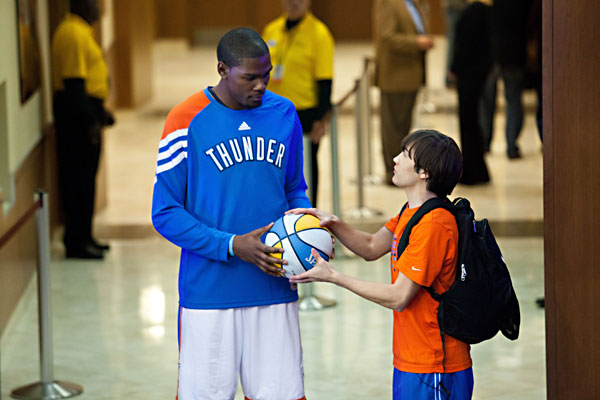
Brian (Gray) is so bad at basketball, dribbling the ball twice without breaking a bone is a major accomplishment. Making a shot, no matter how close to the basket, requires divine intervention. His sister, with an opportunistic camera, regularly posts videos on YouTube of his athletic failures. Still, he loves the sport so much he's the manager for his high school team. He also obsesses over his hometown NBA team, the Oklahoma City Thunder, and their star player, Kevin Durant who plays himself. During halftime of a Thunder game, Brian once again publicly humiliates himself when he's selected to take a half-court shot for a prize, but he gets to meet his idol, Durant. They share a brief moment which includes Brian wishing he had Durant's talent and Durant, being polite, wishing he could give it to the kid. Wouldn't ya know it, the star's talent actually does transfer to Brian through the ball they're simultaneously holding, though this is unbeknownst to either. The next day, Brian is suddenly a basketball prodigy while Durant shoots like he's trying to throw a BB through a keyhole from thirty paces away. More predictably bland cheese ensues.

As expected, Brian makes his way onto his school basketball team and quickly becomes the best high school player in the state of Oklahoma. With his new found skill comes the pretty girl, arrogance, etc. Meanwhile, Kevin Durant's agent frantically tries to figure out what's going on. Eventually, he makes the incredible leap in logic needed to put two and two together and get five which is, of course, the correct answer in this case. The agent is played by Brandon T. Jackson who, as usual, seems to be doing a Chris Tucker impersonation. That said, he's pretty much the only one in the cast with any charisma whatsoever. While Jackson is doing Tucker, Gray as Brian is giving us his best Shia LaBeouf. Our leading lady Tristin Mays is very vanilla as Isabel, AKA the pretty girl. The most notable part of her performance is that she resembles a very young Jessica Alba. The rest of the kids play stock characters and have quite literally fallen off the Disney Channel and Nickelodeon assembly lines judging by my daughters who, after recognizing a number of faces, both exclaimed "Everybody's in this movie!"


Finally, among the actors, there's Kevin Durant. True, he's currently one of the best players in the NBA. However, as an actor, he's no Ray Allen. Many moons ago, Allen gave a performance in Spike Lee's He Got Game that, while not great, improved as the movie went on. KD is stuck in neutral. Based on everything I've heard or read about him, he's a genuinely nice guy. It seems no one has a bad word to say about him. His game has made him a superstar, able to sell shoes and a number of other things. He's just not yet a particularly compelling personality. His presence is entirely summed up in his height. He simply towers over everything else in the movie. However, other than that, there is no reason to actually pay attention to him.

Since Thunderstruck is a basketball movie involving magical powers it draws easy comparisons to Like Mike. Truth told, it's more like the love-child of Freaky Friday and Teen Wolf. It borrows heavily from both. I think you already get the Freaky Friday part of the equation. As far as Teen Wolf is concerned, you might've picked up on the arrogance thing. We also get a best friend who actively promotes him, a world weary coach (Belushi) and our hero has a major decision to make about how he will play the big game. What happens next is about as close as this movie could come to Teen Wolf. Thunderstruck even has similarly awful basketball choreography.

All in all, it's a harmless flick that takes no risks and, as a result, reaps very few rewards. It would be right at home on one of those kiddie stations I mentioned, or on ABC Family. That said, if you have children you have a dilemma. There is enough charm and fun for the kids to enjoy. It plucks along to its inevitable conclusion while you seriously contemplate maiming yourself. And no, I don't remember hearing the AC DC song of the same name.

MY SCORE: 3.5/10

Sunday, February 17, 2013

Something From Nothing: The Art of Rap

Directed by Ice-T.
2012. Rated R, 112 minutes.
Cast:
Ice-T
Grandmaster Caz
Ice Cube
Q-Tip
Dr. Dre
Snoop Dogg
Nas
Rakim
Xzibit
KRS-One
Mos Def
Redman
MC Lyte
Treach

Right away Ice-T, our host and the director, tells us that the one thing he knows for sure is that rapping takes skill. To demonstrate this, he then interviews numerous emcees whose collective careers span the entire chronology of hip hop. This makes Something From Nothing: The Art of Rap part history lesson. Calling it a nostalgic trip down memory lane is more accurate as Ice often seems to be visiting old friends. Inevitably, SFN is also part diatribe against the current state of the genre as a number of old schoolers lament the lack of craft in most of today’s popular rap music. Finally, it couldn’t be a hip hop documentary without lots of rapping. Most of the emcees interviewed give us an impromptu, though not necessarily freestyle, rhyme.

Ice-T makes for an amiable host. He’s genuinely having a good time talking shop with his buddies. He’s even fun when admonishing regular folk on the street for getting in his shot. His love and enthusiasm for hip hop shines through. There’s never a moment when he seems to be just going through the motions. He’s completely invested in his topic and has much admiration for the people he’s speaking with. If he’s faking it then this is, by far, the best acting job he’s ever done.

It shows they feel the same about him, also. Quite a few rappers mention how much Ice-T meant to the game. Invariably, these same rappers would burst into their own rendition of his classic “Six in the Morning” while he beams proudly and helps out.


For any rap fan, hearing these guys break into their own verse is a highlight. As expected, their lyrics run the gamut from political to gangsta, spiritual to braggadocious, profound to profane and whatever else you can think of. We even get to watch hip hop legend Grandmaster Caz compose a verse on the spot with pen and paper, then recite. It’s not the greatest rhyme ever but fun to see.

The absolute pinnacle of all this lyricism is wisely positioned at the very center of the movie. Current star Joe Budden recites a rhyme that’s as harrowing a tale as you’ll ever hear, ripe with all sorts of insight and reasoning. It resonates because the person depicted is not some sort of super-thug, but a real person whose daily choices significantly impact his life. During most of the time Joe is rapping, a montage of shots from around New York City plays out in a non-sensational manner. This not only demonstrates the depths which rap is capable of but it is two minutes or so of brilliant filmmaking. Fittingly, it’s the last thing we experience in New York (though not of New Yorkers) where the entire first half of the movie takes place.

While Ice is a fun-loving host, his questions don’t probe enough. A huge part of his stated purpose for making this film is getting inside the craft of rap. For those he engages on the topic (which isn’t everyone), he asks what they consider ideal writing conditions. This is a fine starting point but he leaves it at that. At best, it’s only a glimpse at the very beginning of the creative process, not the whole thing as his lack of a follow-up question suggest. Consequently, we’re left with a boat load of shallow answers. We only get more interesting, possibly useful information, if the person asked freely volunteers it. This only happens a few times, but you can see the eyes of the speaker light up, alerting the viewer we’re about to dive a bit deeper. Even these guys aren’t always allowed time enough to truly get into it unless they manage to dominate the conversation which Ice doesn’t always allow. Part of this is his fault for just plain stepping on the toes of his subjects, interrupting them when it feels like they’re about to get on a roll. Sometimes, it’s Ice genuinely helping out as a few of the artists are simply not articulate enough to explain themselves in a concise manner.


Another ingredient that seems to hamper Ice’s interviewing abilities is the movie’s apparent preference for quantity over quality. Instead of really getting into the nuts and bolts of with one artist or another, we rush off to the next emcee. Too often, a rapper will give a quick answer to one question and either be shown dropping a rhyme or is never heard from again. Cramming in as many people as possible leads to two things. First, scenes where it’s clear there was more entertaining and relevant discussion feel cut short. Second, it feels like hip hop role call where fans will likely find themselves thinking about who is missing from the roster. Clearly, a less is more approach would’ve worked wonders.

While rappers are obviously missing from either the New York or Los Angeles portions of the movie, both cities and their surrounding regions are well represented. Other than a stop in Detroit to interview both Eminem and Royce da 5’9”, the rest of the country is ignored. Most egregiously, the south is almost wholly absent. Thankfully, rapper Bun B is included, even if it is only briefly. He also happens to give us one of the more poignant moments of the movie. “The Dirty South” has never been thought of as a hotbed for talented lyricists, but there definitely are a number of them who live below New Jersey and east of California. At the very least, could Ice-T not find Scarface? OutKast? Ludacris? I can’t believe what I’m about to say given that I’m hardly the biggest proponent of southern rap. If you’re going to make a big deal about how rap grows region-by-region you should pay more attention to the one that’s been the most prevalent in our collective conscience for the better part of the last decade and a half.

In at least one regard, despite who may or may not be missing, hurrying along from subject to subject works. It keeps things light and moving at a brisk pace. If you’re at all a fan, the nearly two hours flies by as a new perspective or another rhyme is never too far away. Not a ton of it sticks to the ribs but it is fun to sit through. Those interviewees that do manage to go beyond the others include the aforementioned Caz, Bun B, Rakim and Xzibit along with Treach, Ras Kass and KRS-One. KRS and Kanye West both speaking of their first battles is also fun. If these names mean nothing to you this is probably not the movie for you. If they do, this is an enjoyable but only occasionally meaty documentary featuring more rappers than you can shake a mic at.

MY SCORE: 7.5/10